

Following the surprisingly strong U.S. August employment data, gold suffered heavy selling pressure early Friday but reclaimed key support levels ahead of the North American close. The U.S. Labor Department reported 162,000 new jobs in August, far above economists’ prior estimate of roughly 55,000. Right after the robust release, gold tumbled more than $100 within the initial 30‑minute window.
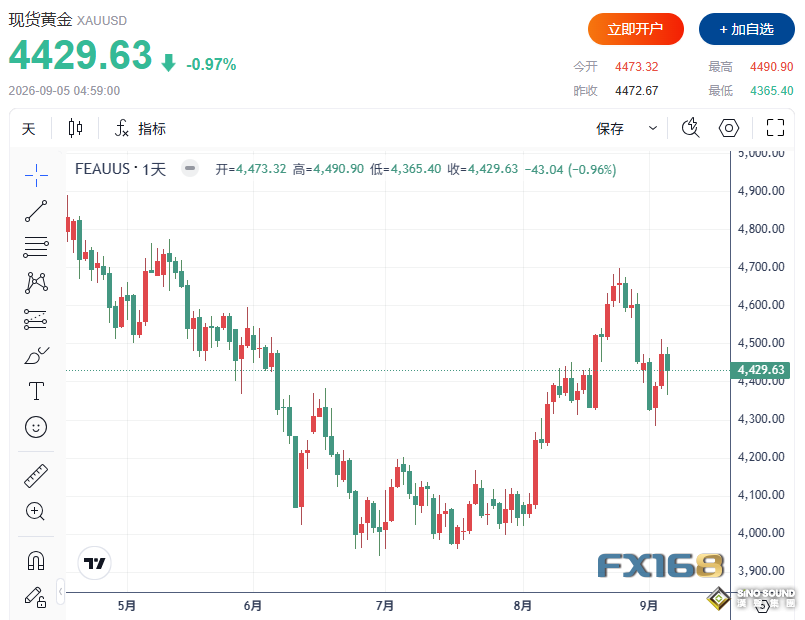
Ahead of the North American close and the U.S. Labor Day long weekend, spot gold settled at $4429.63 per ounce, down 0.96% on the daily chart and 0.56% for the week. Analysts noted this sharp pull‑back was not unexpected: a relatively healthy labour market gives the Fed greater room to prioritize price stability and keep inflationary pressures in check.
(Source: FX168)
Inflation Data Takes Center Stage Next Week
Multiple analysts believe next‑week U.S. inflation prints will serve as critical reference for Fed decisions and may deliver important directional momentum for gold. Adam Schickling, Senior U.S. Economist at Vanguard, stated the labour market retains cyclical resilience in the short term while long‑run structural concerns peRSIst. In his view, a solid labour backdrop allows markets to stay focused on inflation, and inflation trends may carry greater policy weight than a single month’s jobs report.

Fed Governor Christopher Waller also set the tone for next week’s Consumer Price Index (CPI). In a Thursday interview with Reuters, he said he would favour keeping rates unchanged if inflation shows mild readings, yet would consider a rate hike should inflation run hot. He remarked he is ready to back holding policy rates at current levels if inflation keeps advancing toward the 2% target; a rebound in inflation would prompt him to consider raising rates.
Rate‑Hike Expectations Are Not Set in Stone
Charlie Ripley, Senior Investment Strategist at Allianz Investment Management, pointed out that although jobs data has sharply lifted September rate‑hike bets, the final outcome remains uncertain. If subsequent figures further confirm inflation has peaked, it will become harder for the Fed to deliver a hike at its September meeting.
From a technical standpoint, Lukman Otunuga, Senior Analyst at FXTM, noted downside momentum prevails for gold in the near term yet key support has been defended. A weekly close below $4400 could open the path toward the 100‑day moving average at $4350, followed by $4300 and the 50‑day moving average at $4240. Should prices stabilize above $4400 again, bulls may aim for the psychological barrier of $4500.
Otunuga added that as fundamental conditions gradually tilt bearish, markets will turn toward next week’s U.S. inflation reports. Thursday’s Producer Price Index (PPI) and Friday’s CPI represent the last major data releases ahead of the Fed decision. Higher‑than‑expected prints could reinforce arguments for the Fed’s first rate hike in years and place renewed pressure on gold.
Technical Headwinds Coexist With Long‑Term Supports
David Morrison, Senior Market Analyst at Trade Nation, said Friday’s sell‑off has inflicted some damage to gold’s technical picture and momentum indicators point lower, though meaningful long‑term supportive factors cannot be ignored. Charts suggest gold could still gear up for new record highs after repricing. Daily MACD shows weak momentum, so retests toward $4200 or even $4000 cannot be ruled out; $4000 acted as strong support between late June and late July.
Morrison also stressed buying gold on dips still makes sense over longer cycles. He recalled gold struggled to break $3500 one year ago, while $2000 was once viewed as an unreachable milestone. For long‑term allocation, buying dips remains reasonable given that governments across major advanced economies are not prepared to resolve long‑run deficits or national debt via tax increases or spending cuts.
Waleed Said, Technical Analyst at GivTrade, views gold’s pull‑back as a buying opportunity but urges investors to stay patient. If the Fed does raise rates, gold could fall below $4000 per ounce; nevertheless, short‑term volatility is overshadowed by the unsustainable scale of U.S. government debt and its impact on the long end of the yield curve.
He noted that when bond issuers are forced to prop up the long end of their own yield curve, it signals limited policy room. The Fed can lift the federal funds rate yet cannot control movements in 30‑year Treasury yields. While current price levels look appealing, caution is warranted: risk‑free long‑term Treasury yields at 5.25% create stiff competition for non‑yield‑bearing assets. Real yields will weigh on gold if markets price in higher rates. His key monitoring levels are $4330, $4000 and $3800 respectively.
Debt and EASIng Expectations Underpin Gold
In an earlier‑week interview with Kitco News, Eric Strand, Founder of AuAg Funds, said he treats gold’s pull‑back as a buying opportunity despite potential rate‑hike risks. With U.S. sovereign debt exceeding $40 trillion, the government cannot afford materially higher interest rates; one or two rate increases will not contain inflation. He even described the Fed as “all talk and no action”.
Strand argued markets require lower long‑term interest rates. In his view, the Fed may ultimately have to implement quantitative eASIng (QE) or deploy comparable tools under alternative names. Investors only need to wait for prices to rebound eventually.
While Friday’s CPI represents next week’s top focus, some analysts warn that PPI also deserves attention. Since producers pass higher input costs to customers, PPI is widely regarded as a leading inflation gauge. PeRSIstently strong PPI figures may advance market expectations for hotter CPI readings.
Ahead of the Fed’s September 16 rate decision, the European Central Bank will hold its monetary‑policy meeting on Thursday. Markets are pricing in a modest ECB rate hike as rising energy costs keep pushing euro‑zone consumer prices higher.
Key economic data to watch next week: U.S. and Canadian markets closed Monday for Labor Day; Thursday brings ECB monetary‑policy decision, U.S. PPI and U.S. existing‑home sales; Friday features U.S. CPI and preliminary UniveRSIty of Michigan Consumer Sentiment Index.