

The international gold market edged higher during ASIan trading hours on Friday. Spot gold (XAU/USD) traded near $4170 per ounce, attempting to break away from the two-month low hit previously. Gold prices have remained under pressure recently, mainly due to a more hawkish outlook for the Federal Reserve’s monetary policy and rising market fears of further rate hikes. At the same time, shifts in the Middle East situation and energy price trends continue to shape investors’ judgments on inflation, interest rates and safe-haven assets, placing multiple constraints on gold’s rebound.
US President Donald Trump stated that the United States would not launch an attack on Iran before the midterm elections and said the US and Iran were holding “productive discussions” without disclosing specific details. The White House had previously considered military action against Iran before the November midterm elections. The latest remarks have temporarily eased market worries of an immediate conflict escalation and may weaken some short-term safe-haven buying. Nevertheless, diplomatic talks do not mean risks are fully eliminated. Gold may still attract fresh safe-haven demand if subsequent negotiations yield no substantial progress or energy shipping is disrupted again.
Compared with the support brought by geopolitical developments, Fed policy expectations exert a more direct impact on gold. The newly released Fed meeting minutes showed policymakers unanimously backed the September rate hike, and most officials believed another increase in the federal funds rate target range within the year would likely be appropriate. This means even as the market debates whether to pause rate hikes at future meetings, policymakers have not signaled a clear shift toward an accommodative stance.
Fed Governor Christopher Waller said on Thursday that further rate hikes may still be necessary, yet the pace of tightening is flexible and a pause in rate hikes in October remains on the table. His remarks delivered signals on two levels: on one hand, the Fed remains concerned about peRSIstent inflation, and policy rates may need to stay high or even rise further; on the other hand, future policy moves will not necessarily follow consecutive hikes at every meeting, and policymakers will adjust the pace based on economic and inflation data.

The CME FedWatch Tool shows the market is pricing in around a 17.7% probability of a rate hike in October and roughly an 81.3% chance for December. These figures represent market pricing rather than finalized Fed policy decisions. High expectations for a year-end rate hike mean gold will struggle to shake off pressure from interest rates in the short run. If inflation data continues to come in strong, the market may further raise expectations for the terminal rate, pushing the US Dollar and Treasury yields higher and lifting the opportunity cost of holding non-interest-bearing gold. Conversely, if economic activity cools markedly and inflationary pressures ease, expectations for further tightening may recede, creating room for gold price recovery.
Shifts in the energy market complicate this policy tug-of-war. Rising crude oil prices may lift transportation, production and energy consumption costs, making the inflation decline more tortuous. If the energy shock peRSIsts, the Fed may need to maintain a hawkish stance for longer, leaving gold under rate-side pressure. However, if higher oil prices further hurt economic growth and shift market focus toward downside growth risks, safe-haven demand may support gold. Therefore, energy prices are not purely bearish for gold; the key lies in whether inflation effects or growth effects dominate.
In terms of performance across precious metals, gold has recently underperformed some metals such as copper. Scotiabank analysis notes copper prices are consolidating near historic highs, while gold has looked vulnerable after breaking below $4100 per ounce on Wednesday, falling back to levels seen in early August. This divergence indicates gold’s current pressure does not stem entirely from the broader metals sector; it is closely tied to real rate expectations, US Dollar performance and investors’ reassessment of monetary policy. Copper’s consolidation at high levels mostly reflects industrial demand, supply-demand balance and market views on economic activity, and the two cannot simply be viewed under the same trading logic.
In addition, public speeches by Fed officials continue to draw market attention to tightening policy. Metrics tracking related speeches show Waller’s remarks carried a hawkish score of 8, above his historical average of 7.2; the Fed Sentiment Index rose 0.42 points to 138.34, well above the neutral benchmark of 100. Such metrics are quantitative results under a specific analytical framework and do not directly determine interest rate or US Dollar trends, but they reflect that recent policy communications remain generally hawkish. Against this backdrop, even if gold receives temporary buying interest from geopolitical risks, it will face peRSIstent resistance from potential US Dollar strength and rising yields.
The most critical points to watch now are whether Fed rate hike expectations strengthen further, whether US Treasury yields keep rising, and whether gold can build solid support near recent lows. If inflation and employment data continue to show economic resilience, gold’s rebound may be capped. If policy expectations cool or geopolitical risks flare up again, gold may gain fresh upward momentum. The short-term market remains in a phase where policy pressure and safe-haven demand counterbalance each other, and a single day’s rebound is not enough to confirm a trend reversal.
Fundamentally, gold is still suppressed by the Fed’s hawkish stance and year-end rate hike expectations, while eASIng US-Iran tensions have weakened safe-haven demand to some extent. Going forward, if US inflation data remains strong and the US Dollar plus Treasury yields keep climbing, gold may retest recent lows. If rate hike expectations cool or geopolitical risks re-escalate, a stronger technical rebound cannot be ruled out.
On the daily timeframe, spot gold is still trading below the middle band of the BOLLinger Bands and the 100-period simple moving average, with a generally weak trend. The Relative Strength Index (RSI) stands at roughly 39.99, below the neutral level of 50, showing sellers still hold some advantage, though the market has not entered a typical extreme oversold zone. Initial support lies near $4060, corresponding to the lower BOLLinger Band. If gold breaks this level decisively alongside stronger US Dollar and Treasury yields, further downside targets may be triggered. Initial resistance sits around $4240, matching the middle BOLLinger Band, followed by the 100-day moving average near $4265. Only if gold reclaims these two zones can the short-term rebound extend further. The stronger resistance higher up is near $4420 at the upper BOLLinger Band. Overall, the daily rebound should be viewed cautiously until gold recaptures the middle band and the 100-day SMA.
On the 4-hour timeframe, gold has rebounded from the two-month low to the $4170 area, showing some buying interest at lows, yet there is insufficient evidence to confirm a short-term trend reversal. If prices hold steady above $4100 and gradually break local highs formed during the recent rebound, the short-term corrective rally may continue. If the rebound keeps hitting overhead resistance and gold falls back below $4100, traders should watch for a retest of support near $4060. Without complete real-time data for the 4-hour moving averages, RSI and MACD, it cannot be confirmed whether momentum has turned bullish.
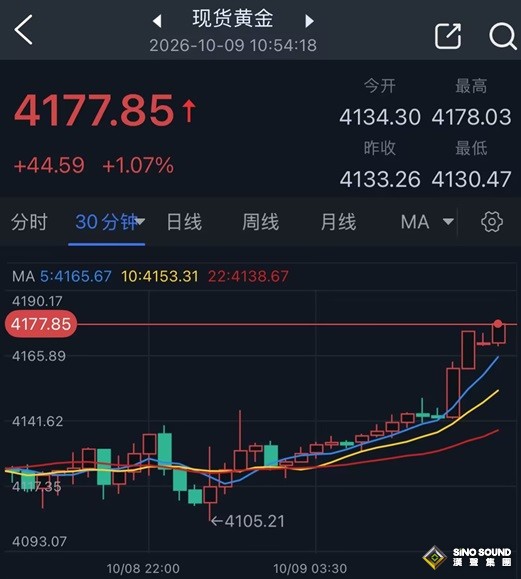
Spot gold is currently in a phase of counterbalance between monetary policy pressure and safe-haven demand. The Fed meeting minutes and Waller’s hawkish remarks have reinforced expectations for further rate hikes within the year, raising the holding cost of gold. EASIng signals from US-Iran talks have temporarily limited safe-haven buying driven by geopolitical risks. The combined effect of these two forces means gold still faces strong overhead pressure even when rebounding.
Fed policy expectations, US Dollar movements, US Treasury yields and energy price shifts will continue to dictate gold’s direction. If inflationary pressures peRSIst and rate hike expectations heat up further, gold may retest support near $4060 or even extend its correction. If US economic data weakens, yields fall, or geopolitical risks flare up again, gold may stage a more noticeable recovery. The rebound near $4170 at present is not enough to confirm a trend reversal. Traders should focus on breaks of the $4060 support and the $4240–$4265 resistance zone, and stay alert to sharp price volatility triggered by macro data and breaking news.