

International gold edged slightly lower during Monday’s ASIan morning session, with spot gold trading near $4400 per ounce and extending its recent corrective move. The direct trigger for this gold decline came from the latest U.S. employment data. Figures released by the U.S. Bureau of Labor Statistics showed that August non‑farm payrolls rose by 162,000, well above the market consensus of 56,000 and markedly higher than July’s increase of roughly 21,000. Strong employment readings reshaped market expectations for the Fed’s near‑term policy path, putting notable pressure on gold.
For gold, U.S. interest‑rate expectations represent one of the most important pricing factors at present. Gold generates no interest income. When markets expect U.S. rates to stay high or rise further, the opportunity cost of holding gold versus dollar‑denominated assets increases accordingly. Consequently, investors quickly raised bets for Fed policy tightening in September following the payrolls release, triggering profit‑taking and capital outflows in gold on the short‑term horizon.
The probability of a 25‑bASIs‑point Fed rate hike at the September meeting has climbed to around 58.3%, up from approximately 50.2% before the data print. Shifting market expectations are directly reflected in precious‑metal prices. Independent analyst Ty Wang commented that the robust jobs report has substantially lifted the odds of a September hike. Gold may remain under near‑term pressure unless the upcoming U.S. Consumer Price Index comes in weak.

Nevertheless, a single jobs report cannot fully determine the Fed’s future policy path. U.S. PPI and CPI releases this week will act as new critical variables. If gains in producer and consumer prices accelerate again, markets may further price in sustained or even more aggressive Fed tightening. The U.S. dollar and Treasury yields could keep drawing support, while gold may undergo additional adjustments.
Conversely, should U.S. inflation figures miss forecasts, especially with core inflation continuing to cool, rate‑hike expectations fuelled by employment data could reverse. Markets will then reassess whether truly aggressive Fed action in September is necessary. Therefore, the drop toward $4395 represents more of a short‑term correction after interest‑rate repricing rather than a complete breakdown of gold’s long‑term bullish narrative.
Meanwhile, mounting energy‑shipping risks in the Middle East add complexity to gold’s trajectory. Tensions across the region have intensified, with commercial shipping through the Strait of Hormuz drawing heavy market attention. PeRSIstent disruptions to energy transportation could keep global oil prices elevated and transmit cost pressures into worldwide inflation. Normally, escalating geopolitical risks support gold via safe‑haven demand. Yet a special dynamic applies now: a sharp sustained oil‑price rally that rekindles U.S. inflation fears may delay the Fed’s shift toward looser policy. Some safe‑haven tailwinds for gold could then be offset by the bearish chain: higher oil prices → rising inflation expectations → peRSIstently high interest rates.
This largely explains why recent gold performance diverges from classic safe‑haven behaviour. Investors focus less on military risks themselves and more on whether such risks disrupt energy supplies, inflation and major central‑bank policy trajectories. If oil climbs while U.S. inflation softens, gold may receive dual support from safe‑haven flows and eASIng expectations. If oil gains push U.S. inflation higher instead, gold may stay under short‑term pressure.
From a capital‑flow perspective, gold had accumulated substantial profit‑taking potential following its strong recent rally. The better‑than‑expected non‑farm print acted as the trigger for profit realization. Until Fed policy expectations stabilize fully, gold is likely to remain highly volatile. Key levels to monitor are whether the $4395‑$4405 zone holds as effective support and whether price rebounds can retake near $4465.
Commerzbank previously noted growing market divergence behind gold’s recent bounce, with some investors questioning whether the Fed will indeed tighten further in September. Cautious policy remarks from Fed Governor Christopher Waller also prompted markets to reprice further‑hike odds. This means no one‑sided bearish narrative dominates the gold market, and future moves remain heavily dependent on U.S. inflation releases and Fed officials’ comments.
From a global asset‑allocation standpoint, gold still carries strategic merit. On one hand, geopolitical hazards and energy‑supply uncertainties peRSIst. On the other, long‑run market views on U.S. fiscal health, interest rates and the U.S. dollar remain divided. Even if strong jobs data weighs on gold in the near term, dips could attract fresh dip‑buying so long as medium‑ and long‑term capital does not exit meaningfully.
Gold’s daily chart retains resilience. Spot gold is still trading above the 100‑period simple moving average near $4350, so its medium‑term bullish structure remains intact. However, prices have broken below the 20‑day BOLLinger mid‑band around $4465, signalling a clear consolidation phase after rapid prior gains. The 14‑day RSI stands at roughly 51, having retreated from elevated territory toward neutral, unwinding overbought conditions without generating clear oversold signals. Initial resistance sits near $4465; a firm break above opens further upside toward $4675. Initial support lies within $4405‑$4395. A decisive breach would trigger a test of the 100‑day moving average at $4350, followed by the lower BOLLinger band near $4260.
On the 4‑hour timeframe, gold remains in a weak corrective setup, with $4395 acting as a key battleground between bulls and bears. If buying interest emerges near $4400 and prices break through the $4435‑$4465 zone, 4‑hour momentum may gradually repair, with rebound targets toward $4500. Conversely, sustained trading below $4465 plus a valid breakdown below $4395 would keep short‑term bears in control, putting $4350 in focus. Traders should watch for bottoming signals on short‑term momentum indicators such as MACD. Whether $4395 holds will determine if the current pull‑back is a normal retracement or the start of deeper trend deterioration.
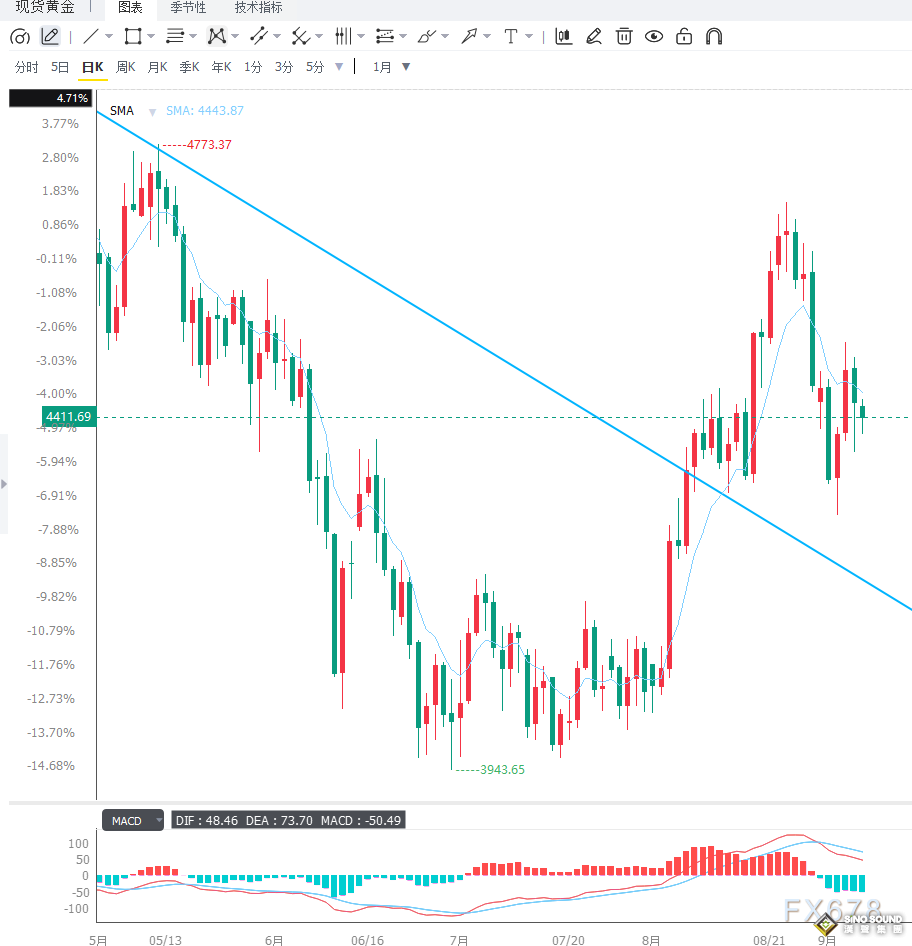
The sharp upside surprise in U.S. August non‑farm payrolls has sharply lifted expectations for a September Fed rate hike, serving as the primary driver behind gold’s latest swift correction. Near‑term, dollar and interest‑rate expectations may continue weighing on gold, while inflation risks stemming from higher energy prices add uncertainty across the precious‑metal market.
Even so, evidence is insufficient to conclude that gold’s medium‑term uptrend has ended. The $4395‑$4350 zone forms an important defensive band. As long as selling pressure is absorbed within this area, gold retains scope for renewed upward recovery. U.S. PPI and CPI prints will ultimately dictate market direction by validating or invalidating bets for additional Fed tightening.
If U.S. inflation re‑accelerates, gold may seek further support near $4350 or even $4260. Markedly cooler inflation paired with dovish Fed rhetoric on further hikes could enable gold to retest $4465 and advance toward $4675. Gold’s core market conflict has shifted away from pure safe‑haven demand toward a rebalancing between geopolitical tailwinds and headwinds from high interest rates plus a strong U.S. dollar. Short‑term volatility may amplify further, while medium‑ and long‑term focus should remain on real yields, dollar trends, central‑bank gold purchases and shifts in global risk‑asset allocation.