

The US Treasury Department announced on Wednesday that it would "at least double" the size of liquidity-support buybacks for 10- to 30-year bonds, a move interpreted by the market as an attempt to push down long-term borrowing costs. Following the announcement, the yield on the 30-year US Treasury note fell 10 bASIs points to 5.18%, the 10-year yield dropped 6 bASIs points to 4.65%, while short-end yields moved higher in the opposite direction, distorting the yield curve.
Against the backdrop of falling long-bond yields and the dollar hitting a three-month low, precious metals strengthened across the board.
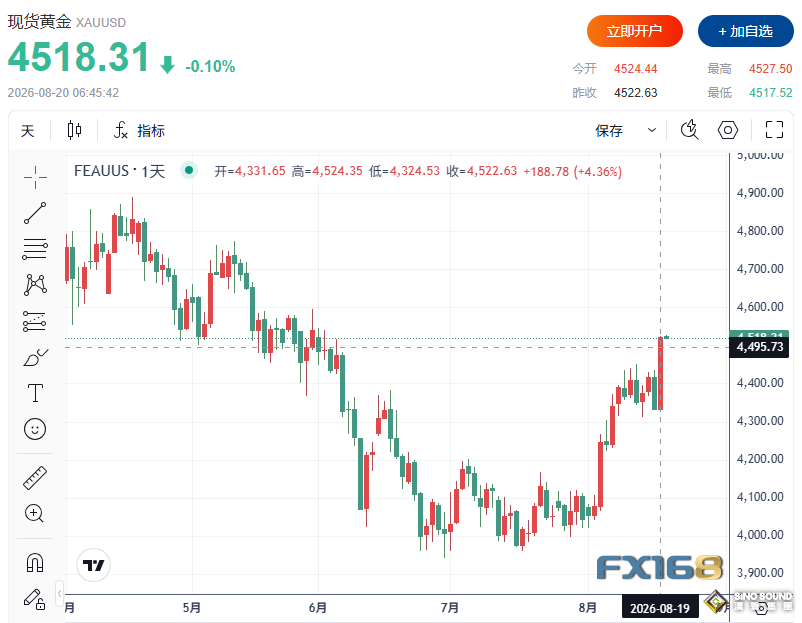
At the close, spot gold settled at $4,522.68 per ounce, rising $188.78 on the day, or 4.36%.
(Source: FX168)
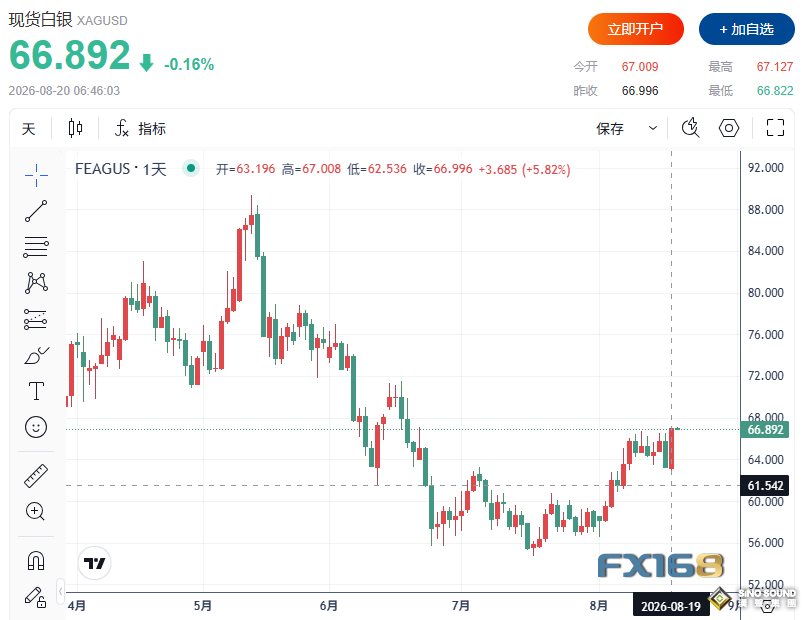
Spot silver closed at $66.996 per ounce, up 5.82%.
(Source: FX168)
Spot palladium rose 3.74% to settle at $1,337.15 per ounce; spot platinum was the strongest performer, surging 6.07% to $1,817.45 per ounce, with an intraday high of $1,820.50 per ounce.
Treasury Buybacks Viewed as an "Intervention"
The US Treasury stated that the expansion of buyback size aims to "provide greater liquidity support in the longer-dated nominal bond segment where market participants continue to express strong demand", adding that the adjustment reflects the Treasury’s need to maintain market functioning. The Treasury did not specify how the buybacks would be funded; typically, such volatile funding needs are covered by issuing short-term T-bills.
Nonetheless, the bond market regards the move as direct intervention in long-end interest rates. By repurchASIng long-dated debt and replacing it with short-term debt, the Treasury is effectively seeking to lower long-end yields, a mechanism similar to the "Operation Twist" implemented by the Federal Reserve in the 1960s and after the financial crisis — except this time the actor is the Treasury rather than the Fed.
In terms of scale, the operation remains modest for now. The Treasury’s published schedule shows larger operations will not begin until September 9. Existing arrangements through November 4 allow buybacks of up to $14 billion across the 10- to 30-year segment; doubling this would roughly add the same amount again. Still, against a bond market with hundreds of billions of dollars in daily turnover, it functions more as a signal than a tidal wave.
Fed Minutes vs. Treasury Actions: Competing Signals
On the same day the Treasury announced expanded buybacks, the Federal Reserve released the minutes of its July policy meeting. The minutes showed several officials had advocated for rate hikes, and many believed further policy tightening might be necessary if inflation failed to cool. In other words, the market received two opposing signals at once: on one hand, central bank records showing policymakers leaning toward higher rates; on the other, the Treasury attempting to push long-end rates lower.
Traders ultimately leaned toward the Treasury’s signal. CME FedWatch data showed that as of early Wednesday, federal funds futures priced a roughly 36% chance of a September rate hike, down from more than 70% at the end of July. The market’s repricing of the policy path has also formed an important backdrop for the rally in non-interest-bearing assets such as gold.
Gold Eyes Three Key Levels
James Dima of StoneX told Kitco News that gold futures are currently testing two key technical levels. The first is the 50-week moving average at $4,540 for December gold futures, a level broken to the downside back in May. He noted that only a Friday close back above this level could reignite buying interest. The second is the 200-day moving average at $4,625; a close above that could also attract new follow-on buying.
Dima stressed that December gold futures briefly broke above $4,540 intraday on Wednesday, but the real validation lies in the Friday settlement price, not the intraday peak. Ole Hansen of Saxo Bank flagged $4,500 as another key threshold earlier this week, when gold was still hovering near $4,390. He argued that if gold holds firmly above $4,500, with the Iran conflict de-escalating and inflation cooling, there is scope to retest $5,000 before year-end. On the downside, he hopes $4,200 will hold. With gold breaking above $4,500 on Wednesday, one of the three key levels has been conquered.
Industrial Metals Under Pressure; Aluminium Hurt by Tariff News
In stark contrast to the strength in precious metals, base metals mostly retreated on Wednesday. Copper fell 0.85%, nickel dropped 1.62%, zinc lost 0.80%, and aluminium declined 0.66%. This indicates buying was concentrated in "store-of-value" metals rather than industrially used metals that day.
The fall in aluminium was also tied to tariff news. US President Trump told reporters on Wednesday he is considering cutting tariffs on Canadian metals, currently set at 50%. He stated: "We may bring the tariffs down to match other countries, because Canada is paying higher tariffs." Bloomberg, citing people familiar with the matter, reported that a preliminary deal could lower duties on some Canadian steel and aluminium exports to 25%, though terms are not finalised and are not expected to apply broadly. The relevant deadline falls on Friday.
Canada is the largest single source of US aluminium imports, supplying roughly half of US consumption. A tariff reduction would mean more cheaper Canadian aluminium could flow into the US market, where domestic production cannot fully meet demand. The market moved ahead of an official announcement: Algoma Steel surged as much as 24% in Toronto, while Century Aluminium fell 11% and Nucor dropped 8.9% in US trading.
Notably, London Metal Exchange (LME) aluminium inventories have just fallen to their lowest level since 1990, and nearly all remaining stock is Russian material, which US and European buyers cannot purchase. That means if cheaper Canadian aluminium enters the market, it will do so against a supply backdrop with almost no physical buffer.
For the rest of the week, markets will continue watching two developments: gold’s close on Friday and whether the tariff deadline yields an agreement. Looking further ahead, one week from now, Kevin Warsh will deliver his first speech as Federal Reserve Chair at Jackson Hole.