

US President Trump announced on Wednesday a more aggressive round of economic pressure on Iran, warning that any country or institution continuing to provide financial, trade or transport support to Iran will face severe economic consequences. This wording marks a notable escalation compared with his remarks in recent weeks, making crude oil assets directly exposed to a new round of geopolitical risks. #IranCrisisTracking#
Trump posted on Truth Social that Iran has repeatedly been given opportunities to reach an agreement but failed to seize them, so the US will launch what he described as "the harshest economic action ever taken against a country".
He also reaffirmed that the United States will not allow Iran to possess nuclear weapons.
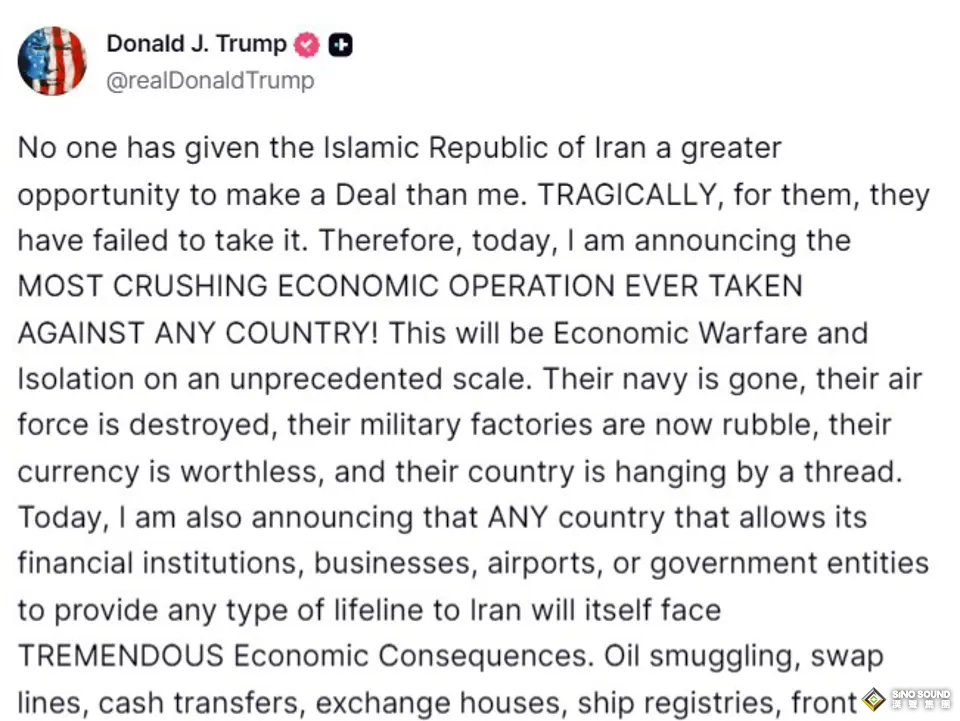
(Source: Truth Social)
Trump Extends Warning to Third-Party Countries and Institutions
The core of this statement targets not only Iran itself, but also extends pressure directly to all third parties that may support Iran's economy.

Trump stated that any country allowing its financial institutions, enterprises, airports or government entities to provide any form of "lifeline" to Iran will face severe economic consequences.
He specifically called for the immediate shutdown of multiple channels, including oil smuggling, currency swap lines, cash transfers, currency exchange agencies, ship registration and shell companies.
This means US enforcement priorities may expand further from directly sanctioning Iranian entities to intermediaries helping Iran maintain oil exports, fund settlements and cross-border trade.
Trump also called on US allies to join the operation to isolate Iran, describing the move as an "Economic D-Day".
Crude Oil Market Becomes the Most Directly Exposed Risk Asset
The market impact of Trump’s latest remarks on crude oil deserves particular attention.
The Middle East is already in a highly volatile situation, with shipping through the Strait of Hormuz and US-Iran conflict developments continuously affecting oil prices. If the US further imposes sanctions on third-party institutions assisting Iran in crude transportation, settlement or export, Iran’s actual crude supply to global markets may decline even if official shipping volumes through the Strait remain unchanged.
Notably, if new restrictions eventually cover intermediaries based in China, Russia or Gulf states handling Iranian crude transactions, market fears of "effective supply tightening" may rise sharply.
This means oil price risks no longer stem solely from strait blockades or military conflicts, but are compounded by secondary sanctions and financial isolation risks.
Oil Smuggling and "Shadow Networks" Face Greater Pressure
Trump explicitly listed oil smuggling, ship registration and shell companies among channels to be halted immediately, drawing greater market attention to the informal trade networks Iran has long relied on to sustain crude exports.
Under formal sanctions, Iranian oil exports often depend on complex intermediaries, vessel ownership arrangements, third-party registration and non-traditional settlement methods.
If the US expands enforcement to these intermediary networks in the future, Iranian crude may face higher transportation, insurance, settlement and final delivery costs even after being loaded onto tankers.
Meanwhile, banks, currency exchange firms, shipping companies and registered entities participating in relevant transactions will face elevated risks of secondary sanctions.
Geopolitical Risk Premium May Rise Further
Trump’s speech may also push up broader geopolitical risk premiums.
Crude prices have been affected for consecutive trading days by uncertainty over shipping in the Strait of Hormuz and US-Iran tensions. If Washington expands pressure from military and maritime spheres to global financial and trade networks, markets may reassess how much crude Iran can continue exporting.
In addition, tougher economic pressure increases the likelihood of retaliatory rhetoric or action from Tehran.
Therefore, over the coming trading sessions, markets will watch not only whether the US releases specific sanction lists, but also how Iran responds via the Strait of Hormuz, tanker movements or other regional actions.
Trump Says Iran’s Military and Economic Capabilities Have Been Severely Weakened
In the statement, Trump also issued a tough assessment of Iran’s current military and economic conditions.
He claimed Iran’s navy has vanished, its air force destroyed, military factories reduced to rubble and its currency rendered worthless, describing the country as highly vulnerable.
These remarks form the political backdrop for Trump’s further escalation of economic pressure.
Judging from his statements, Washington’s current strategy advances simultaneously along military pressure, maritime blockades and financial sanctions to further weaken Iran’s capacity to sustain warfare and external operations.
Next Oil Price Focus Lies in "Enforcement Strength"
For markets, Trump’s statement itself has lifted risk premiums, yet the key factor determining subsequent crude price reactions remains how the measures are implemented.
If the US only reinforces existing sanctions, market impact may largely take the form of sentiment-driven risk premiums; but if Washington begins large-scale sanctions against third-party institutions involved in Iranian crude transportation, financial settlement and vessel registration, Iran’s actual export volumes may suffer more notable declines.
Investors will therefore focus closely on whether the US announces new sanctions targeting banks, shipping firms, currency exchange agencies and third-country entities, and whether these measures will materially affect Iranian crude access to global markets.
With the situation in the Strait of Hormuz far from fully stabilised, Trump’s expansion of sanction threats to third-party nations and institutions means Middle East energy risks are extending beyond pure military conflict into financial and trade systems. For crude markets, this may become one of the most important new variables in the next phase.