

International gold price (XAU/USD) attracted some bargain-hunting buying during Wednesday's ASIan trading session, temporarily halting its previous decline from around the $4,435 level. This peak marked the highest level since June 5. Gold has now re-established a foothold above $4,400, with investors waiting for the latest US inflation data to gauge the Federal Reserve's future interest rate policy direction.
The gold market has recently been influenced by a confluence of multiple factors. On one hand, signs of a cooling US job market have boosted market expectations of potential Fed rate cuts down the line. The previously released US non-farm payrolls report showed new job additions fell short of market forecasts, indicating a slowdown in the labor market and undermining the Fed’s rationale for further monetary policy tightening.
On the other hand, rising energy prices have reignited inflation risks, keeping the market cautious about Fed policy. International crude oil prices have rallied notably recently, mainly driven by heightened supply risks in the Middle East. Investors worry that disruptions to energy shipments could push up global energy costs. Surging oil prices have become a key variable affecting gold’s performance. Sustained increases in energy costs may slow the pace of inflation cooling, prompting the Fed to keep interest rates higher for longer and lifting the opportunity cost of holding non-interest-bearing gold.
Uncertainty surrounding shipping security in the Strait of Hormuz has lifted the risk premium in the energy market. Meanwhile, elevated shipping hazards near the Red Sea and Bab el-Mandeb Strait have also lifted crude oil prices and bolstered safe-haven demand for the US dollar. A stronger dollar has exerted downward pressure on gold. Since gold is denominated in US dollars, a rising US Dollar Index erodes the purchASIng power of investors using other currencies to buy gold. In addition, the recent rebound in US Treasury yields has raised the carrying cost of gold.
<
Market data shows the yield on the 10-year US Treasury note has recently edged back toward its late-July high, as investors reprice expectations for the Fed’s policy path. The market remains divided over future rate adjustments: some investors argue labor market weakness warrants a policy pivot, while energy-driven inflation risks may force the Fed to stay hawkish. Commerzbank’s analysis pointed out that sharp volatility in energy markets is stoking pressure in the interest rate complex. Higher crude prices have pushed bond yields upward and reinforced market bets on tighter monetary policy ahead. Against this backdrop, gold needs fresh positive catalysts to break above key resistance zones.
Core factors on investors’ radar include the print of US CPI data, subsequent remarks from Fed officials, US dollar movements and swings in the energy market. A further slowdown in US inflation could ramp up market bets on policy eASIng, paving the way for gold to retest recent highs. Conversely, if inflation rebounds amid elevated oil prices, gold will likely remain pressured by a stronger dollar and higher bond yields.
On the daily chart, gold is consolidating sideways around the 100-day moving average, maintaining a moderately bullish short-term structure but facing dense overhead resistance. The price is capped by the 50% FibonaCCI retracement level of the April-June corrective pullback, coinciding with the 200-day moving average around $4,500, which acts as a critical technical barrier. A decisive breakout above the $4,400–$4,500 range would hand the upper hand back to bullish traders and open a retest of previous peaks. On the downside, the 100-day MA near $4,388 serves as primary support. A break below this level could trigger a correction toward the 38.2% FibonaCCI retracement at $4,298, with secondary support sitting around $4,161. A loss of $4,161 would expose the key structural support near $3,940. Overall, the daily timeframe leans toward a choppy uptrend, though upward momentum awaits confirmation from macroeconomic fundamentals.
On the 4-hour timeframe, gold saw a technical pullback after surging to roughly $4,435 and is now consolidating near $4,400. Short-term moving averages remain sloping upward, albeit at a slower pace, while the RSI indicator has retreated from overbought territory, signaling fading near-term buying interest. A renewed break above $4,435 would target the psychological $4,500 mark to the upside. Failure to clear this level and a drop below support around $4,388 would trigger a deeper correction with a focus on the $4,300 zone. Short-term price action hinges on whether US inflation data sparks further volatility in the US dollar and Treasury yields.
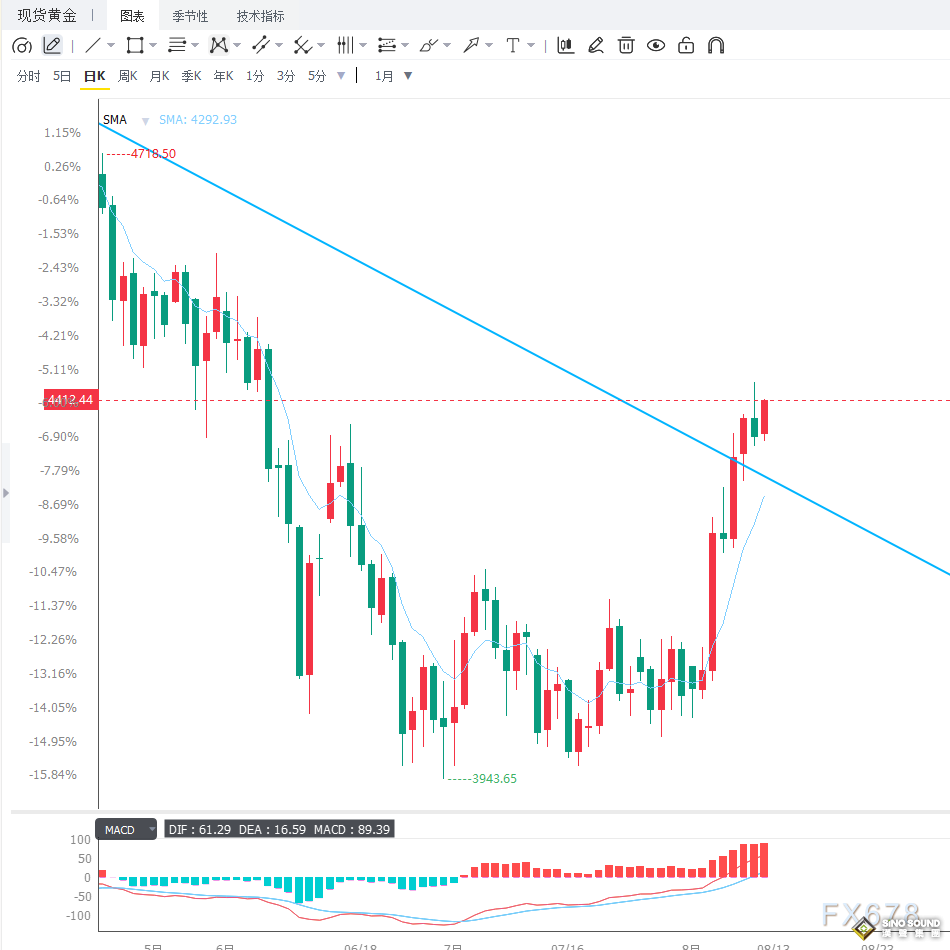
Gold is currently in a phase of rebalancing macro drivers. The metal draws support from dovish policy expectations stemming from a cooling labor market on one side, while being weighed down by climbing oil prices and renewed inflation risks on the other.
In the short run, US inflation figures will act as a pivotal catalyst for gold’s directional move. Further eASIng in inflation would reignite bullish momentum for gold and enable a test of resistance around $4,500. In contrast, an inflation rebound fueled by energy costs would tilt Fed policy expectations hawkish, with a stronger dollar and higher yields capping gold’s upside potential.
From a medium-to-long-term perspective, gold remains underpinned by safe-haven demand and uncertainty over global monetary policies. Traders should closely monitor whether the $4,400–$4,500 resistance band can be breached and the integrity of support near $4,300. Opportunities and risks coexist in the gold market amid heightened volatility.