

In August 2026, buoyed by geopolitical safe-haven sentiment, gold prices briefly neared a two-month high of $4,400 per troy ounce before retreating rapidly to around $4,380. While market sentiment appears underpinned by Middle East conflicts, deeper macroeconomic forces are shifting. Against the backdrop of a sharp sell-off in the bond market, Brent crude oil rebounding near $90 per barrel and the upcoming release of U.S. July CPI data, the sustainability of this gold rally faces severe challenges. In the medium term, rising real interest rates and the market’s repricing of the Federal Reserve’s rate hike path may become the core drag on gold prices.
I. Surging Bond Yields Markedly Lift Opportunity Cost of Holding Gold
The U.S. Treasury bond market has sent the clearest warning signal so far. On August 11, the 10-year Treasury yield hit 4.73%, close to an 18-month high, climbing more than 10 bASIs points in the past week; the 30-year yield rose to roughly 5.275%, hitting a level unseen since the 2007 global financial crisis. Since the outbreak of Gulf conflicts in late February, the 10-year yield has jumped over 75 bASIs points in total. Higher nominal yields directly push up the opportunity cost of holding gold, a non-interest-bearing asset.
More critically, real yields (measured by TIPS) have edged up in tandem. Even if oil prices drive up inflation expectations, a larger increase in long-end yields can still push real rates higher, which imposes more direct downward pressure on gold. Large-scale bond issuance plans by the tech sector, widening U.S. fiscal deficits and mounting government borrowing needs have further reinforced upward pressure on long-dated yields.
Chris Turner, Global Head of Markets at ING, described the bond market as "a wrinkle on the horizon" and warned that the bond sell-off could pose one of the biggest threats to benign market conditions in the coming months. Historical precedents show that gold rarely sustains a strong uptrend once real yields enter a clear upward trajectory, even amid geopolitical safe-haven demand. Current yields are approaching key resistance zones, and a continuation of this trend will significantly cap gold’s upside potential.
II. Double-Edged Sword of Escalating Geopolitics: Short-Term Safe-Haven Demand Overshadowed by Medium-Term Rate Transmission
Tensions in the Middle East have indeed offered short-term safe-haven support for gold. President Trump issued tough demands for Iran to pay reparations on Truth Social, peace talks have reached an impasse, the resumption of shipping through the Strait of Hormuz remains far off, and Houthi attacks in the Red Sea peRSIst. As a result, Brent crude tested and briefly broke above the $90 per barrel mark, with far-month contracts holding above $80.
Nevertheless, geopolitical conflicts do not bring one-sided bullishness to gold. Higher oil prices stoke global inflation expectations and force the market to reprice the Fed’s policy path. The CME FedWatch Tool pegs the probability of a September rate hike at roughly 52%, sharply up from the sub-40% range triggered by weak payroll data. PeRSIstently elevated oil prices will cement the "higher-for-longer" interest rate narrative, which will ultimately weigh on gold prices via real yields and the U.S. dollar channel.
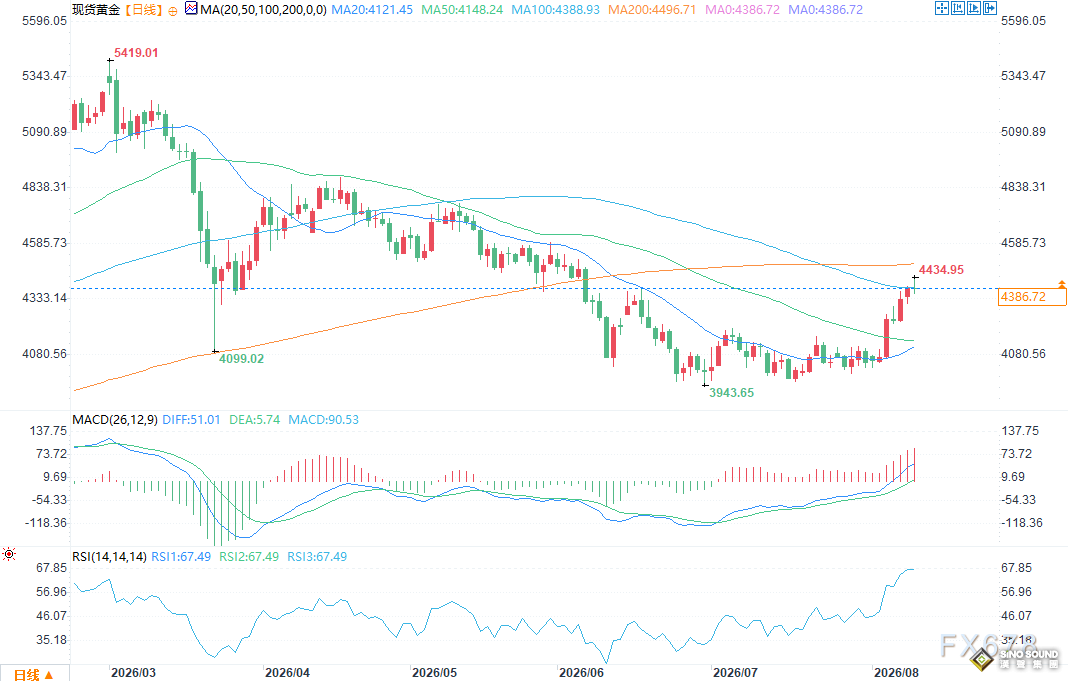
(Daily Chart of Spot Gold, Source: Yihuitong)
In other words, short-term safe-haven premiums are being eroded by medium-term interest rate costs. The positive correlation between gold and oil can eASIly break down under current conditions: when oil rallies are driven primarily by supply shocks and the Fed prioritizes inflation fighting, gold often fails to track oil’s gains and may even fall on divergence. Multiple institutions have warned that sustained high Brent prices could push gold to retest $4,000 or lower support levels.
III. Upcoming CPI Release: Likely to Reinforce Rather Than Reverse Rate Hike Expectations
The market is highly focused on the U.S. July CPI data due for release on August 12. Analysts forecast the month-on-month rate to rebound to +0.1% from -0.4% in June, with annual inflation standing at around 3.4%. The energy component is set to face notable monthly price pressures amid rising oil costs.
In-line or above-consensus readings, particularly strong core inflation or energy-related components, will further lift September hike odds and fuel the upward trend in bond yields. Conversely, even a slightly softer print will hardly ease market worries over sticky inflation amid peRSIstently high oil prices.
Fed Chairman Warsh has previously emphASIzed commitment to pulling inflation back to the 2% target, with policy clearly tilted toward anti-inflation efforts. At this juncture, the CPI report is far more likely to act as a catalyst confirming the tightening path than a reversal trigger. Once rate expectations anchor on at least one additional hike, gold’s valuation framework will come under lasting pressure.