

On Tuesday (August 11), the gold market cooled off rapidly after hitting a two-month high. Spot gold briefly climbed to $4435 per troy ounce during ASIan trading hours. However, as U.S. economic data remained resilient, sharp surges in global crude oil prices reignited inflation fears, and the market priced in higher odds of additional Federal Reserve rate hikes, gold prices subsequently gave back most of their gains.
Following the release of U.S. existing home sales data, gold dipped into negative territory for the day. Spot gold hit an intraday low of $4356.99, then rebounded modestly as oil prices retreated from their session peak, and is currently trading around $4372 per ounce.
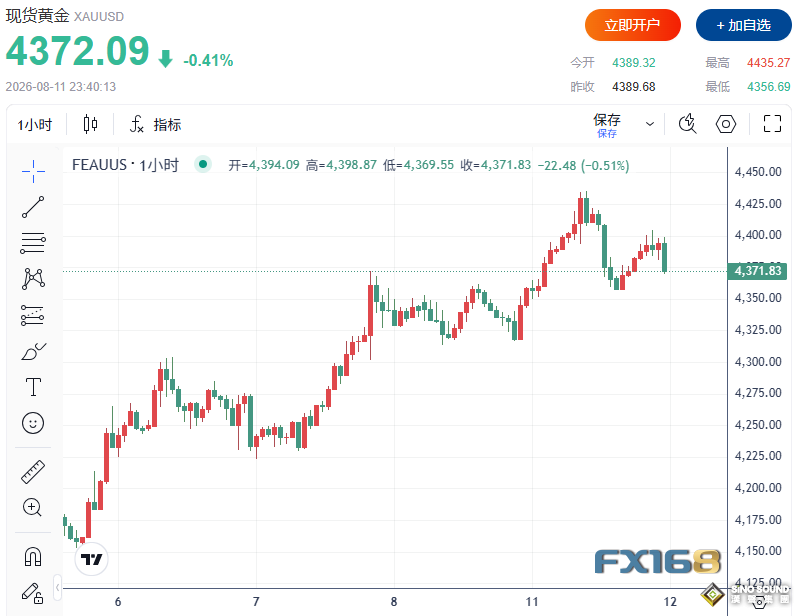
(Source: FX168)
The current gold price trend is driven by three major forces: U.S. economic resilience dampens rate-cut expectations and even reinforces hike bets, Middle East tensions underpin safe-haven demand, while inflation risks from soaring oil prices raise the likelihood of the Fed maintaining a hawkish stance.
U.S. Existing Home Sales Fell but Beat Market Expectations
Data released by the National Association of Realtors (NAR) showed total existing home sales, including single-family homes, townhouses, condominiums and co-ops, dropped 1.7% month-on-month in July to a seasonally adjusted annual rate of 4.06 million units.
Despite the monthly decline, the reading topped economists’ consensus forecast of 4.04 million. Meanwhile, June’s existing home sales were revised up from 4.09 million to 4.13 million, indicating the U.S. housing market performed slightly better than initially estimated.
Gold quickly erased partial gains and turned negative after the data print. Housing data is not usually a core driver for gold pricing, but amid heightened investor scrutiny over whether the U.S. economy can withstand high interest rates, the stronger-than-expected report reinforced views of economic resilience and curbed market bets on monetary eASIng.
By region, July existing home sales rose month-on-month in the Northeast, held steady in the West, and declined in the Midwest and South. On an annual bASIs, sales grew in the Midwest and West, and were flat in the Northeast and South.
Lawrence Yun, Chief Economist at NAR, stated U.S. home sales have remained "unusually stable" despite rising mortgage rates over the past several months. Year-to-date, existing home sales are up 2.4% from the same period last year.
Yun noted the national housing market would "undoubtedly strengthen" if average mortgage rates fall closer to 6%.
He also emphASIzed that national stability masks stark regional divergence. In smaller cities, particularly across the Midwest, households with an annual income of roughly $60,000 can still afford the median local home price. This means the U.S. housing market is not under broad pressure in a high-rate environment, with clear performance gaps across regions.
Oil Surges Over 5% This Week, Inflation Worries Resurface
Energy market movements exert a more direct impact on gold at present compared to housing data.
West Texas Intermediate (WTI) crude traded near $80.80 per barrel on Tuesday. Although intraday gains narrowed, the benchmark has climbed more than 5% for the week. The sharp oil rally revived market concerns over U.S. inflation pressures and directly altered investor outlooks for the Fed’s rate path.
Previously, the weaker-than-expected July nonfarm payroll report had prompted the market to scale back expectations for additional Fed tightening. However, rebounding energy prices stoked fears that cost pressures would filter through gasoline, transportation and production expenses to broader consumer prices.
Against this backdrop, Fed policy expectations turned hawkish again. Markets now view a September rate hike as a tangible risk, with the CME FedWatch Tool pegging the probability at around 49%.
Gold generates no interest income, so higher benchmark interest rates raise its opportunity cost of holding. If inflation forces the Fed into further tightening, U.S. Treasury yields and the U.S. Dollar Index will likely strengthen, capping gold’s upside potential.
Negotiations Over the Strait of Hormuz Enter Critical Phase
Beyond U.S. economic fundamentals and monetary policy, Middle East geopolitics remain a key variable for gold and crude oil prices.
Latest updates from Qatar indicate high-level negotiations between Iran and Oman on reopening the Strait of Hormuz have yielded positive feedback from both sides.
The news eased market fears over disrupted energy shipping routes, pulling oil prices down from their intraday highs and enabling a mild bounce in gold from the $4356 low.
Nevertheless, a full de-escalation is far from secured.
Iran has insisted the strait will not reopen unless the U.S. pays war reparations and fulfills a list of demands, including lifting sanctions, releASIng frozen Iranian assets, halting military threats and ending the U.S. naval blockade.
U.S. President Donald Trump issued counter-demands in a post on Truth Social on Monday, requiring Iran to compensate the U.S. for deaths and injuries caused over past decades.
Hardline rhetoric from both sides on compensation and sanctions means substantial uncertainty lingers over the Strait of Hormuz even if diplomatic talks make partial progress.
This dynamic places gold under conflicting dual drivers: geopolitical risks boost its safe-haven appeal, yet sustained oil price spikes fueled by tensions fan inflation and Fed hike expectations, and restrictive monetary policy in turn weighs on gold valuations.
U.S. Dollar and Treasury Yields Constrain Gold’s Rebound
As the market reprices the Fed’s policy trajectory, the U.S. Dollar Index gained traction and U.S. Treasury yields stayed elevated, preventing gold from extending its strong ASIan session rally.
The market is locked in a classic tug-of-war between safe-haven bullishness and rate-driven bearish pressure for gold.
On one hand, Middle East geopolitical risks, Strait of Hormuz supply concerns and energy market uncertainty underpin gold’s haven demand. On the other, oil-led inflation pressures and resilient U.S. economic data rule out bets on an imminent Fed pivot to eASIng.
Investors are now turning their focus to Wednesday’s U.S. Consumer Price Index (CPI) release. Another hot inflation print would ramp up September hike odds, lift the dollar and Treasury yields, and create renewed downward pressure on gold.
Conversely, cooler CPI data would prompt the market to pare rate hike bets and offer gold a reprieve.
Ahead of the CPI print, developments in U.S.-Iran relations and Strait of Hormuz negotiations are set to dominate short-term volatility in gold and crude oil.
Technical Outlook: Gold Bulls Hit Resistance Near the 100-Day Moving Average
On the daily chart, gold retains a near-term bullish structure. XAU/USD trades well above the 50-day simple moving average (SMA) around $4148 and holds above multiple key FibonaCCI retracement support levels.
However, the price is now testing the 100-day moving average near $4389, a critical dividing line for short-term bulls and bears.
On technical indicators, the Relative Strength Index (RSI) stands near 66, edging close to overbought territory. The Average Directional Index (ADX) reads slightly below 30, confirming a defined trend with fading upward momentum.
This signals gold’s medium-term uptrend remains intact, yet the risk of chASIng highs has risen sharply following the rally to a two-month peak, opening the door for sideways consolidation or further pullbacks.
To the upside, gold needs to reclaim the 100-day moving average at $4389 as immediate support. Next resistance lies at $4435, the recent cycle high and 100% FibonaCCI retracement level. A decisive break above $4435 would unlock fresh upside for bullish positions.
On the downside, the 78.6% FibonaCCI retracement near $4351 acts as the first line of support. A break below this zone would expose subsequent supports at the 61.8% retracement ($4285) and 50% retracement ($4238).
The key medium-term structural support rests at the 50-day moving average around $4148. As long as this level holds, gold’s broader bullish bias remains valid.
Overall, gold has entered a critical consolidation phase after peaking at $4435. Short-term market focus has shifted from pure geopolitical haven trading to the complex interplay between oil prices, inflation prints and Fed policy pricing. Wednesday’s U.S. CPI report will likely serve as the next major catalyst to determine whether gold retests its recent high or extends its corrective pullback.