

Spot international gold closed slightly lower on Tuesday (August 12) after hitting a more than two-month high. Market sentiment swung back and forth amid geopolitical uncertainties and the upcoming release of key U.S. inflation data. Although gold failed to hold above the $4,400 threshold, it lingered at relatively elevated levels, indicating that buying support formed following weak employment data has not fully faded. Investors are fully focused on the U.S. Consumer Price Index (CPI) due out on Wednesday, which will directly drive market repricing of the Federal Reserve’s policy path and determine gold’s short-term direction.
In early ASIan trading on Wednesday (August 12), spot gold is trading near $4,370 per troy ounce. The gold market is currently caught in a window driven by both macroeconomic fundamentals and geopolitical conflicts. On one hand, last week’s softer-than-expected nonfarm payrolls have markedly priced down the odds of a September rate hike, delivering clear interest-rate tailwinds for gold. On the other hand, volatile developments in the Middle East, especially uncertainties over shipping access in the Strait of Hormuz, continue to impact gold prices through two channels: crude oil prices and safe-haven sentiment. Meanwhile, the U.S. Dollar Index remained broadly steady, and U.S. Treasury yields erased early gains to trade within a narrow range. The entire market is waiting for inflation data to deliver clearer guidance.
Gold Rallies Then Pulls Back: Subtle Shifts in Technicals and Market Sentiment
Spot gold finished Tuesday down 0.5% at $4,368 per ounce, sitting marginally below the 100-day moving average of $4,388. It surged intraday to $4,435.20, the highest level since June 5, showing bulls still attempted to break above key resistance. However, a wave of profit-taking and heightened caution ahead of upcoming data prevented gold from sustaining its peak, pulling the price back toward the moving average.
This pattern of a sharp rally followed by a mild pullback without a major breakdown reflects the mixed mindset among market participants. For one thing, gold skyrocketed 2.4% in a single session after last week’s jobs report, igniting strong buying enthusiasm. For another, investors are reluctant to chase further upside before the inflation release. Peter Grant, Vice President and Senior Precious Metals Strategist at Zaner Metals, stated that the market is looking to this week’s inflation print for confirmation that price pressures are under control, and a slowdown in annual CPI growth should continue to underpin gold. He also stressed that disappointing payrolls have diminished September hike odds, leaving gold backed by robust buying demand.
From a technical perspective, although the closing price near $4,368 broke below the 100-day MA, it remains not far from the recent peak within the two-month high range. If the upcoming CPI misses expectations and further reduces rate hike probabilities, gold may retest levels above $4,400. Conversely, sticky inflation could trigger a more pronounced technical correction.
Fed Policy Expectations Dominate Short-Term Outlook, CPI as the Critical Litmus Test
Highly sensitive to real interest rates, gold’s current trajectory is tightly tethered to expectations for the Fed’s policy roadmap. Per the CME FedWatch Tool, traders now price the probability of a September rate hike at roughly 50%, down from earlier levels, while the odds for a December hike stand as high as 80%. This split outlook offers a buffer for gold: the market has not ruled out tightening entirely, yet there is no solid consensus for aggressive policy restraint.
Cleveland Fed President Beth Hammack said on Monday that she believes now is the appropriate time to start gradual rate increases to avoid more drastic hikes down the line. Her remarks served as a reminder that hawkish voices peRSIst within the Fed. Nevertheless, weak July payrolls released on Friday have prompted the market to reassess the pace of economic cooling, curbing the spread of hawkish narratives to some extent.
The Wednesday CPI report and Thursday’s Producer Price Index (PPI) will mark pivotal repricing events. Surveys show consensus forecasts for July headline CPI to edge up 0.1% month-on-month, with the year-over-year rise eASIng from 3.5% to 3.4%; core CPI is projected to rise 0.2% MoM and slow from 2.6% to 2.5% YoY. In-line or softer prints will reinforce the narrative of contained inflation, lower near-term hike odds and support gold. Resurgent inflation stickiness, by contrast, would lift tightening bets and weigh on bullion.
Notably, oil prices constitute a latent variable in inflation expectations. Both Brent crude and WTI futures advanced on Tuesday to settle at one-week highs, driven by fading prospects of a U.S.-Iran diplomatic deal and peRSIstent shipping risks in the Strait of Hormuz. A sustained rally in energy costs could lift aggregate inflation expectations, boost Fed hike odds and cap gold’s upside.
Escalating Geopolitical Risks: Strait of Hormuz and Trump’s Remarks Emerge as New Wildcards
Beyond macroeconomic data, geopolitics has played an indispensable role in the latest gold volatility. In response to Iran’s terms for a peace accord, U.S. President Trump explicitly demanded Iran pay compensation for fatalities resulting from conflicts, attacks and protests. Meanwhile, Mohsen Rezaei, the newly appointed Secretary of Iran’s Supreme National Security Council, declared on Tuesday that the Strait of Hormuz would remain closed unless the U.S. alters its posture and accepts Iran’s conditions to end hostilities. The statement represents the clearest signal to date that shipping through the chokepoint may not resume swiftly even amid diplomatic progress.
Shipping data showed only six vessels transited the Strait of Hormuz on Monday, far below the 11-vessel daily average over the prior 10 days and drastically down from the pre-conflict normal volume of 125 to 140 ships per day. Disrupted passage stoked market fears of Middle Eastern supply outages and underpinned crude prices. Separately, attacks by Yemen’s Houthi rebels on Saudi vessels and a missile strike on a container ship off Pakistan further escalated regional tensions.
On one hand, simmering Middle East tensions attracted traditional safe-haven buying for gold. On the other hand, elevated oil prices stemming from the tensions act as an invisible drag on gold’s performance.
PeRSIstently high oil prices directly lift global inflation expectations, forcing the market to recalibrate the Fed’s rate hike cycle. Hamad Hussain, Economist at Capital Economics, put it plainly: “Rising oil prices push U.S. Treasury yields higher, which is exerting downward pressure on gold.” Costlier energy can exacerbate inflationary pressures and lock in elevated interest rates, diminishing the appeal of non-yielding gold. In short, the short-term safe-haven premium from geopolitical flare-ups is being eroded by higher carrying costs driven by medium-term rate increases. This is one core reason gold retreated rapidly after its intraday peak on Tuesday.
Sustained Ukrainian strikes on Russian energy infrastructure, compounded by Middle Eastern strife, have significantly constrained global oil supply, lifting Brent crude roughly 44% year-to-date. The U.S. Energy Information Administration (EIA) even warned that some Middle Eastern oil producers may fail to restore output to pre-conflict levels by late 2027, even if trade flows normalize early next year. These long-term supply concerns have renewed investor interest in gold’s allocation value as a classic safe-haven asset.
Across fixed income markets, U.S. Treasuries gave back early Tuesday gains; the 10-year yield fluctuated mildly while the 2-year yield declined. Optimism over a U.S.-Iran agreement faded following the Iranian official’s comments, and climbing oil prices limited the scope for lower yields. The U.S. Dollar Index held steady near 99.80, with traders likewise awaiting inflation data for directional clarity. Overall, the relative stability of the dollar and Treasury yields created a neutral monetary backdrop for gold, leaving it largely driven by geopolitics and data prints.
Mixed Bull and Bear Drivers: Gold Likely to Extend Sideways Range at High Levels
Taken together, gold is operating in an environment defined by data dependence and geopolitical noise. Expectations for rate cuts (or at minimum, a pause in hikes) from soft jobs data, paired with safe-haven demand from Middle Eastern instability, form the primary pillars supporting elevated gold prices. However, rallying crude oil keeps the market pricing an 80% probability of Fed tightening this year, giving gold bulls pause. The upcoming CPI carries two-way risks, and further oil price gains fueled by geopolitics could reignite inflation worries and cap gold in the interim.
Judging by market sentiment, investors have not resorted to panic selling, with dip-buying emerging on pullbacks, signalling the bull camp remains intact. Analysts including Peter Grant maintain that gold will retain support as long as disinflation is confirmed. In addition, the Trump administration’s hardline stance toward Iran and ongoing shipping uncertainty in the Strait of Hormuz mean the geopolitical risk premium will not fully evaporate in the near term.
Markets will trade around inflation prints, Fed officials’ speeches and Middle Eastern developments in the coming days. A dovish CPI reading could send gold retesting recent highs, while hot inflation may trigger a technical pullback. That said, robust safe-haven demand and rate expectations should limit the risk of a severe breakdown. For investors, focus should fall on post-data market repricing rather than one-sided directional bets.
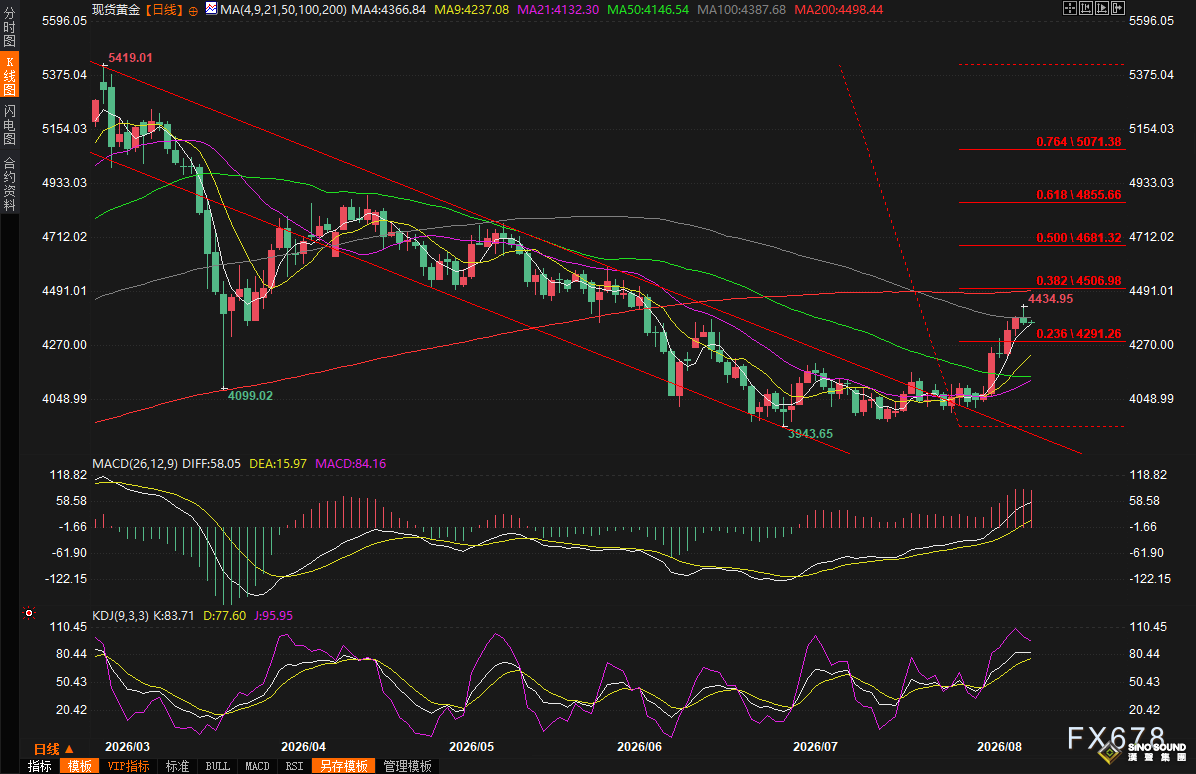
(Spot Gold Daily Chart, Source: Yihuitong)
As of 07:42 Beijing Time, spot gold is quoted at $4,368.31 per troy ounce.