

Last Friday, Federal Reserve Chair Warsh’s hawkish remarks put rate‑hike discourse back onto the market’s radar and pressured spot gold sharply lower. Spot gold broke below the $4400 threshold after opening today for the first time since August 19, hitting an intraday low of $4396.65 per ounce. Prices then stabilised and rebounded back above $4400. At press time, gold trades sideways near $4437, down 0.45% for the session.
Following last Friday’s sharp rally in the US Dollar Index, the greenback has pulled back from an intraday high of 99.72 to a low of 99.47 and is last quoted at 99.54, down 0.14%. US Treasury yields retreated in tandem: the 2‑year Treasury yield fell 2.5 bASIs points to 4.325%, while the 10‑year yield dropped 1.9 bASIs points to 4.703%.
Amid renewed US‑Iran conflict, both WTI and Brent crude gapped higher at today’s open. WTI crude stands at $85.70 per barrel, up 2.67%; Brent crude trades at $90.62 per barrel, gaining 2.61%. US natural gas CFD is quoted at $2.858 per MMBtu, down 0.66%.

In equities, China’s three major A‑share indices opened lower then rebounded, all turning positive during the session. At close, combined Shanghai‑Shenzhen turnover reached 2.13 trillion yuan, about 29.3 billion yuan higher than the previous session. The Shanghai Composite Index rose 34.12 points (+0.86%) to 3986.3; the Shenzhen Component Index added 61.93 points (+0.44%) to 14015; the ChiNext Index climbed 14.28 points (+0.42%) to 3438.68.
Hong Kong’s Hang Seng Index opened lower and edged higher. At closing, the Hang Seng Index lost 17.8 points (-0.07%) to 25566.99; the Hang Seng Tech Index gained 14.72 points (+0.32%) to 4619.87; the Hang Seng China Enterprises Index rose 22.79 points (+0.27%) to 8513.18; the Hang Seng Red Chip Index fell 88.82 points (-2.09%) to 4170.36.
European equity markets opened in the afternoon: Germany’s DAX 30 opened‑0.45%, France’s CAC 40 +0.12%, Spain’s IBEX 35‑0.05%, Italy’s FTSE MIB +0.02%, Euro Stoxx 50‑0.13%.
In afternoon trade, Shanghai Gold Exchange’s Au(T+D) closed‑2.99% at 961.0 yuan per gram; Ag(T+D) finished‑3.16% at 16310.0 yuan per kilogram.
Latest data released today shows China’s official August manufacturing PMI printed at 49.8 versus expectations of 49.6 and a prior reading of 49.2. The National Bureau of Statistics reported clear improvement in manufacturing sentiment, with simultaneous expansion in production and domestic demand as well as better external demand. Policy support has effectively bolstered economic momentum.
Last Friday, Fed Chair Warsh’s hawkish remarks lifted rate‑hike expectations. Despite a forceful market reaction, Warsh’s policy credibility has not been fully restored. Markets now await further Fed signals, while Middle‑East tensions may amplify volatility.
Shortly after the Jackson Hole global central‑bank symposium concluded, the G20 meeting of finance ministers and central‑bank governors got underway in Asheville, North Carolina. This gathering of global policymakers deserves attention for its collective assessment of inflation and policy stances.
Two central‑bank rate decisions are due this week: the Reserve Bank of New Zealand and Bank of Canada on Wednesday. On Thursday, the Fed releases its Beige Book, the final regional economic snapshot ahead of the September policy meeting, offering policymakers updated labour‑market and price data. Bank of England Governor Bailey speaks on Friday.
Markets price a high probability of a RBNZ rate hike, with a 25‑bp lift in the overnight cash rate to 2.75% expected. The Bank of Canada is seen staying cautious and widely expected to hold rates steady at 2.25%.
Key US data due Friday includes August unemployment rate, seasonally adjusted non‑farm payrolls, and monthly/yearly average hourly earnings. This jobs report is the final employment print before the September 16 FOMC meeting and a critical gauge for policy direction following Warsh’s hawkish tone.
In remarks to G20 finance ministers and central‑bank governors, Financial Stability Board Chair and Bank of England Governor Bailey issued a stern warning: the global financial system is already stretched by energy‑driven inflation, high interest rates and rising investment leverage. Under these conditions, cybersecurity threats from advanced AI models substantially raise systemic collapse risks.
US Treasury Secretary Bessent stated that Trump plans to impose sanctions on another bank this week to further isolate Iran from the global financial system. Yet Turkey, the UAE, Pakistan and other nations have not fully severed ties with Iran, making comprehensive US‑led economic containment difficult.
US President Trump claimed Iran’s Kharg Island has been “blown to smithereens” and shared an AI‑generated video depicting the island in ruins. US officials stated Iranian actions created threats, and military strikes were undertaken to protect civilian crews, commercial shipping and free global trade. Iran, by contrast, denied Kharg Island was attacked and dismissed Trump’s post as ridiculous.
US military officials said navy vessels, air‑force jets and army helicopters are closely monitoring the Strait of Hormuz and stand ready to strike Iranian forces threatening merchant vessels transiting the waterway.
Iran’s military reported a very large crude oil tanker caught fire and lost propulsion after being struck by two mines inside the Strait of Hormuz while attempting illegal transit. Authorities stressed vessels must comply with local passage regulations. Iran also stated a US MQ‑9 Reaper drone, valued at $30‑50 million, was hit by Iranian missiles over the Strait of Hormuz.
Russia’s Defence Ministry warned that in response to sustained Ukrainian attacks on Russian civilian and energy infrastructure, Moscow is preparing large‑scale retaliatory strikes against Ukrainian energy facilities. As the conflict remains deadlocked with no realistic peace talks, global refining and agricultural commodity prices face sharp swings.
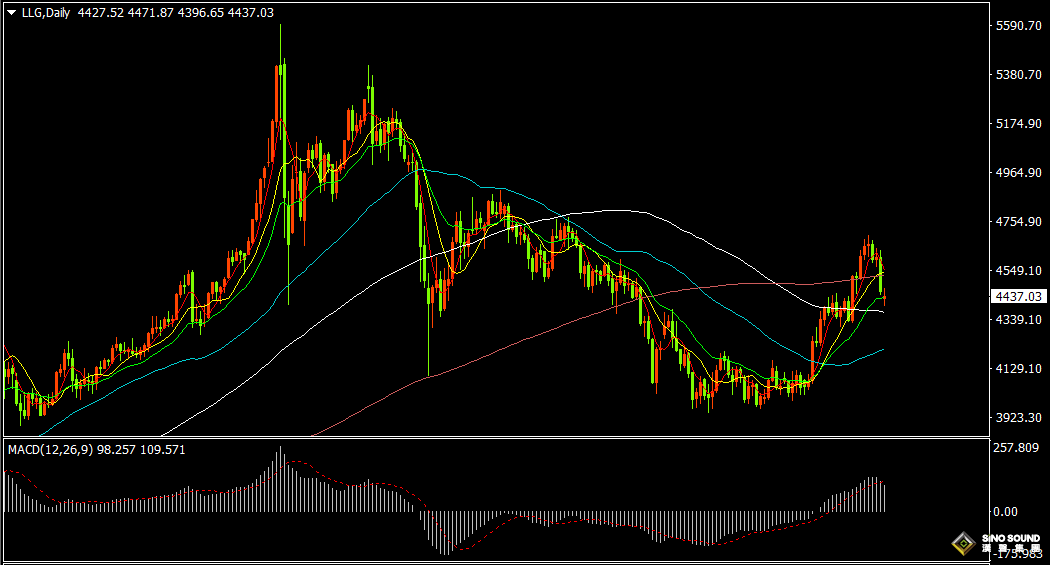
On the daily chart, gold printed a doji candle across European‑ASIan sessions, trading between $4471 high and $4395 low. Prices hover near $4437 around the 20‑day moving average. Watch support near the 100‑day moving average at $4370 overnight. Daily technicals show gold has broken below the 5‑day, 10‑day and 200‑day moving averages. MACD positive histogram keeps shrinking, while RSI hovers near 53.
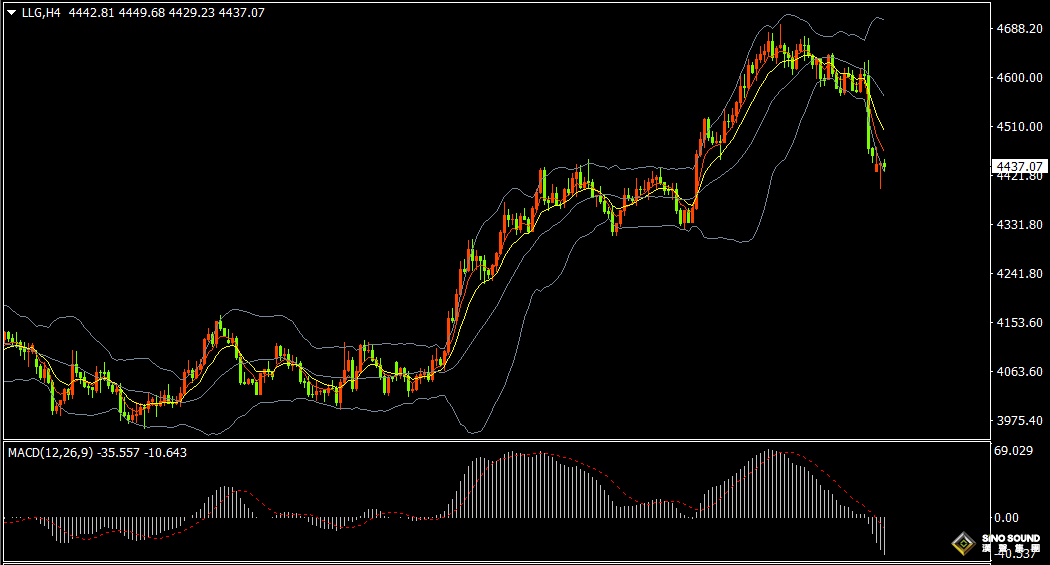
On the 4‑hour chart, gold consolidates along the lower BOLLinger Band. Short‑term EMA5 and EMA10 point bearishly lower. MACD negative histogram continues expanding, and RSI stays close to the oversold level of 30. For overnight short‑term trading, the morning strategy remains unchanged: monitor price action within $4395‑4470. A breakout higher targets $4480‑4500 or $4520. A breakdown lower targets $4375‑4360 or $4335.
Key overnight economic releases and events:
20:00 Germany August preliminary CPI MoM
22:30 US August Dallas Fed Manufacturing Index
[Disclaimer]The views and opinions expressed in this article are solely those of the author and do not necessarily reflect the views of SinoSound. SinoSound remains neutral regarding the opinions and statements contained herein and makes no representations or warranties, whether express or implied, regarding the accuracy, reliability, or completeness of the information provided.
The content of this article is intended for informational and reference purposes only. Readers should exercise their own judgment and assume full responsibility for any decisions or actions taken based on the information contained herein.
[Copyright Notice]This article is original content and is protected by applicable copyright laws. Any reproduction, distribution, citation, or use of this content must clearly acknowledge the original source:
Gold2U
www.gold2u.com
We reserve all rights and may take legal action against any individual or entity that fails to comply with this notice or otherwise infringes our intellectual property rights.