

On Tuesday (Oct 6), falling oil prices and cooling global bond yields boosted risk appetite in financial markets. The resumption of Middle East crude exports plus the G7 plan to release emergency reserves eased energy supply concerns. US Treasury yields retreated from 24-year highs, supporting tech stocks and gold, while the S&P 500 and Nasdaq notched fresh intraday all-time highs. Meanwhile, the US Dollar weakened and the Euro rebounded, yet Bitcoin pulled back after failing to break above $87,000, showing divergent reactions across asset classes to this market shift.
Nevertheless, lower energy prices have not erased Middle East supply risks, and US services sector price pressures remain prominent. Although markets have sharply cut bets on an October rate hike, expectations for another December rate hike stay high. The release of the Fed’s September meeting minutes on Wednesday will serve as the next critical test.
Crude Oil: Supply fears ease, Brent drops below $98
International oil prices declined on Tuesday. Resilient Middle East crude exports and the G7 emergency reserve release plan temporarily overrode supply worries stemming from regional conflicts. At 7:46 AM ET, Brent crude futures fell 2.3% to $97.99 per barrel; US WTI crude futures also dropped 2.3% to $87.33 per barrel.

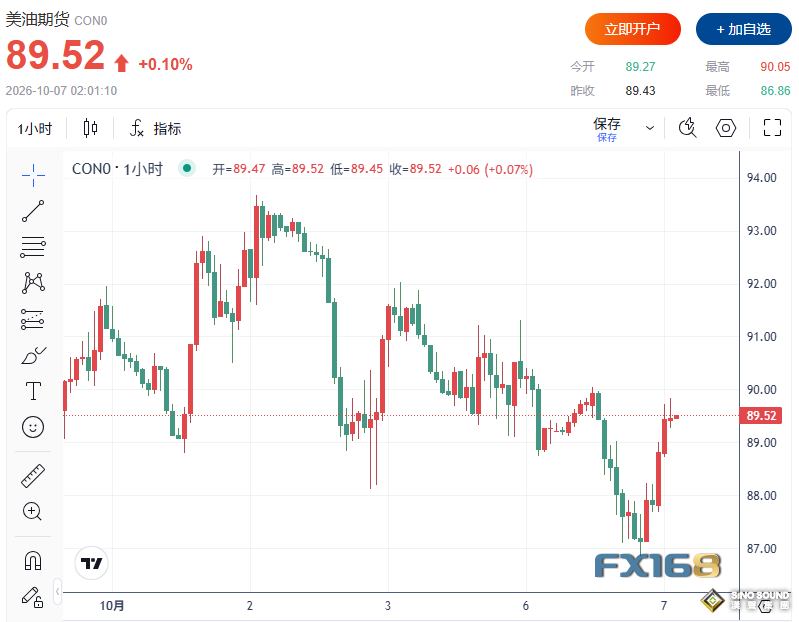
(Source: FX168)
Shipping data released on Monday showed Middle East crude exports exceeded pre-conflict levels on four days in the final week of September, indicating regional oil transport retains certain resilience even with ongoing attacks on vessels transiting the Strait of Hormuz. Meanwhile, the G7 agreed last Friday to release 100 million barrels of crude oil and diesel reserves over four months coordinated by the IEA, and pledged not to restrict energy exports among member states.
Tim Waterer, Chief Market Analyst at KCM Trade, stated that rebounding Saudi exports and strategic reserve releases are eASIng market supply anxiety and capping oil price gains for now. Still, without clear diplomatic breakthroughs or further material improvements in crude export efficiency, downside support for oil prices may remain solid.
Regional security risks peRSIst. Yemen’s Houthi movement claimed on Monday it attacked multiple Saudi targets, including King Khalid International Airport in Riyadh, a Saudi Aramco refinery in Rabigh and Abha Airport; Saudi authorities did not immediately confirm the claims. On the other hand, Yemen’s government stated that Saudi-backed government forces have recaptured parts of coastal areas around the Bab el-Mandeb Strait up to Mokha. Military tensions and deadlock in US-Iran negotiations keep traders alert to fresh disruptions to Gulf energy supplies.
Bond Market: US Treasury yields retreat from 24-year highs, inflation pressures unresolved
Falling oil prices brought some relief to the US Treasury market. During Tuesday’s session, the 10-year US Treasury yield dropped more than 4 bASIs points to 5.262%, the 30-year yield fell over 3 bASIs points to 5.631%, and the 2-year yield dipped roughly 4 bASIs points to 4.793%. In the prior session, the 10-year and 30-year yields had hit their highest levels since April 2002 and May 2002 respectively.
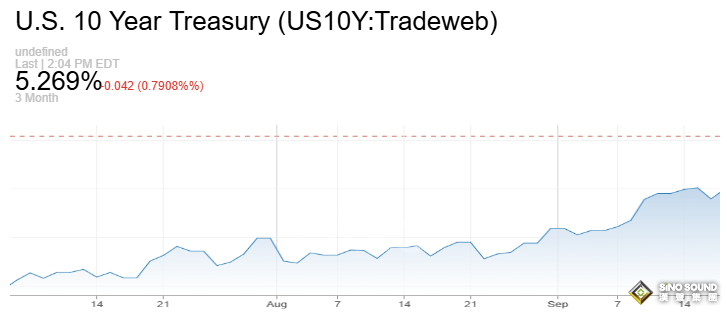
(Source: CNBC)
However, the latest economic data still shows a mix of slowing growth and elevated price pressures. The ISM reported on Monday that the US September Services PMI fell to 54.9 from August’s 55.4, staying within expansion territory, while the prices index rose 1.4 points to 74.0, the highest reading since July 2022. This signals cooler services growth, yet cost pressures have not eased accordingly.
According to intraday pricing from CME FedWatch, the probability of at least a 25-bASIs-point rate hike in October stands around 22%, sharply lower from roughly 51% one week ago, with the odds of unchanged rates near 80%. That said, the probability of a December rate hike remains above 80%, meaning markets have not fully dismissed concerns over further policy tightening. Investors will closely scrutinize Wednesday’s September meeting minutes to gauge policymakers’ views on inflation, economic slowdown and room for additional rate hikes.
Stock Market: Chip stocks lead gains, S&P 500 and Nasdaq hit intraday records
The simultaneous drop in oil prices and US Treasury yields partially eased pressure on equities, and rising tech stocks pushed major indices higher. The S&P 500 set a fresh all-time intraday high in early Tuesday trading. In intraday quotes, the S&P 500 climbed about 0.8%, the Dow Jones Industrial Average rose 338 points or roughly 0.7%, and the Nasdaq Composite gained around 0.8%, also hitting a new intraday record high.
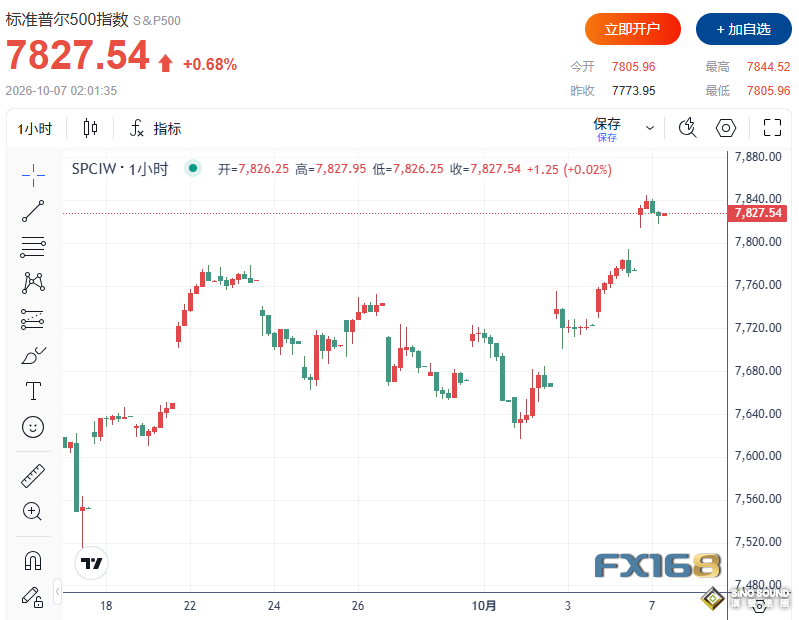
(Source: FX168)
Chip stocks were a major driver of the rally. Marvell Technology shares rose roughly 7%, Broadcom gained about 4%, and Nvidia advanced nearly 1%. Sustained enthusiasm for AI-related investments underpinned the market, while lower energy costs and long-term interest rates further improved investor sentiment.
Even so, bond market volatility remains a key variable for equities. Lisa Shalett, Chief Investment Officer at Morgan Stanley Wealth Management, wrote in a client note that bond markets have seen notable volatility over the past six weeks, driven by potential shifts in the Fed’s policy framework, economic growth outlook and high oil prices amid ongoing Middle East conflicts. She also mentioned that while implied volatility has risen intraday, recent swings have not reached the extreme levels that triggered the 2022 bear market.
FX Market: US Dollar falls, Euro rebounds, French bond pressure eases temporarily
The US Dollar weakened on Tuesday, while the Euro bounced back from the 17-month low hit in the prior session. Intraday quotes showed EUR/USD rose 0.28% to 1.1252, poised for its largest single-day gain since September 3. The US Dollar Index fell 0.26% to 101.89. The Euro dipped near 1.116 on Monday, having lost more than 1% in the prior week and traded lower for four consecutive weeks.
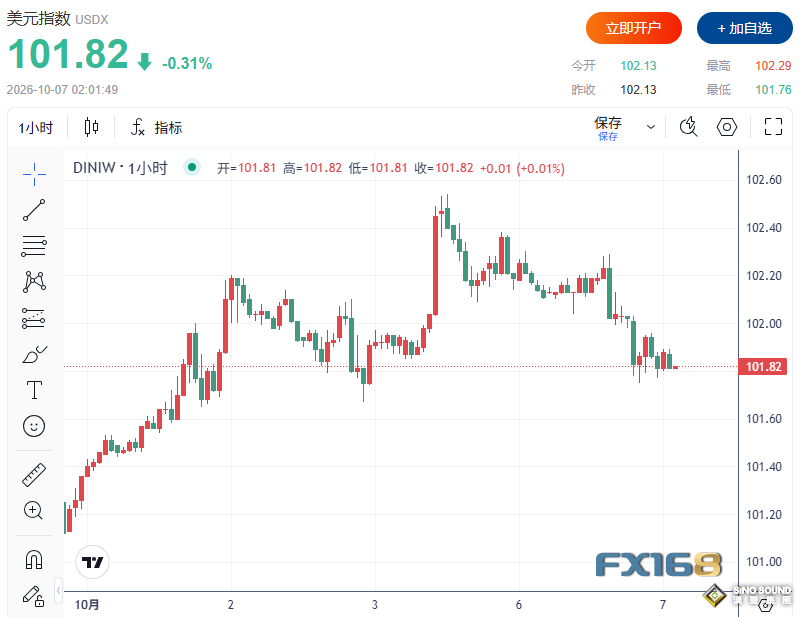
(Source: FX168)
Lower energy prices stabilized European bond markets and eased worries over Eurozone fiscal and debt pressures. France’s 10-year government bond yield fell about 8 bASIs points to 4.7824% intraday. Marc Chandler, Chief Market Strategist at Bannockburn Capital Markets, stated that the recapture of strategic areas by Yemen’s government forces pushed oil prices down, which in turn pulled French and Italian bond yields lower and supported the Euro rebound.
France’s fiscal deficit and the outlook for the 2027 election remain under scrutiny. French presidential candidate Marine Le Pen raised her planned fiscal savings target from 125 billion euros to 140 billion euros on Tuesday. At the same time, political uncertainty brought by Spain’s snap general election forms a backdrop weighing on the Euro recently.
The weaker US Dollar also lifted Sterling. GBP/USD rose 0.39% to 1.327, touching a one-week high of 1.3283 intraday. The Yen performed relatively weakly, with USD/JPY edging up roughly 0.05% to 157.98. Sources say the Bank of Japan may signal this month that underlying inflation has broadly hit the 2% target, paving the way for another rate hike in the coming months. BoJ Governor Kazuo Ueda also emphASIzed that stabilizing underlying inflation around 2% has grown more important.
Precious Metals: Weaker Dollar and falling yields support gold, institutions remain bullish long-term
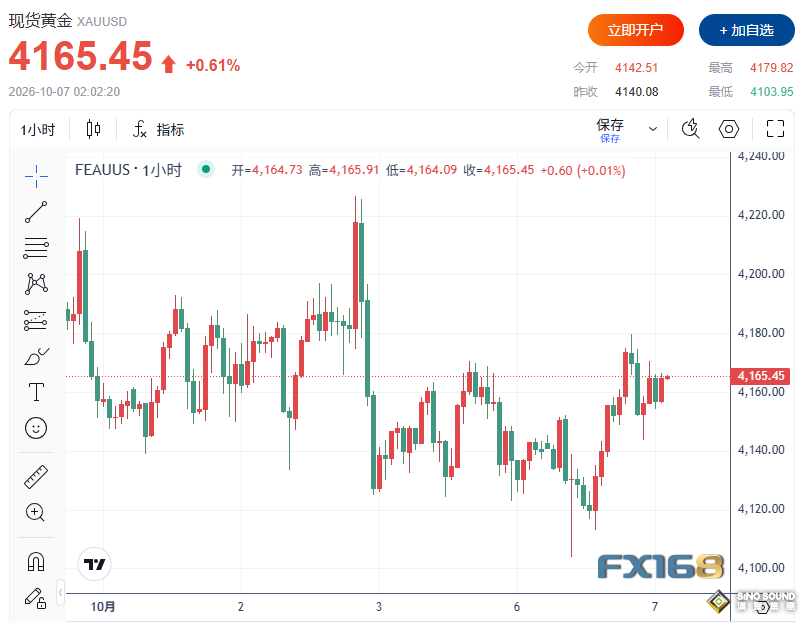
Gold edged higher on Tuesday, supported by a weaker US Dollar and retreating US Treasury yields. Spot gold was up 0.6% at $4165.45 per ounce; US December gold futures rose 0.6% to $4182.30 per ounce.
(Source: FX168)
Jim Wyckoff, Market Analyst at American Gold Exchange, said turmoil in French bond markets and concerns over the US Treasury market are generating some safe-haven demand for gold. A weaker US Dollar cuts gold purchase costs for non-dollar investors, and lower yields reduce the opportunity cost of holding this non-yielding asset.
Still, year-end rate hike expectations cap gold’s upside. While weaker-than-expected September job growth prompted markets to trim October hike bets, expectations for December tightening stay elevated. Whether the Fed meeting minutes can further alter rate path expectations will shape gold’s subsequent moves.
Analysts at TD Securities wrote in a report that despite short-term headwinds for gold, sustained ETF inflows and demand from discretionary investors offer support. The bank maintains its long-term view that gold will climb above $5000 per ounce by 2027, based on factors including investment demand.
Crypto: Bitcoin fails again at $87,000, ETF flows turn negative
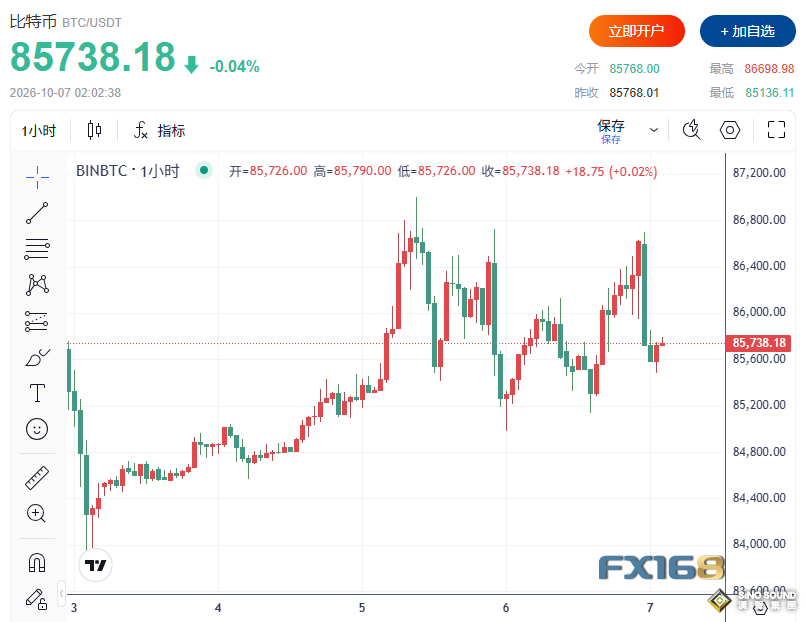
Bitcoin failed to sustain its upward momentum on Tuesday and pulled back to roughly $85,500 after another rejection near $87,000. CoinGecko data shows its 24-hour trading range stood at $85,010 to $86,662, with a market cap of about $1.72 trillion. It marks exactly one year since Bitcoin hit its all-time high of $126,080 on Oct 6, 2025, and the token remains roughly 32.2% below that record.
(Source: FX168)
Over the past two weeks, Bitcoin has traded mainly between $83,000 and $87,000. Analyst Daan Crypto Trades noted that $85,000 has repeatedly become a battleground for bulls and bears, with liquidity clustered near $87,000 above and $83,000 below. A breakout from either side of this range may trigger more pronounced price swings.
Analyst Ali Martinez cited Glassnode on-chain data and pointed out that $83,300 to $84,600 forms a key support zone corresponding to on-chain turnover for roughly 1.59 million Bitcoin. He views $86,700 as a critical level buyers need to break, and a valid breakout could put $100,000 back on the radar, though this view hinges on sustained breakout momentum and follow-up buying strength.
On capital flows, SoSoValue data shows US spot Bitcoin ETFs recorded a net outflow of $89.9 million on Oct 5, ending a prior two-day streak of combined inflows totaling about $293 million. BlackRock’s IBIT was the only fund with inflows that day, attracting roughly $69.9 million; ARKB, managed by ARK Invest and 21Shares, saw a net outflow of about $85.2 million, the largest outflow of the session.
Meanwhile, Martinez cited Santiment data stating that large holders have accumulated more than 14,335 Bitcoin since Oct 1, worth approximately $1.22 billion at the price used in his analysis. The divergence between whale accumulation and ETF outflows sends mixed signals. Whether Bitcoin can hold the $83,000–$85,000 zone and break above the $86,700–$87,000 resistance remains a major market focus.