

Macro strategist Henrik Zeberg has issued a stunning warning: rather than resembling the eve of the 2000 dot-com bubble burst or the 2007–2008 global financial crisis, the current US economy bears greater similarity to the year 1929.
(Screenshot source: Finbold)
Zeberg believes that against a backdrop of deteriorating labor market conditions, mounting financial pressure on consumers and a continued slump in the real estate market, a stock market bubble driven by tech stocks and centered on artificial intelligence (AI) is forming.
He states that the coexistence of an overheated financial market and a fragile real economy makes the current environment more akin to the eve of the Great Depression. Zeberg shared these views on the social platform X on September 28.
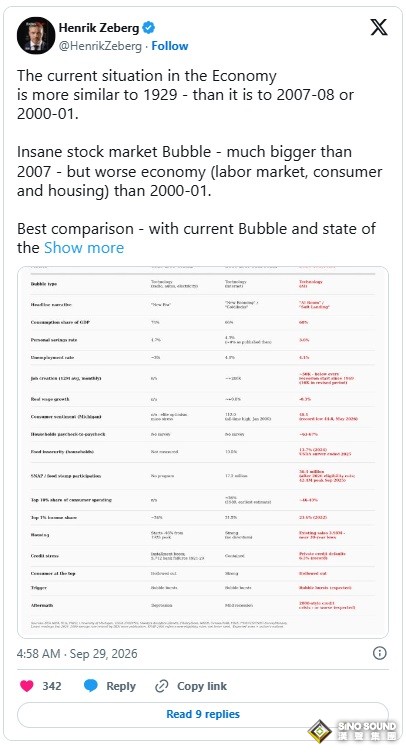
(Screenshot source: X)
The strategist, creator of the "Zeberg Macro Navigation Framework", has compared a series of economic and market indicators from 1929, the peak of the 2000 dot-com bubble, and 2026.

His analysis concludes that current economic and market conditions most closely resemble those just before the 1929 stock market crash.
Why Does Zeberg Think the US Economy Is Repeating the "1929 Moment"?
The core bASIs for Zeberg’s judgment is a massive divergence he observes: asset prices are soaring while economic fundamentals keep worsening.
In his comparison, the AI-centered stock bubble has become one of the most important narratives in the current market, similar to market manias fueled by new technologies during past speculative frenzies.
At the same time, he points out that the US personal savings rate stands at roughly 3%, real wage growth remains weak, household financial pressure is rising, and consumer confidence indicators hover near multi-year lows.
The analysis also notes that about two-thirds of US households live paycheck to paycheck, relying on monthly wages to get by, while food insecurity remains at a relatively high level.
The US real estate market has also cooled markedly, with existing home sales lingering near multi-decade lows.
In terms of the job market, Zeberg argues that current job creation trends are even weaker than those before the 2001 and 2008 recessions.
He also mentions that full-time employment growth is slowing, while signs of stress are becoming increASIngly evident in the private credit market.
Stock Market Bubble on One Side, Weak Economy on the Other
A core viewpoint in Zeberg’s economic outlook is that the current market boom is not driven by broad-based economic growth but is increASIngly concentrated in a small number of sectors of the economy.
He believes high-income households now account for a growing share of consumer spending. This supports aggregate economic data to some extent, making the US economy appear resilient on the surface even as financial stress on many ordinary Americans keeps intensifying.
Meanwhile, AI-related enterprises continue to attract massive investment capital, pushing valuations of associated stocks even higher.
According to Zeberg’s assessment, among several major historical bubble periods, only the eve of 1929 saw an extreme combination like this: a huge stock market bubble driven by a major technological wave, alongside widespread economic weakness beneath the apparent prosperity.
Zeberg also warns that the long-running bull market in tech stocks starting in the early 2000s may be approaching its final phase.
Although another market rally may still occur, as the US economy