

On Monday (Sep 28), spot gold tumbled nearly 4% to hit a fresh seven-week low. FXStreet analyst Christian Borjon Valencia released a new article analysing gold price movements.
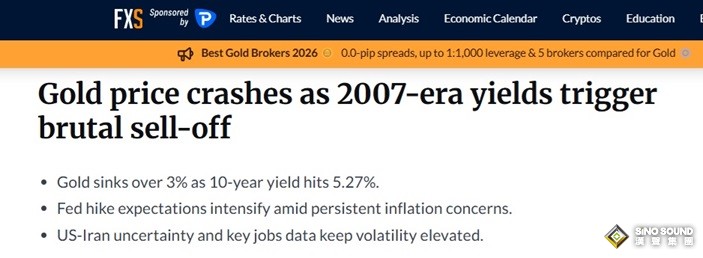
Valencia wrote that gold crashed on Monday as a sharp spike in US Treasury yields triggered heavy selling in the precious metal, while oil prices remained elevated. Amid fears of peRSIstent inflation, market expectations for Federal Reserve rate hikes heated up. The 10-year US Treasury yield touched 5.27%.
(Screenshot Source: FXStreet)
Spot gold closed Monday down $169.74, or 3.96%, at $4114.88 per ounce. The metal dipped to an intraday low of $4110.55, the lowest level since August 5.
Gold Hammered by Surging Treasury Yields and Fed Hike Expectations

Rising US Treasury yields increase the opportunity cost of holding non-yielding gold.
The 10-year US Treasury yield jumped 10 bASIs points intraday on Monday to 5.27%, its highest since June 2007, before retreating to 5.23%.
In addition, multiple Fed officials delivered hawkish remarks on elevated US inflation, raising the odds of further rate increases. Fed Governor Cook struck an especially hawkish tone, forecasting that AI development and Middle East conflicts will keep inflationary pressures alive in the coming months.
Money markets currently price in a 65% chance of a 25-bASIs-point rate hike at the Fed’s October meeting. According to Prime Terminal data, a December rate hike is nearly a lock with odds as high as 94%.
The Fed raised rates by 25 bASIs points earlier this month and signalled further hikes may lie ahead in the coming months.
Traders are now turning their focus to US employment data, including JOLTS job openings, September ADP employment change, the core PCE price index, and September non-farm payrolls.
Soaring Oil Prices Also Weigh on Gold
Oil surged roughly 3% intraday on Monday after US President Trump rejected Iran’s peace proposal designed to resolve bilateral conflict and reopen the Strait of Hormuz.
Higher oil prices raise the risk of rising inflation and reinforce expectations of tighter monetary policy.
The US dollar held steady near a two-month high, making dollar-denominated gold more expensive for overseas buyers.
Jim Wyckoff, market analyst at the American Gold Exchange, said: “We are seeing a sharp rise in crude oil prices. That means inflation could worsen and Fed monetary policy may become more restrictive.”
Wyckoff said climbing Treasury yields combined with a multi-week high in the US dollar created “a perfect storm that sent metal prices sharply lower.”
Although gold is traditionally viewed as an inflation hedge, higher interest rates reduce its appeal as investors favour income-generating assets.
Gold Technical Analysis
FXStreet analyst Christian Borjon Valencia noted gold had traded in a narrow range within a bullish wedge pattern before breaking below the wedge’s lower trendline, targeting the next key level of the August 3 low at $4019 per ounce. The downtrend remains firmly intact; bearish momentum is strengthening as the RSI plunges vertically toward oversold territory.
Valencia said for the decline to extend, gold must first break the $4100 level, followed by $4050. Further downside would target the August 3 low of $4019 and potentially the psychological mark of $4000 per ounce.
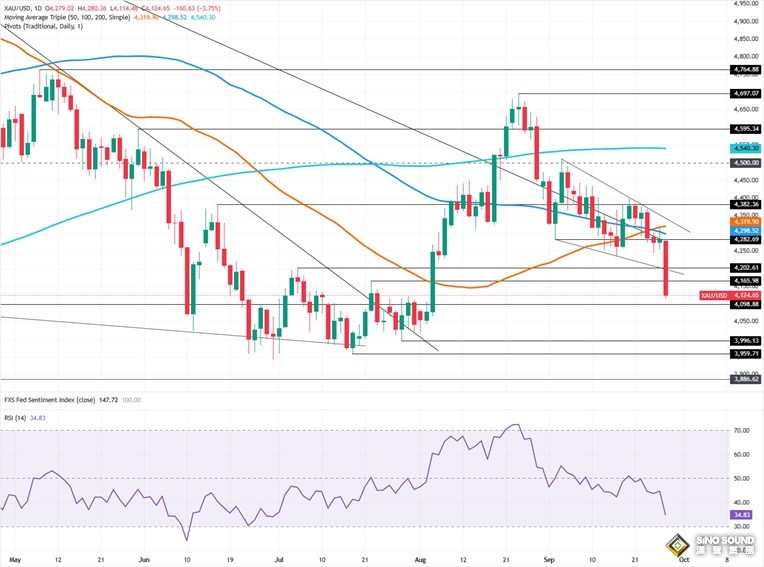
(Spot Gold Daily Chart | Source: FXStreet)
Valencia added that for a bullish reversal, gold needs to break above $4200, and then overcome the convergence zone of the 100-day and 50-day simple moving averages at $4298 and $4319 respectively.