

On Wednesday (September 23), spot gold prices plunged. Fresh remarks from Federal Reserve officials and strong US economic data have fueled a sharp rise in market expectations for Fed rate hikes and pushed the US dollar to a two-month high, weighing on non-yielding gold. FXStreet analyst Christian Borjon Valencia recently published an article analyzing gold price movements.
Spot gold closed down $70.96 or 1.63% on Wednesday at $4287.24 per ounce, touching its lowest level since September 17 during the session.
Valencia wrote that gold fell more than 1.5% during Wednesday’s North American session as investors grew increASIngly convinced that the Federal Reserve would raise interest rates at its October meeting. This conviction stemmed from hawkish remarks by multiple officials.
Earlier this week, developments in the Middle East pushed US oil prices close to $90 per barrel. However, news emerged on Wednesday that the United States may ban diesel exports, reveRSIng crude oil trends. West Texas Intermediate (WTI) crude rose more than 1.5% to $91.42 per barrel.
Since the outbreak of the US-Iran conflict in late February, gold and oil prices have moved almost in opposite directions. Rising energy prices stoke fears of inflation and monetary tightening by central banks, putting gold under pressure.
US Dollar Hits Two-Month High
The US dollar climbed to a two-month high, making dollar-denominated gold more expensive for investors holding other currencies.
The US Dollar Index (DXY), which tracks the greenback against six other major currencies, rose 0.7% on Wednesday to 101.22, creating headwinds for gold.
Peter Grant, Vice President and Senior Metals Strategist at Zaner Metals, said the stronger dollar weighs on gold. Post-meeting Fed officials have delivered quite hawkish comments, so the market is gradually pricing in expectations for at least one more rate hike before year-end, which is pressuring gold.
Fed officials sent hawkish signals this week. Chicago Fed President Austan Goolsbee stated that the Fed may need to treat the current energy shock as a peRSIstent source of inflation instead of expecting it to fade on its own.
Richmond Fed President Thomas Barkin and Boston Fed President Susan Collins both said they supported last week’s Fed rate hike amid inflation concerns.
These remarks echoed recent comments from other Fed officials over inflation worries, showing their expanding concerns about inflation.
Although gold is a traditional inflation hedge, its non-interest-bearing nature means rising interest rates can reduce its appeal compared with interest-bearing assets.
Expectations for October Fed Rate Hike Surge to 77%
On Wednesday, US business activity and price pressures rose simultaneously in September. Coupled with Fed Governor Christopher Waller’s remarks that further policy adjustments may be needed, market bets on another 25-bASIs-point rate hike by the Fed in October soared.
The 10-year US Treasury yield briefly climbed to 5.129%, the highest since July 2007. The policy-sensitive 2-year US Treasury yield also rose more than 13 bASIs points to roughly 4.9%.
The data driving higher rate-hike expectations came from S&P Global US PMI figures. The September flash reading showed services PMI rose to 58.7, a 59-month high; manufacturing PMI climbed to 57.0, a 53-month high; composite PMI hit 58.4, a 62-month high. A PMI reading above 50 indicates expanding business activity.
Fed Governor Christopher Waller said at a housing conference in Chicago on Wednesday that after last week’s rate hike, the Fed may still need further policy adjustments to bring inflation back to target in a timely manner. He stated the Fed seeks sustainable growth and full employment, with price stability being critical.
The Fed raised its benchmark interest rate target range by 25 bASIs points last week to 3.75%–4%. Waller supported the decision and said prior interest rate settings were no longer aligned with economic conditions, making this a correctly directed adjustment.
Following the US PMI data and Waller’s speech, traders now price a 77% probability of an October Fed rate hike according to the CME FedWatch Tool, up from approximately 53% before the data and remarks were released.
Gold Technical Analysis
FXStreet analyst Christian Borjon Valencia pointed out that gold failed to break above the upper bound of a bullish wedge pattern and fell below the convergence of the 100-day and 50-day simple moving averages (SMA) at $4313/oz and $4306/oz respectively, before sliding further below $4300/oz.
Valencia said the Relative Strength Index (RSI) shows bearish momentum (below the neutral level of 50) and a downward trend, indicating sellers are stepping in. Even so, the market structure still leans bullish for gold; however, conflicting signals between price action and market sentiment mean further confirmation is required.
Valencia stated that for the downtrend to continue, gold must break below the September 16 swing low of $4235 per ounce. A break of this level would target $4202 per ounce (the former July 6 high now turned support), followed by the key July 29 low of $3996 per ounce.
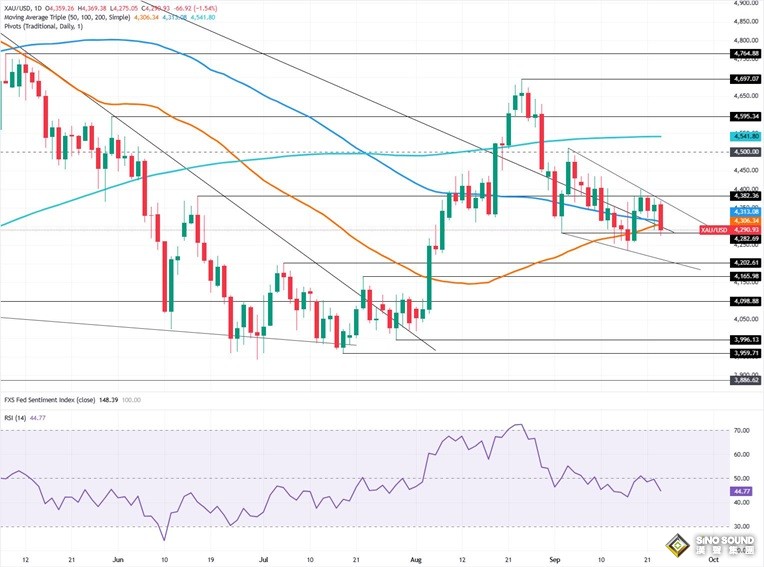
(Spot Gold Daily Chart Source: FXStreet)
Valencia added that on the upside, gold may break the upper trendline of the bullish wedge near $4365–$4370 per ounce and then test the $4400 per ounce level. Subsequent resistance levels are $4500 per ounce and the 200-day SMA at $4541 per ounce.