

Boosted by a strong rebound in US equities, falling crude oil prices and a slight pullback in US Treasury yields, spot gold and silver both weakened after US stock market close on Monday, with safe-haven demand cooling notably. Nevertheless, amid the still hawkish Federal Reserve rate expectations, the downside for precious metals was somewhat limited. #GoldMarketClose#
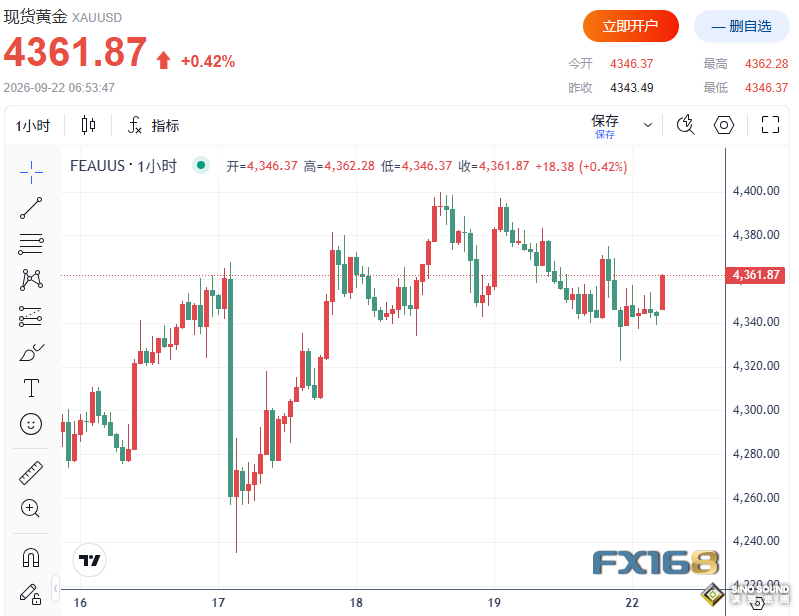
At the close of the US session, spot gold settled at $4,343.49 per ounce, down 0.78% on the day; spot silver was at $66.013 per ounce, a drop of 0.35%. Meanwhile, North American stock markets closed broadly higher. The S&P 500 rose 1.5% to 7,764.70 points, the Nasdaq Composite gained 2.3% to 27,122.09 points, the Dow Jones Industrial Average climbed 0.7% to 52,048.83 points, and the Russell 2000 edged up 0.5% to 2,875.36 points. European stock markets also strengthened: the STOXX Europe 600 rose 1.0%, Germany’s DAX gained 1.1%, the Euro Stoxx 50 rose 1.3%, France’s CAC 40 advanced 0.9%, and the UK FTSE 100 added 0.8%.
(Source: FX168)
Fed Policy Path Remains Hawkish
Current market pricing is still centered on the Fed’s 25-bASIs-point rate hike last week, yet the possibility of further tightening has not been fully ruled out. The Federal Open Market Committee (FOMC) raised the federal funds rate target range to 3.75%–4.00% on September 16, and the median forecast still points to 4.1% by year-end. August retail sales rose by 1.2%, and initial jobless claims dropped to 196,000. Traders are pricing in an 88% probability of another rate hike in December.

This set of data and expectations has put gold in a tug-of-war between two forces: on the one hand, falling oil prices ease inflationary pressure; on the other hand, the hawkish rate outlook weighs on non-interest-bearing assets. Although the 10-year US Treasury yield retreated to the 4.95%–4.96% range, it remains close to the psychological threshold of 5%, continuing to cap the upside of gold and silver.
Risk Premium from the Strait of Hormuz Fades
The Strait of Hormuz remains a pressure valve for markets rather than a fully resolved risk. As investors bet on a partial recovery of Saudi crude exports and watch for potential diplomatic channels during this week’s UN meetings, oil prices fell for the fourth consecutive trading day. Brent crude settled at $100.34 per barrel, down 3.4%; WTI crude closed at $95.78 per barrel, a decline of 4.5%.
Over the past six days, Saudi crude oil transported through the Strait of Hormuz averaged 2.9 million barrels per day, higher than the roughly 700,000 barrels per day in August. In the short run, falling oil prices support stock markets but are slightly bearish for gold, as part of the geopolitical risk premium has been unwound from crude oil, and demand for safe-haven capital in precious metals has weakened accordingly.
Long-Term Interest Rates Still Pose Structural Risks
Greater structural risks still stem from the US bond market. The 10-year US Treasury yield near 5% not only lifts the discount rate for stock valuations but also raises mortgage and corporate financing costs, making interest payments on federal debt a more visible macro constraint. Data from the US Treasury shows that as of April, federal debt held by the public stood at $31.3 trillion, roughly equivalent to the size of the US economy; net interest expenses in the 2025 fiscal year have exceeded defense spending.
With the deficit still large, every sustained rise in long-term interest rates will directly push up refinancing costs, intensify concerns over US Treasury supply, and exert real-rate pressure on non-yielding assets such as gold and silver.
Institutional Views and Technical Levels
Rania Gule, Market Analyst at XS.com, says the market is currently affected by "contradictory fundamental factors", a statement that aptly summarizes gold’s operating environment. She believes higher yields and Fed rate-hike pricing limit gold’s upward momentum, while geopolitical risks, central bank demand and fiscal concerns still underpin long-term buying interest.
From a technical perspective, the next target for spot gold bulls is to reclaim the resistance zone of $4,400.00–$4,407.27. A sustained breakout would open further targets at $4,443.00 and $4,475.00. The near-term target for bears is a break below $4,334.00, with subsequent downside targets at $4,304.00 and $4,261.00. The first resistance lies at $4,370.78, followed by $4,407.27; the first support is $4,341.90, then $4,334.00.
For silver, bulls’ next goal is to retake the $66.318–$67.275 zone. A breakout above this range would target $71.18 and $73.14. If bears push prices below $65.26, further downside targets are $63.14 and $62.31. The first resistance level is $66.318, followed by $67.275; the next support level is $65.299, then $65.260.
In external markets, Nymex WTI crude oil hovers around $95.78 per barrel, Brent crude near $100.34, the US Dollar Index strengthens, and the benchmark 10-year US Treasury yield lingers near the 5.0% mark. Markets will continue to monitor the combined impact of US Treasury yields, oil prices and subsequent Fed policy signals on precious metals.