

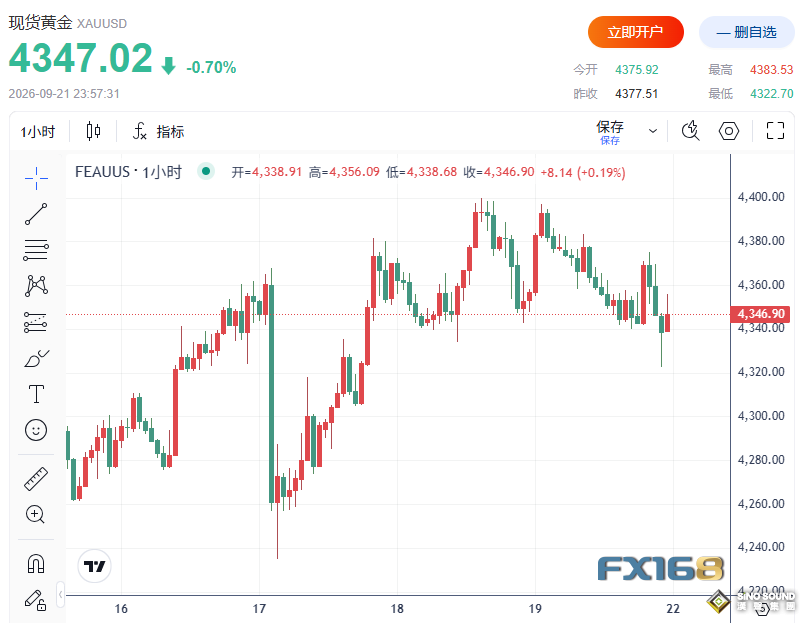
During early US trading hours on Monday, spot gold fluctuated at high levels while spot silver remained relatively firm. Supported by peRSIstently high US Treasury yields and a stronger US dollar, part of gold's safe-haven buying was offset. Nevertheless, rising tensions between the US and Iran and restricted passage through the Strait of Hormuz still underpin precious metals. As of press time, spot gold stood at $4347.02 per ounce, down 0.7% on the day, rebounding slightly from the intraday low of $4322.70 hit earlier; spot silver traded at $66.102, a drop of 0.2% for the session.
(Source: FX168)
Naeem Aslam, Chief Investment Officer of Zaye Capital Markets, believes gold is caught between two opposing forces: eASIng US-China trade risks on one hand, and peRSIstent geopolitical pressures related to sanctions and security negotiations involving Iran and Russia on the other. He notes that safe-haven demand for gold remains in place, yet higher yields are still the main factor preventing gold from a clear breakout above recent highs.
For silver, Aslam states that silver sits at the intersection of monetary policy and industrial demand. China’s one-year and five-year Loan Prime Rates (LPR) were kept unchanged at 3.00% and 3.50% respectively, stabilizing expectations for industrial demand without shifting sentiment firmly bullish.
Coexistence of Safe-Haven Demand and Interest Rate Games

A set of economic data released last Friday provided some fundamental support for precious metals, but did not alter market expectations of policy constraints from the Federal Reserve. Recent data points to slowing industrial momentum and weak forward demand signals, though not enough to override the Fed’s inflation concerns. Austan Goolsbee, President of the Chicago Fed, said early Monday that supply shocks may force a painful trade-off between employment and inflation. This keeps rate markets focused on whether oil prices, services inflation and AI-related demand will extend the tightening cycle.
In terms of market positioning, overall sentiment remains defensive but is no longer one-sided as it was earlier this month. The latest CFTC positioning data shows that managed money accounts held 133,116 net long COMEX gold futures contracts, a decrease of 1,856 contracts from the previous week; silver net longs stood at 13,124 contracts. In other words, gold remains more crowded on the long side than silver. Despite weak US industrial output and leading indicator data last Friday, market reactions were dominated mainly by Fed repricing rather than growth fears. The FOMC raised the federal funds rate target range by 25 bASIs points to 3.75%-4.00% last week. Interest rate futures are still pricing in roughly a 53% probability of another rate hike in October, keeping short-end yields firm, supporting the US dollar and limiting gold from staging a clean breakout on weak growth data.
Risks in the Strait of Hormuz Remain Unresolved
The Strait of Hormuz continues to be the core source of geopolitical risk premium for gold, crude oil and tanker markets. The number of traceable commodity vessels transiting the strait over the weekend fell to 17, down from 37 a week earlier. However, as some Middle East export vessels turned off their transponders, cargo flows did not halt entirely. In short, the situation is not a full blockade, but it is far from returning to normal.
With shipping conditions improving and diplomatic channels around the UN General Assembly still functioning, oil prices retreated in early Monday trading. Brent crude traded near $101.94 per barrel and WTI crude around $98.27 per barrel. Falling oil prices help ease immediate inflation shocks and reduce upward pressure on yields, yet shipping risks linger, meaning gold still finds support on pullbacks, and energy-linked inflation expectations remain under watch.
Pressure in the US Treasury Market Continues to Build
The US bond market remains the current pressure point for markets. The 10-year US Treasury yield hovers near 5%, close to highs last seen in 2007, and this trend is no longer just a story about Fed policy. Total US public debt stands at approximately $40.05 trillion. The latest baseline projections from the Congressional Budget Office (CBO) show that debt held by the public as a share of GDP will rise from 101% in 2026 to 120% in 2036, while net interest costs will climb from 3.3% to 4.6% of GDP over the same period.
For gold, this sends dual signals: on the one hand, concerns over fiscal sustainability create a structural case in favor of hard assets; on the other hand, in actual trading, tighter financial conditions, higher real yield competition and rising holding thresholds for non-interest-bearing assets will cap gold’s upside.
In external markets, Nymex WTI crude trades around $98.27 per barrel, Brent crude near $101.94 per barrel, the US Dollar Index strengthens, and the benchmark 10-year US Treasury yield is close to the 5.0% zone.
Technical Outlook: Clear Key Levels for Gold and Silver
Technically, the next target for spot gold bulls is to reclaim the resistance zone of $4407.27 to $4530. A sustained breakout would open the way toward $4800, and further up to the $5000 area. On the bearish side, a break below $4341.90 would target $4300 next, then $4150. The primary resistance sits at $4407.27, followed by $4530; primary support is $4341.90, then $4300.
For spot silver, bulls’ next objective is to retake the zone from $67.2747 to $67.80. A breakout above this range would target $72.00 and the prior breakout level at $72.00. If bears push prices below $65.2992, further downside targets are $63.00 and $60.00. The first resistance level is $67.2747, followed by $67.80; the next support level is $65.2992, then $63.00.