

Late in Monday’s US trading session, amid renewed military tensions between the United States and Iran, soaring oil prices and heightened Federal Reserve rate‑hike expectations, spot gold and silver moved in divergent directions. Gold edged lower while silver staged a modest rebound. Meanwhile, North American and European equities closed broadly lower, with risk‑taking sentiment clearly dampened. #GoldMarketWrapUp#
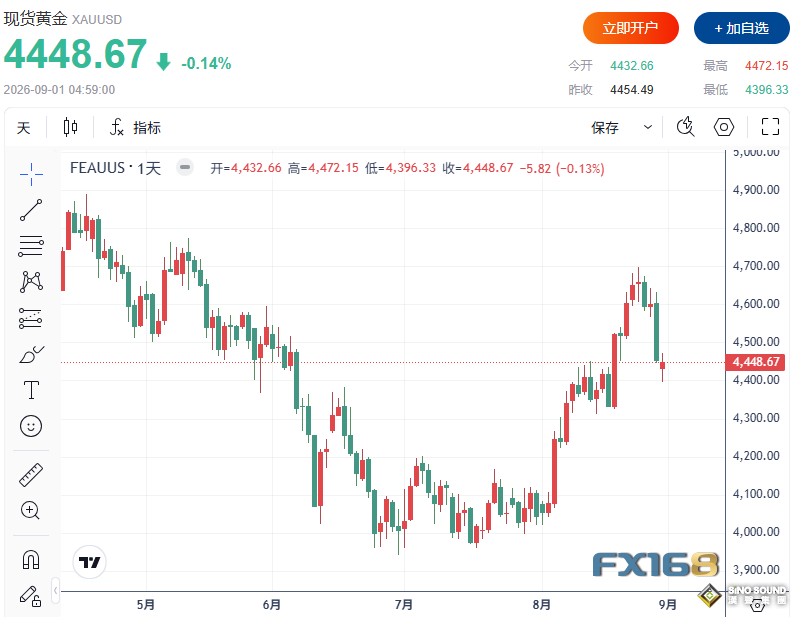
At US market close, spot gold settled at $4,448.67 per ounce, down 0.14%.
(Image Source: FX168)
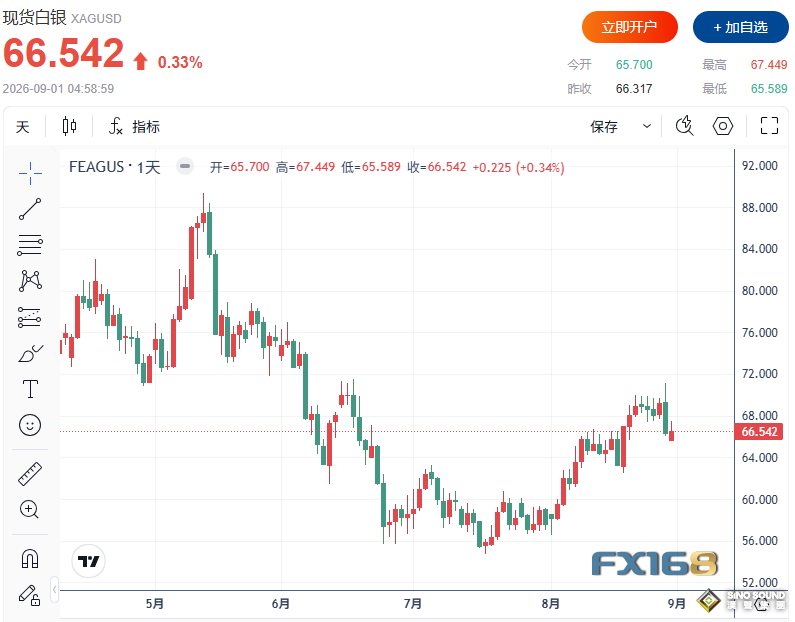
Spot silver closed at $66.542 per ounce, gaining 0.3% on the day.
(Image Source: FX168)
Market participants noted that precious metals were already under pressure following Friday’s hawkish Federal Reserve rhetoric. Monday’s renewed oil price rally further lifted inflation expectations and pushed up long‑dated US Treasury yields, limiting rebound potential for non‑yielding assets.

Oil Prices and Yields Weigh on Precious Metals
US equities finished lower on Monday. The S&P 500 fell 25.62 points, or 0.3%, to 7,686.14. The Dow Jones Industrial Average dropped 374.09 points, or 0.7%, to 53,185.90. The Nasdaq Composite lost 31.53 points, or 0.1%, to 26,370.89. The Russell 2000 declined 15.92 points, or 0.5%, to 2,956.45.
European markets also closed in negative territory. The STOXX Europe 600 fell 0.62% to 651.10. Germany’s DAX lost 1.17% to 26,258.11. France’s CAC 40 dropped 0.79% to 8,334.50. Italy’s FTSE MIB edged down 0.01% to 52,612.69. London markets were closed for a bank holiday.
In fixed‑income markets, the 2‑year Treasury yield held near 4.34%, the 10‑year yield rose to 4.75%, and the 30‑year yield stayed close to 5.25%. The US Dollar Index also traded firm. Markets widely agree that the combination of higher oil prices and rising yields is sapping near‑term appeal for gold and silver.
September Rate‑Hike Probability Rises to 66.1%
Current market pricing is driven largely by interest‑rate repricing after Jackson Hole and this week’s labour‑market data calendar. Federal funds futures show traders have raised the probability of a September Fed rate hike to 66.1%, up from 57% last Friday. Investors view Fed Chair Kevin Warsh’s hawkish speech together with Monday’s oil‑price shock as jointly reinforcing inflation pressure and monetary‑tightening expectations.
Ahead, markets will closely monitor Tuesday’s JOLTS job openings and ISM Manufacturing figures, Wednesday’s ADP employment report and Beige Book, Thursday’s initial jobless claims and ISM Services release, plus Friday’s August non‑farm payrolls report. Analysts note that amid rising rate‑hike expectations and peRSIstently high yields, gold remains defensively positioned in the short run. Even so, safe‑haven buying stemming from geopolitical and fiscal risks has so far prevented sharp further losses below last Friday’s lows.
Gold and Silver Technicals Remain Weak
Technically, precious metals found some late‑session stability yet failed to repair the technical damage inflicted last Friday. Spot gold held above its intraday low of $4,395.80 and rebounded toward the $4,452‑$4,487 resistance zone, though it remains below short‑term moving averages and the 61.8% FibonaCCI retracement level cited in recent technical studies.
Spot silver bounced from $65.51 and peaked near $67.60 intraday, yet stayed beneath the short‑term 50% retracement level at $66.87 and well below last Friday’s reversal high of $71.18. The late rebound shows dip‑buying interest peRSIsts, but the combination of interest‑rate and oil‑price dynamics keeps selling momentum dominant in the near term.
Strait of Hormuz Stands as Key Variable
The Strait of Hormuz remains the core geopolitical channel shaping oil prices, inflation expectations and safe‑haven demand. Over the weekend, US forces struck Iranian rocket launchers near the strait, marking Washington’s first military action in roughly one month. Iran retaliated with missile strikes targeting US military assets in Jordan. Markets have therefore reassessed supply risks for the waterway carrying around 20% of global oil trade, sending crude sharply higher.
Brent crude closed back above $90 per barrel, while US crude traded in the mid‑$80 range. For gold, this creates dual forces: on one hand, escalating Middle‑East tensions underpin safe‑haven demand; on the other, higher oil prices stoke inflation fears, raise odds of additional Fed tightening and keep Treasury yields elevated, thereby weighing on bullion.
Key Technical Levels
Technically, the next bullish objective for spot gold is reclaiming the $4,487.00 resistance. A sustained break above that opens targets at $4,515.00 and $4,543.00. On the bearish side, a break below $4,396.00 could trigger further declines toward $4,341.00 and $4,319.60. First resistance sits at $4,452.00, followed by $4,487.00. First support lies at $4,396.00, then $4,341.00.
For spot silver, bulls aim to retake $66.87. A break above this level would open $67.47 and $68.16. If bears push price below $65.67, further downside toward $62.98 and $62.45 may unfold. Immediate resistance: $66.87, then $67.47. Next support: $65.67, then $62.98.
Overall, with oil prices, yields and the US dollar all firm, precious metals face near‑term headwinds. Still, geopolitical risks have not faded, and gold’s safe‑haven character caps downside scope for the time being.