

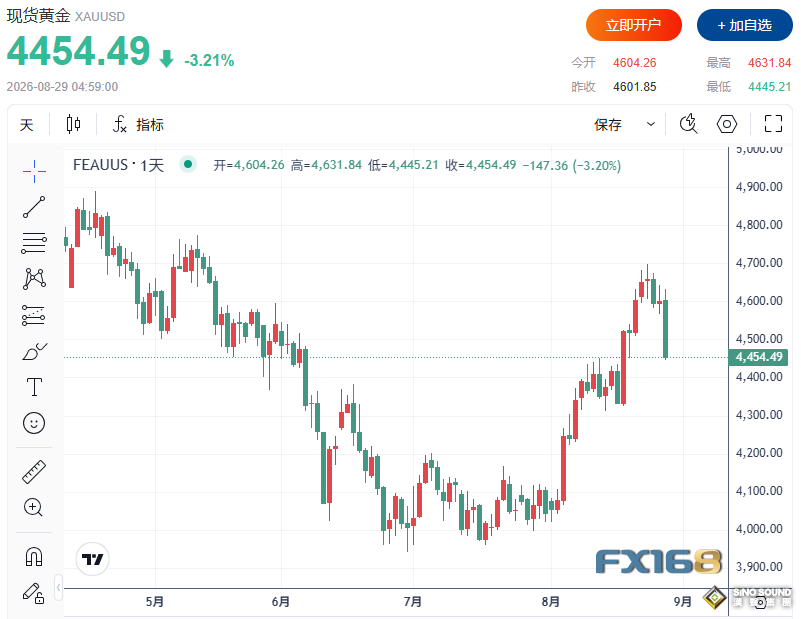
The gold market witnessed a dramatic reversal this week. Driven by US dollar movements, US fiscal concerns and the Treasury’s bond‑buyback programme, spot gold surged as high as $4697.66 per ounce earlier in the week. However, after Federal Reserve Chair Kevin Warsh delivered hawkish signals at the Jackson Hole Global Central Bank Symposium, markets rapidly repriced rate‑hike odds. Gold suffered heavy selling pressure on Friday and dropped to an intraday low of $4445.21 per ounce, nearly erASIng its earlier gains. Spot gold closed at $4454.39 per ounce, down $147.36 on the day and $148.84 for the week.
(Source: FX168)
Meanwhile, market expectations for Fed rate hikes in September and December rose markedly. A stronger US dollar and climbing short‑term Treasury yields further weighed on non‑yielding assets such as gold. Warsh’s speech reinforced the Fed’s anti‑inflation stance and reignited market bets on a September rate increase.
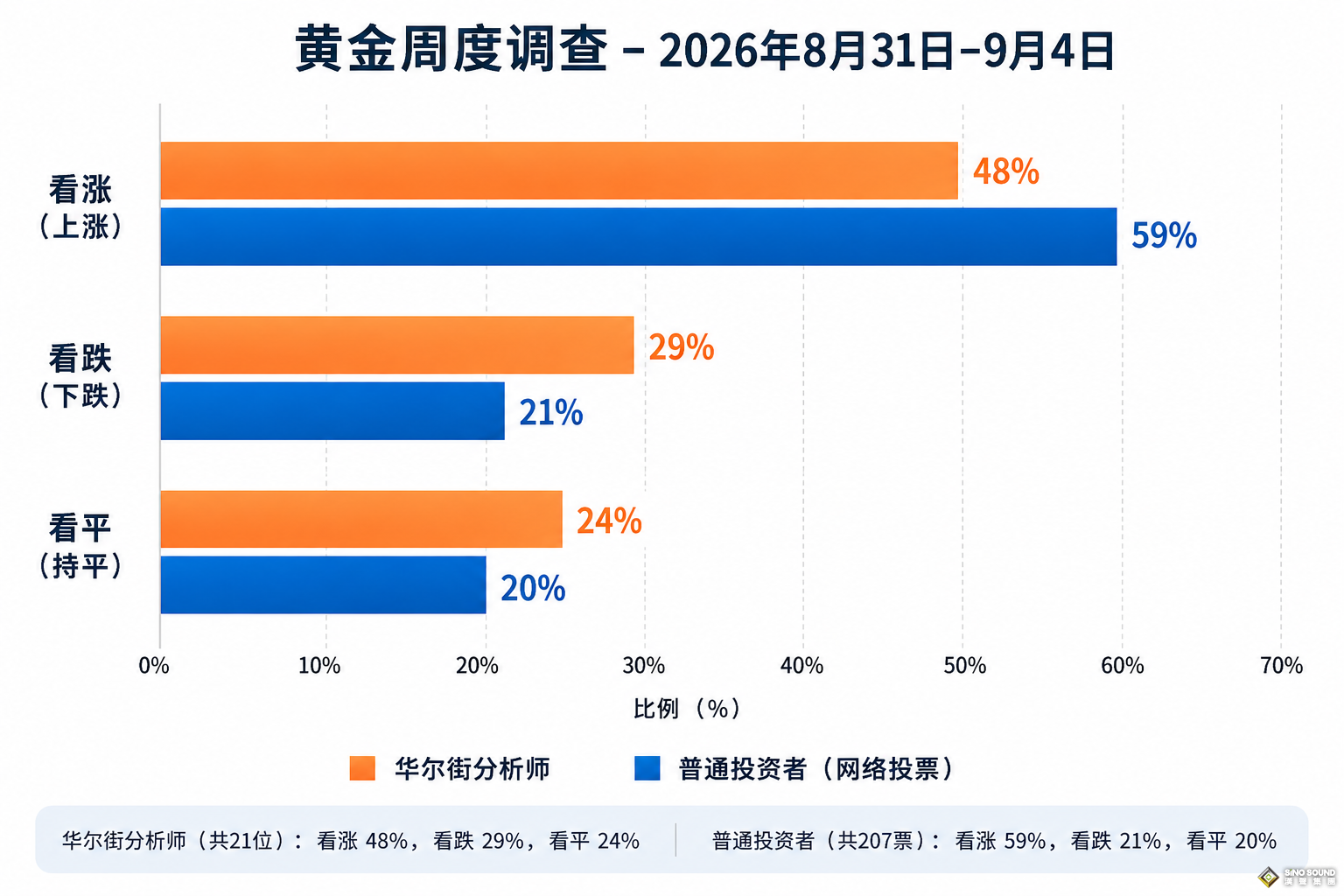
Still, Wall Street has not turned fully bearish following gold’s sharp slump. The latest Kitco News gold survey shows nearly half of professional analysts expect gold to rebound next week, while bullish sentiment among retail investors stands close to 60%.

Gold’s Sharp Reversal From $4697
Gold extended its powerful rally at the start of this week.
Spot gold opened at $4618.79 per ounce on Sunday evening. Entering Monday, traders continued to digest the US Treasury’s previously announced bond‑buyback plan and assessed its impact on long‑term Treasury yields, US debt sustainability and demand for hard assets, drawing additional buying interest for gold.
On Tuesday, amid weaker US consumer‑confidence data and position adjustments ahead of inflation and growth releases, gold kept climbing and hit a weekly peak of $4697.66 per ounce.
Bullish momentum faded notably starting Wednesday.
Core PCE inflation and US Q2 GDP data did not materially alter perceptions of the US economy: activity remains resilient while inflation pressures stay elevated. As Treasury yields advanced, gold fell back below $4600 and investors reduced risk exposure ahead of the Jackson Hole address.
On Thursday, mounting Fed rate‑hike bets lifted the dollar and short‑dated Treasury yields, putting notable pressure on non‑interest‑bearing assets including gold.
Spot gold dipped to $4566.17 per ounce at one point before rebounding quickly toward $4631.98 early Friday.
Warsh’s Jackson Hole speech was the catalyst that reversed market direction.
Warsh Turns Hawkish, Gold Breaks Below $4500
Warsh’s hawkish comments swiftly shifted market sentiment.
Gold’s losses widened within hours after the speech. Spot gold dropped to a weekly low of $4445.45 per ounce before 3 p.m. ET on Friday, recovered only modestly, and finished near $4455.
Adam Button, Head of FX Strategy at investingLive, believes Warsh effectively signalled to markets that a September rate hike is on the table.
He notes that markets have priced in roughly 50% odds for a September hike, yet probabilities normally need to climb above 80% if the Fed is genuinely set to act.
Marc Chandler, Managing Director at Bannockburn Global Forex, observed that gold was already showing fading upside momentum near $4697 even before Warsh’s speech.
He expects further dollar strength ahead of next week’s US employment report. He previously watched the key level near $4555 and argued a break there could send gold toward the $4500‑$4527 zone.
Following gold’s sharp post‑speech sell‑off, Chandler cut his near‑term targets and pointed to $4440 next, with a possible test down to $4360.
48% of Wall Street Analysts Remain Bullish
Despite Friday’s heavy rout among gold, professional investors are not uniformly bearish.
Twenty‑one analysts took part in this week’s Kitco News gold survey: 10 respondents (48%) look for higher gold prices next week; 6 (29%) see further declines; and 5 (24%) expect consolidation around current lower levels or balanced bull‑bear forces.
Retail‑investor sentiment remains more optimistic.
Kitco’s online poll received 207 votes: 121 participants (59%) forecast gold gains next week; 44 (21%) expect further weakness; the remaining 42 (20%) call for sideways range‑bound trading.
Even so, Main‑Street bullish sentiment has cooled compared with recent highs.
“Just a Healthy Correction”? Bulls Are Not Throwing in the Towel
James Stanley, Senior Market Strategist at Forex.com, characterises the move as a healthy correction triggered by Warsh’s speech rather than a reversal of gold’s long‑term trend.
Stanley points out that massive US fiscal deficits and rising government borrowing remain intact, forming important long‑term bullish underpinnings for gold.
In his view, Warsh’s remarks may aim to contain rising Treasury yields, yet he does not anticipate peRSIstently extreme hawkish policy from the Fed over longer horizons and therefore stays bullish on gold.
Rich Checkan, President and Chief Operating Officer of Asset Strategies International, also maintains a bullish stance.
He notes US federal debt stands at roughly $40 trillion. Both the Fed and the US Treasury have incentives to prevent excessive spikes in interest rates and Treasury yields, and such policy choices may keep inflation pressures alive over the long run.
Checkan says gold is still set to move higher long‑term; the current pullback should be viewed as a short‑term correction and may present better buying opportunities.
Adrian Day, President of Adrian Day Asset Management, comments that following gold’s largest monthly advance since 1999, the market was due for a pause, and Warsh’s Jackson Hole speech simply gave investors a reason to take profits.
He believes this adjustment will likely prove temporary.
Day points out that huge global fiscal deficits, high debt‑servicing costs and sticky inflation place central banks in a dilemma: heavy debt limits scope for further rate hikes while peRSIstent inflation demands tighter monetary policy. Against this backdrop, gold retains long‑term appeal.
Rate‑Hike Expectations Remain the Primary Headwind
Daniel Pavilonis, Senior Commodities Broker at StoneX Group, attributes Friday’s precious‑metals decline to a combination of economic data and Warsh’s hawkish rhetoric.
He states that higher interest rates and a stronger US dollar will pressure commodities across the board. In particular, sharply elevated odds for a September hike and even larger upward shifts in December‑hike expectations represent unwelcome signals for gold.
Pavilonis nonetheless emphASIses that the overall US economy is not deteriorating and inflation is not spiralling out of control. Markets in coming weeks must assess whether Fed hawkish talk is merely expectation management or signals genuine additional tightening.
Precious metals could regain support should inflation pressures ease alongside improvements on fronts such as Iranian tensions and oil supply.
The $4400 Defence Battle Begins
Technical conditions have also entered a critical phase.
Fawad Razaqzada, Market Analyst at Forex.com, notes gold has broken the previously‑watched $4655 key zone and is now testing its near‑term uptrend.
He identifies the next major support near $4436, followed by $4400. Failure to see buying interest emerge at those levels would tilt gold’s technical structure further bearish.
This means that after the rapid drop from $4697 to $4445, the $4400 area may become one of next week’s fiercest bull‑bear battlegrounds.
Sean Lusk, Co‑Director of Commercial Hedging at Walsh Trading, points out gold was still advancing ahead of Warsh’s speech before nearly giving back all its gains, while US equities did not see comparable negative reactions.
He reads Warsh’s remarks as effectively putting rate hikes onto the policy path, with a possible 25‑bASIs‑point increase that markets are gradually pricing in.
Lusk cautions investors not to fixate solely on interest rates. Trade policy, tariffs, employment prints and US political developments can all alter gold’s trajectory in the months ahead.
From a seasonal perspective, he observes gold typically shows strength around early‑September, then corrects, potentially moving higher again in October. Demand tied to India’s Diwali festival and year‑end buying can offer support in November. Still, US mid‑term elections and latent political risks may disrupt traditional seasonal patterns.
Washout or Trend Reversal?
Alex Kuptsikevich, Senior Market Analyst at FxPro, holds a more optimistic outlook for gold.
He views the pullback after gold’s powerful rally as a normal technical consolidation, noting visible dip‑buying emerged near $4600 during earlier retracements.
Other precious metals retained solid performance meanwhile: palladium rose roughly 7% on Friday, and silver gained 2.5% for the week after breaking above $70 to hit its highest level since June.
For Kuptsikevich, this suggests broader precious‑metals risk appetite remains intact. Gold’s recent wild volatility is more likely a local washout rather than a reversal of the long‑term trend.
He adds that gold’s prior rally originated from a classic 61.8% FibonaCCI retracement zone and featured robust rebounds. The current round of profit‑taking eases near‑term overbought conditions and clears space for future price action.
Next Week’s Biggest Test: US Non‑Farm Payrolls
In the wake of volatility unleashed by Warsh’s speech, market focus will quickly shift toward the US labour market.
On Tuesday, the US releases August ISM Manufacturing PMI and JOLTS job‑openings data; the Reserve Bank of New Zealand announces its monetary‑policy decision.
Wednesday brings US ADP private‑sector employment figures and the Bank of Canada’s latest rate announcement.
Thursday sees US initial jobless‑claims numbers and ISM Services PMI.
Friday delivers the main event: the US August non‑farm payrolls report. Traders will closely watch whether this key jobs indicator misses market consensus for a fourth consecutive month.
For gold, this employment report can directly drive repricing of September rate‑hike probabilities.
Strong jobs data would reinforce market conviction in Warsh’s hawkish stance, potentially lifting the dollar and Treasury yields and testing gold at $4400 or lower levels.
Noticeably softer employment readings, by contrast, could cast doubt on the need for further Fed tightening and open the door for a sharp gold rebound following this week’s steep drop.
Gold bulls and bears now stand at a fresh crossroads.
On one side lie Warsh’s hawkish signals, revived rate‑hike expectations and a strong US dollar. On the other side sit massive US fiscal deficits, government debt and lingering long‑term inflation risks.
Gold staged a $250‑plus reversal within days, falling from $4697 down to $4445.
Whether the $4436 and $4400 support zones hold, and whether next week’s US jobs numbers further bolster rate‑hike expectations, will likely determine the direction of gold’s next major breakout move.