

Reuters reported on Friday (August 28) that Mohsen Rezaei, Secretary of Iran’s Supreme National Security Council, stated that following mediators’ request for Tehran to put forward specific requirements, Iran is drawing up a list of conditions for reopening the Strait of Hormuz, which includes ending regional wars.
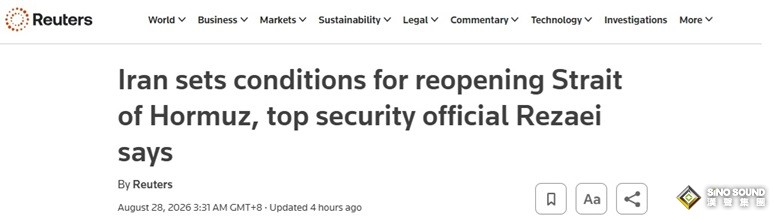
(Screenshot source: Reuters)
Rezaei noted that Iran and Oman have reached an agreement on setting up a shipping corridor through the Strait of Hormuz. Part of the shipping route lies within Omani waters and part within Iranian waters.
In an interview with Al Manar TV, a television outlet affiliated with Lebanon’s HezBOLLah, he said vessels will be allowed to sail through the designated central waterway if the United States meets Iran’s conditions.
A senior source said on Wednesday that Iran and Oman are still negotiating specific details for this waterway agreement. Earlier, the Islamic Revolutionary Guard Corps of Iran stated that the two countries had reached consensus regarding the allocation of control and related benefits over the Strait of Hormuz.

A spokesperson for the Islamic Revolutionary Guard Corps stated Iran will not consent to the reopening of the Strait of Hormuz unless Washington lifts what it calls “the blockade against Iranian ports”, pays compensation and cancels sanctions.
Prior to the outbreak of regional warfare in February this year, the Strait of Hormuz handled roughly one‑fifth of global oil and liquefied natural gas shipments. Shipping activity along this waterway has dropped sharply since the conflict erupted.
The United States and Iran separately announced cease‑fire deals in April and June, which were originally intended to restore maritime transportation, yet neither arrangement proved durable.
The prospect of reopening the Strait of Hormuz is no longer merely a shipping‑related issue; it has become a core bargaining chip in Middle‑East geopolitical games.
As one of the world’s most critical energy‑transport chokepoints, any prolonged closure or restricted passage may exert direct impacts on international crude‑oil prices, energy supplies and global inflation expectations. If markets perceive mounting risks surrounding the strait, crude‑oil prices may swing violently once again.
Judging from Iran’s newly‑proposed terms, Tehran is not merely seeking the resumption of shipping. Instead, it attempts to secure greater political and economic gains in exchange for opening the strait. Demands including ending regional wars, lifting sanctions and obtaining compensation touch multiple dimensions covering security guarantees, economic recovery and the reshaping of international relations. This means the Strait of Hormuz will likely serve as a vital bargaining lever for future US‑Iran negotiations.
Nevertheless, huge uncertainties peRSIst over whether the agreement can actually materialise. Whether the United States is prepared to accept Iran’s terms, especially concessions over sanctions and compensation, will directly shape negotiation trajectories. In addition, stances held by hard‑line factions inside Iran and regional allies may also affect final implementation outcomes.
Should stable navigation resume in the Strait of Hormuz, energy‑market jitters may ease in the short‑term and weigh on oil prices. Should negotiations collapse, markets may reprice Middle‑East risk premiums, and safe‑haven assets such as crude oil and gold may draw capital inflows once more.