

Gold has continued trading at elevated levels lately, supported by a mix of macro‑market factors. A weaker U.S. Dollar Index lowers holding costs for non‑dollar gold investors, falling U.S. Treasury yields reduce the opportunity cost of holding non‑yielding gold, while worries over U.S. fiscal deficits and debt sustainability keep boosting demand for gold as a long‑term store of value.
That said, the market dynamics driving gold higher are shifting. Citi points out that the recent breakout has been largely fueled by speculative futures capital, with physical demand failing to keep full pace. This means gold’s “financial attribute” has grown markedly, and prices have become more sensitive to shifts in the U.S. dollar, real interest rates and policy expectations.

From a trading‑structure perspective, speculative capital displays clear pro‑cyclical traits. When prices break key technical resistance and establish an uptrend, trend‑following funds tend to add long positions and magnify price gains. Yet once core market narratives shift, these same funds can unwind positions rapidly and trigger sharp short‑term corrections in gold.
Compared with traditional safe‑haven assets, gold now shows pronounced high‑beta macro sensitivity. Previously, market participants mostly gauged gold’s direction from geopolitical risk and risk‑off sentiment. Today the trading framework has expanded to include U.S.‑dollar moves, real yields, fiscal risks and Fed policy expectations, with the U.S. Treasury market acting as one of the most vital transmission channels. Recent declines in long‑dated U.S. Treasury yields have created a more favorable rate backdrop for gold. Should long‑end yields keep falling, gold’s opportunity cost will shrink further, while long‑run concerns over fiscal deficits and debt levels may push investors toward higher gold allocations.
Falling bond yields do not guarantee sustained gold rallies, however. If lower yields stem from deteriorating growth expectations rather than dovish monetary‑policy shifts, overall risk appetite may deteriorate alongside them. While safe‑haven buying will peRSIst for gold, bullish and bearish forces could offset each other. Markets are now fixated on the Jackson Hole Global Central Bank Symposium. Federal Reserve Chair Kevin Warsh’s speech will serve as a critical signal for the future monetary‑policy path. Should his remarks emphASIze lingering inflation risks and hint at higher‑for‑longer rates, U.S. real yields and the dollar could rebound, putting heavy profit‑taking pressure on gold’s large accumulated speculative long positions.
Conversely, dovish signals from the Fed could push market rate expectations lower, weighing on Treasury yields and the U.S. dollar. Under that scenario, gold may regain upward momentum and advance into higher price territory. Accordingly, Jackson Hole will not merely set gold’s directional bias; it may directly determine whether speculative funds keep chASIng gains or exit en masse. This largely explains the sharp rise in gold volatility of late.
From a medium‑term fundamental standpoint, gold retains solid underpinnings. PeRSIstent central‑bank gold‑reserve accumulation, widening fiscal deficits and investor anxiety over sovereign‑debt risk are lifting gold’s appeal as a non‑sovereign asset. Meanwhile, high uncertainty across global financial markets means gold’s safe‑haven function remains intact.
Still, positive medium‑term fundamentals do not rule out short‑term corrective risk. Gold carries strong upward momentum. Rapid repricing of Fed policy expectations or simultaneous rebounds in the dollar and real yields could trigger mass unwinding of speculative positions and powerful negative price feedback. The more gold relies on financial‑market flows, the more prone it becomes to the pattern of “fast advances, fast pullbacks”.
The ability of physical demand to keep up also warrants close monitoring. Sustained high gold prices may dampen jewelry consumption and real‑market buying due to price sensitivity. Investors need to distinguish between finance‑driven rallies and genuine end‑user absorption. Durable upside at current highs requires stable combined support from speculative flows, central‑bank purchases and physical demand.
Within global asset‑allocation frameworks, gold has become a key pricing instrument reflecting shifts in the dollar system, real interest rates and fiscal risk. A weaker dollar, falling real yields and rising fiscal risk all tend to benefit gold. When all three variables move favorably in tandem, gold often generates strong trend opportunities.
By contrast, renewed hawkish Fed expectations, a sharp jump in U.S. real yields and a stabilizing‑to‑rebounding U.S. Dollar Index would create triple headwinds for gold. Under those conditions, even lingering geopolitical risk may not fully offset short‑term selling pressure from fleeing financial capital.
Therefore, the critical question for gold markets is not simply “will it rise or fall”, but whether the capital structure behind the rally is changing. If speculative positioning keeps expanding while the dollar and real yields stay soft, gold’s bull run can extend. If policy expectations reverse, crowded long positions at high levels will amplify rapid price drawdowns.
On the daily chart, gold remains in a clear uptrend, holding above key medium‑term moving averages and the middle BOLLinger Band, with the post‑breakout bullish structure still intact. Even so, as prices hover near highs, short‑term momentum has intensified and technical indicators have moved into overbought territory, raising the risks of chASIng strength. Initial resistance sits in the $4670‑$4700 zone. A decisive close above $4700 would open a test toward $4725 and then $4750. Failed upside attempts will invite increased high‑level profit taking.
Immediate support lies near $4600, followed by $4580 and $4550. Sustained hold above $4550 keeps the medium‑term bullish setup largely intact. A sharp break below $4550 signals fading upward momentum and may trigger a move toward $4500 for support.
On the 4‑hour timeframe, gold maintains an upward‑sloping consolidation pattern but is now in a strong high‑level sideways phase. Should dips toward $4620‑$4600 attract buying interest, bulls may retest $4670‑$4700. Valid breakout confirmation above $4700 would unlock further upside. On the downside, a break beneath $4600 could extend the short‑term correction toward $4550. The 4‑hour pivotal zone spans $4600‑$4700; the breakout direction will define the next short‑term trend.
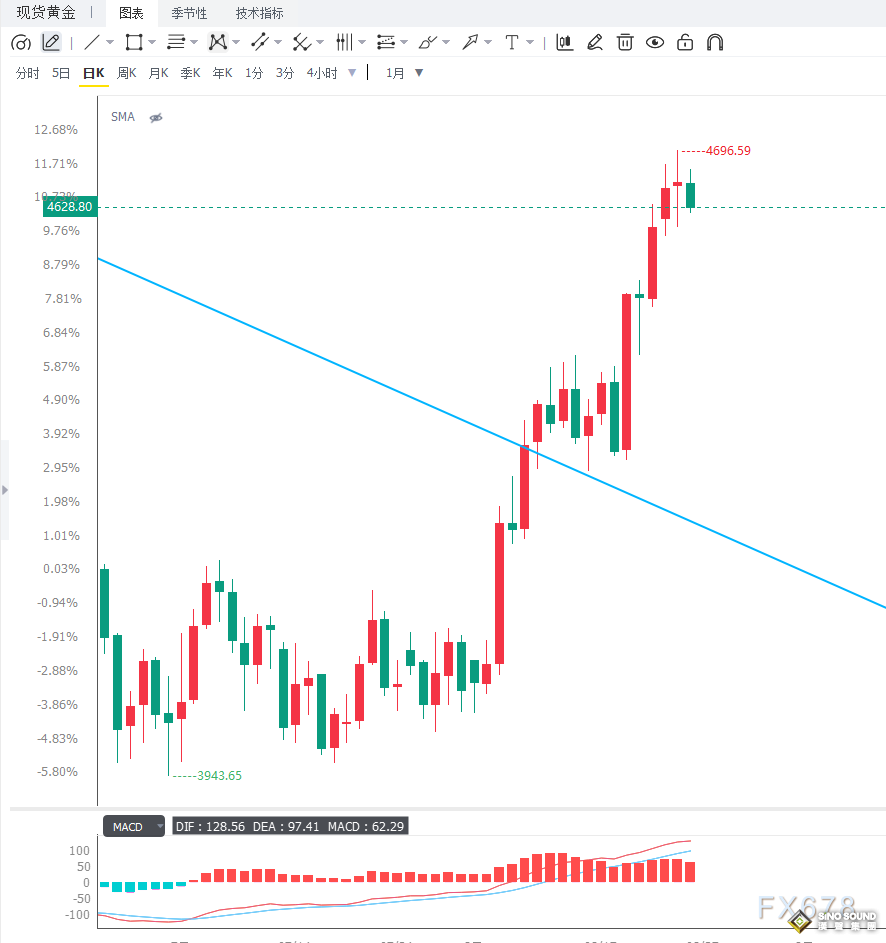
Gold still enjoys robust medium‑to‑long‑term fundamental support built on dollar weakness, lower Treasury yields, fiscal risk and central‑bank buying. Unlike past safe‑haven‑driven episodes, the current rally leans heavily on futures‑based financial capital, and rising speculative positioning points toward heightened market volatility.
In the near term, the Jackson Hole symposium represents a major policy test for gold bulls. Dovish Fed rhetoric could push the dollar and real yields lower and clear the path for gold to break higher. Hawkish commentary, by contrast, may spark rebounds in the dollar and yields and trigger widespread speculative profit taking.
To sum up, gold’s medium‑term bullish thesis remains intact, yet short‑term conditions are high‑volatility. Investors should track the U.S. Dollar Index, U.S. real interest rates, long‑end Treasury yields, central‑bank buying and futures‑market fund flows. So long as the dollar and real yields stay weak, gold retains upside potential. A simultaneous rebound in both, however, warrants caution against rapid pullbacks driven by crowded long positioning.