

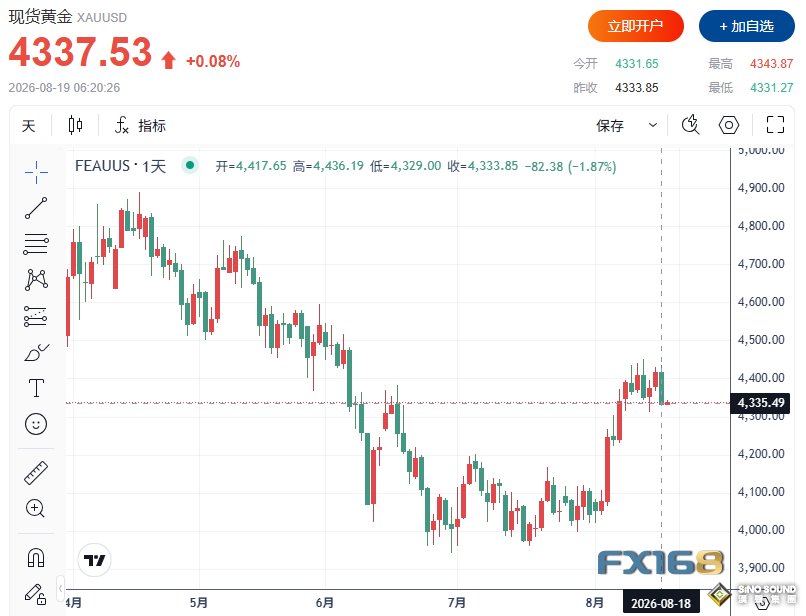
Spot gold and silver fell notably in late US trading on Tuesday. Sustained high global bond yields and renewed selling pressure on AI-related stocks offset support from a weaker US dollar and geopolitical risks around the Strait of Hormuz. At the close of US trading, spot gold settled at $4,333.85 per ounce, down $82.38 or 1.87%; spot silver closed at $63.311 per ounce, a drop of 3.74%. #GoldMarketClose#
(Source: FX168)
Risk Sentiment Dragged Lower by Falling Equities
North American equities ended Tuesday lower, led by declines in technology and semiconductor sectors. The S&P 500 fell 48.42 points, or 0.63%, to 7,696.64; the Dow Jones Industrial Average dropped 87.51 points, or 0.16%, to 53,372.27; the Nasdaq Composite lost 355.20 points, or 1.33%, to 26,289.72.

European markets also weakened. The STOXX Europe 600 fell 0.69% to 651.90; Germany’s DAX declined 0.80% to 26,128.36; France’s CAC 40 dropped 0.82% to 8,509.36; Italy’s FTSE MIB fell 1.06% to 53,017.84. The UK FTSE 100 bucked the trend and edged up 0.07% to 10,728.04.
Rate Expectations Remain the Core Driver
Markets continue to swing between soft US economic data and the “higher-for-longer” rate narrative. Weak US retail sales, muted CPI, flat PPI and falling consumer confidence last week reduced bets on a September Fed rate hike. However, Monday’s New York Fed Empire Manufacturing Survey showed improvements in activity and prices paid, reviving concerns that interest rates will stay elevated.
The US 10-year Treasury yield eased slightly to around 4.71% but remains well above pre-crisis levels, while the 30-year yield holds near highs last seen in 2007. Investors are focused on the Fed’s July meeting minutes due Wednesday at 2 p.m., Thursday’s initial jobless claims and Philadelphia Fed Manufacturing Index, plus Friday’s flash PMI readings, to gauge whether the Fed can keep rates on hold.
Risks Around the Strait of Hormuz Continue to Unfold
The Strait of Hormuz remains a key geopolitical chokepoint affecting oil prices, inflation expectations and safe-haven demand, though market reaction was mixed on Tuesday. Washington stated the strait remains open and operational, adding that maritime blockades remain effective and mines have been cleared or detonated.
Brent crude held near $91 per barrel. Traders are watching for a potential US-Iran deal to allow tankers to move freely through the PeRSIan Gulf again. For gold, the environment is two-sided: geopolitical tensions and a softer dollar support safe-haven buying, yet peRSIstently high crude prices keep inflation risks elevated and prevent a meaningful, sustained drop in US bond yields.
Cross-Market Linkages and Technical Levels
Across other markets, NYMEX WTI crude futures strengthened near $84.98 per barrel, while Brent traded close to $91.24. The benchmark 10-year US Treasury yield hovered around 4.7%, and the US Dollar Index weakened. The Kitco Global Index breaks down how much of gold’s price move stems from dollar fluctuations versus gold-specific factors.
From a technical perspective, the next bullish target for spot gold is reclaiming resistance at $4,448. A sustained break opens upside toward $4,518 and $4,596. Near-term bearish targets are a drop below $4,333, followed by $4,262 and $4,205. Immediate resistance sits at $4,448, then $4,518; immediate support is $4,333, then $4,262.
For spot silver, bulls need to push prices back above $66.78 to regain control, with further upside to $68.24 and $69.63. Bears target a break below $63.57, potentially opening a move to $62.20 and $61.50. Silver’s first resistance is $66.78, followed by $68.24; next support lies at $63.57, then $62.20.