

Wall Street’s bullish outlook on gold is cooling notably. Wells Fargo Investment Institute has recently lowered its 2026 gold target range to $4,900–$5,100 per ounce, down from the prior $5,300–$5,500 per ounce. Its 2027 target has also been revised down to $5,400–$5,600 per ounce, representing an overall $400 cut from previous estimates.
This marks the third revision to the bank’s gold price forecast in 2026. More notably, since its most bullish call in February, the midpoint of its 2026 gold target has fallen from $6,200 to $5,000 per ounce — a $1,200 reduction in just six months.
That said, Wells Fargo has not turned bearish on gold. Based on the updated target range and the spot price near $4,397 per ounce, the bank still expects upside potential of roughly 11% to 16% for the year. It has simply tempered expectations for a rapid rally.

Three Revisions in Six Months, the $6,200 Forecast Sharply Trimmed
Back in February, Wells Fargo lifted its 2026 gold target to $6,100–$6,300 per ounce. At that time, bullion traded around $4,961 per ounce, implying a potential gain of 23% to 27% by year-end.
The reasoning was clear then: markets expected the Federal Reserve to enter a rate-cut cycle, global central banks kept adding gold reserves, while geopolitical risks and reserve diveRSIfication offered long-term structural support.
Market conditions shifted significantly afterward. Gold hit a record peak near $5,594 per ounce in January before a sharp pullback. The Fed adopted a more hawkish stance, the US dollar strengthened, US Treasury yields stayed elevated, and central bank gold purchases slowed.
By June, Wells Fargo had cut its 2026 gold target to $5,300–$5,500 per ounce. The latest August revision to $4,900–$5,100 per ounce brings the midpoint down from $6,200 to $5,000.
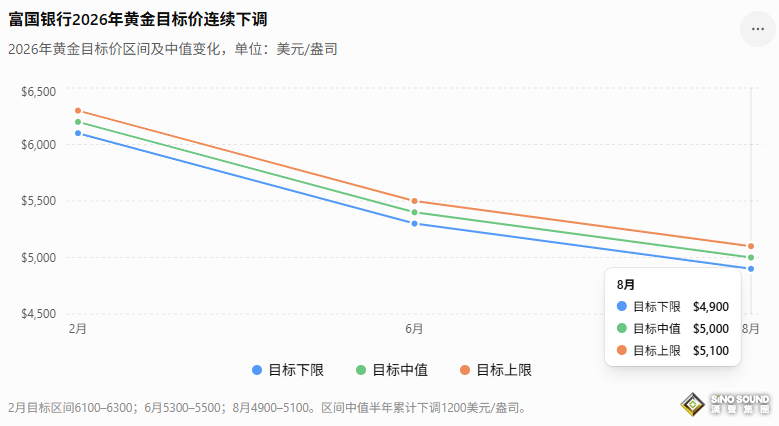
(Source: FX168)
The target adjustments show Wells Fargo has not changed its view that gold will rise over the long run, yet it keeps lowering expectations for the pace and magnitude of gains.
High Interest Rates Become Gold’s Biggest Headwind
The core pressure weighing on gold remains peRSIstently elevated US Treasury yields.
As of August 18, spot gold traded near $4,397 per ounce. Rising long-dated US bond yields and higher international oil prices are capping bullion’s performance.
Gold generates no interest or dividend payments. When US Treasury yields climb, the opportunity cost of holding non-yielding gold rises, making a high-rate environment one of the most direct headwinds for the metal.
Wells Fargo previously noted that gold had fallen more than 20% from its January peak, dragged by profit-taking after a sharp rally, outflows from gold ETFs, expectations of further Fed tightening, a stronger US dollar and intermittent central bank selling.
At the height of fund outflows, US-listed gold funds saw roughly $5.3 billion in redemptions within a single month. With these negative factors not fully reversed, Wall Street has scaled back forecasts for gold’s near-term upside.
Rising oil prices add further pressure. Higher crude prices can lift inflation expectations, which in turn push bond yields higher and weigh on gold via greater opportunity costs.
This also explains why gold has failed to attract sustained safe-haven buying recently despite elevated geopolitical risks.
$5,000 Remains a Target, Yet Stronger Capital Inflows Are Needed
Even after repeated target cuts, Wells Fargo has not abandoned its bullish thesis on gold.
Its latest forecast calls for gold to reach $4,900–$5,100 per ounce in 2026. Based on the current price around $4,397, that implies 11% to 16% potential upside.
The 2027 target stands at $5,400–$5,600 per ounce, representing roughly 23% to 27% upside from current levels.
In short, Wells Fargo has not changed its view on whether gold can rise, but rather when gains will materialize and how quickly prices can advance.
Central bank demand, global foreign reserve diveRSIfication and ongoing geopolitical uncertainty remain key reasons for the bank’s long-term positive stance. Yet a “higher-for-longer” rate environment and a firm US dollar are forcing gold bulls to wait longer.
For investors who bet gold would surge toward $5,400 or higher this year, the downgrade is a clear cooling signal. For investors holding gold as a long-term store of value, Wells Fargo’s core bullish framework remains intact.
The Federal Reserve Is the True Decisive Factor
Near-term gold direction depends less on Wall Street price targets and more on the Fed’s policy path.
Gold is highly sensitive to US interest rates and the US dollar. Recent soft US economic data has reduced bets on further rate hikes, yet rising oil prices, high long-term Treasury yields and fiscal risks limit expectations for an imminent dovish pivot.
Investors are awaiting the minutes from the Fed’s July policy meeting for fresh clues on officials’ views toward inflation, growth and the future rate path.
If the minutes show peRSIstent hawkish concern over inflation risks, long-term Treasury yields may stay elevated and gold will remain under near-term pressure. Conversely, if policymakers express greater worry over slowing growth, markets may pare hike expectations further and open room for a gold rebound.
Wells Fargo has not ruled out $5,000 gold, yet the downward revision from $6,200 makes one fact clear: Wall Street is reassessing how far and how fast this gold bull market can run.