

Spot gold extended its rally during Tuesday’s ASIan morning session, climbing near $4420. The core drivers in the gold market are shifting away from pure safe‑haven demand toward a rebalancing among monetary‑policy expectations, US‑dollar movements and geopolitical risks. The unexpectedly weak US July non‑farm payrolls together with generally moderate recent inflation data have markedly cooled expectations for further Federal Reserve policy tightening. This weighs on the US dollar and lowers the purchASIng cost of dollar‑denominated gold for holders of other currencies.
Markets are now pricing in roughly a 35% probability of a rate hike at the Fed’s next policy meeting, sharply down from around 47% one month ago. This sharp pullback in hike expectations is a major factor restoring upward momentum for gold. Should the US labour market keep softening without a meaningful inflation rebound, Fed‑policy expectations could shift further toward eASIng. Pressure on US Treasury yields and the US Dollar Index may intensify, creating more favourable financial conditions for gold prices.
Changes in the US labour market deserve close attention. The unexpected drop in July non‑farm payrolls has prompted a reassessment of US economic growth and labour‑market resilience. Previously, markets widely believed the US economy could withstand elevated interest‑rate levels. Weak jobs data shows monetary policy is gradually weighing on economic activity. For gold, a non‑yielding asset, falling opportunity cost naturally boosts investment demand.
On inflation, recent figures also fail to deliver strong evidence for additional rate hikes. US July consumer‑price gains moderated versus prior periods, while core inflation remained relatively subdued. Markets have therefore scaled back bets on near‑term further tightening. That said, gold is not fully insulated from inflation risks. Crude‑oil prices have moved higher recently. Should Middle‑East supply risks keep lifting energy costs, inflation pressures could resurface via transportation, production and consumption channels.
This represents one of the biggest potential headwinds for gold’s current advance. Market participants note gold still has room to move higher short‑term as long as oil prices do not become the core driver of inflation trades. Rapid energy‑price gains that reignite US‑inflation worries, however, may alter expectations for Fed cuts and even revive hike bets. The US dollar and Treasury yields could then strengthen again to cap gold.
Meanwhile, global demand‑side developments send noteworthy signals. Retail‑sales growth in a major ASIan economy slowed to 0.6% in July, below June’s 1.0% and well short of market expectations near 1.5%. Cumulative retail‑sales growth year‑to‑date stands at roughly 1.2%, pointing to a still‑sluggish consumption recovery. Disappointing retail expansion suggests domestic demand in one of the world’s key economies remains fragile, which may weigh on some commodity demand. For gold, by contrast, slower growth can reinforce safe‑haven and eASIng expectations.
From a global asset‑allocation perspective, gold benefits from multiple forces simultaneously. First, US monetary‑policy expectations are shifting from “higher‑for‑rates or even further tightening” toward policy‑eASIng prospects. Second, the phase of US‑dollar weakness reduces holding costs for gold. Third, regional geopolitical risks have not fully faded, sustaining investor demand for traditional safe‑haven assets.
Still, gold’s rally carries risks. With prices approaching prior highs, some short‑term profit‑taking may emerge. In addition, gold is growing more sensitive to US economic releases. Any major upside surprise in US jobs, inflation or activity data can rapidly reshape Fed‑rate expectations. A corresponding US‑dollar bounce could trigger sharp short‑term volatility in gold.
Market sentiment remains broadly bullish yet pockets of caution have appeared. Following gold’s run‑up, several technical indicators have moved into overbought territory. Further gains therefore require fresh fundamental catalysts. Gold may test prior resistance levels if Fed‑eASIng expectations keep building and the dollar stays weak. Alternatively, rapid oil‑price gains stoking renewed inflation fears could send gold into high‑level consolidation or a technical correction.
On the daily chart, spot gold maintains a clear short‑term bullish setup, trading above the 100‑period simple moving average and the middle BOLLinger Band, confirming a positive medium‑term trend. At the current price near $4420, the 100‑day SMA sits close to $4380, forming the first key support level. Sustained footing above this mark would leave the bullish structure largely intact. The 14‑period RSI reads around 65.37, near overbought territory, signalling strong upward momentum alongside rising odds of short‑term profit taking as prices advance further.
Upside focus first falls on the upper BOLLinger Band near $4480, the nearest technical resistance. A decisive daily close above $4485 would reinforce bullish momentum and open higher targets. Rejection near $4480 followed by a sharp pullback would put the 100‑day SMA around $4380 as the primary bullish defence line. A break below $4380 may trigger a retest of the middle BOLLinger Band near $4200. Substantial damage to the overall bullish bias would only materialise on a meaningful drop toward the lower BOLLinger Band near $3900.
On the 4‑hour timeframe, gold trends higher amid oscillations, though a degree of profit‑taking has built after successive gains. The $4420 zone marks a key short‑term repricing area. Holding above this level and breaking $4480 would strengthen the near‑term uptrend. Failure to break higher followed by a drop below $4380 would likely trigger a technical correction. Overall the 4‑hour structure remains bullish yet indicators sit at stretched levels. In coming sessions, traders should prioritise “follow‑through after breakouts” rather than simply chASIng price advances.
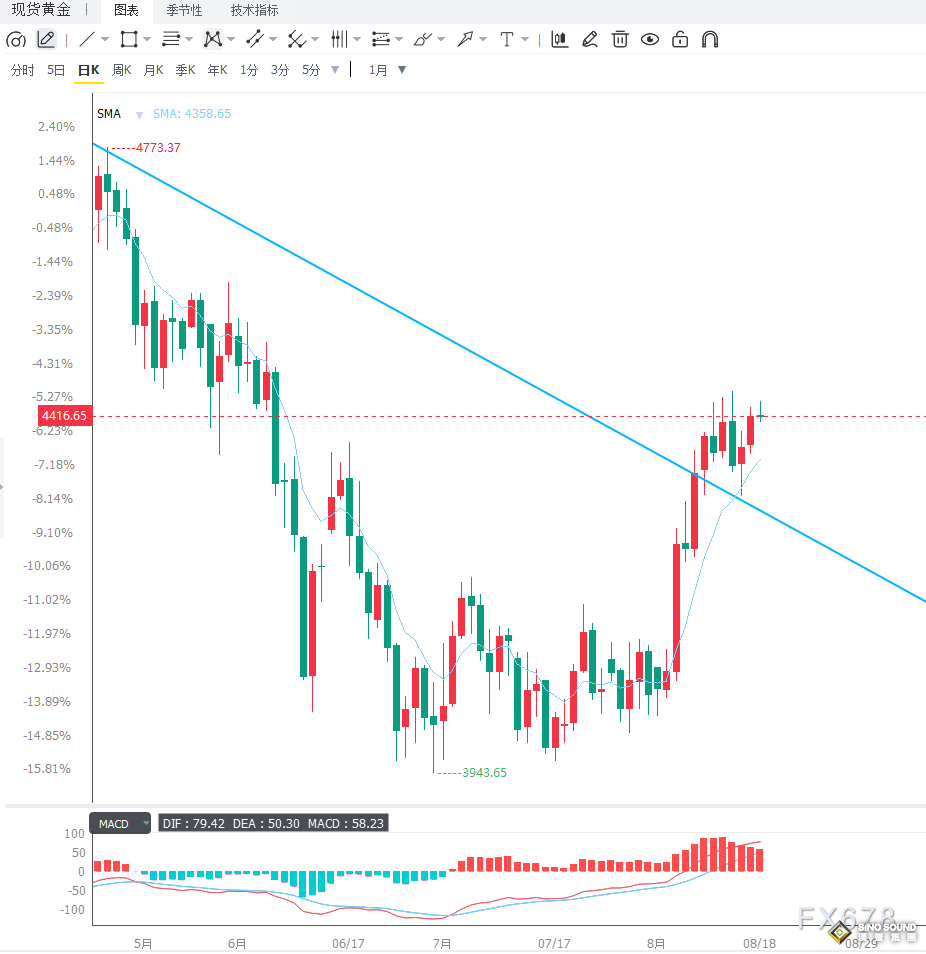
Gold sits in an environment where both fundamentals and technicals favour the bulls. Diminished expectations for additional Fed hikes, US‑dollar weakness and safe‑haven demand together underpin its short‑term advance. Even so, as gold nears technical resistance at $4485, markets have entered a critical bull‑bear battleground.
Three variables will determine whether gold can unlock further upside: whether US jobs and inflation data keep steering monetary‑policy expectations toward eASIng; whether the US dollar stays weak; and whether Middle‑East tensions spark another sharp oil‑price surge. Favorable outcomes for the first two factors alongside stable energy prices would substantially lift odds of a break above $4480. Surging oil prices reviving inflation expectations, by contrast, could force markets to re‑evaluate the Fed’s policy path.
In summary, gold trades bullish‑biased within oscillations in the short run, with the $4400‑4480 zone now a high‑stakes consolidation area. Watch closely for breaks of $4380 support and $4480 resistance. Until trend confirmation arrives, exercise caution against chASIng highs and rapid pullbacks triggered by surprise macroeconomic data.