

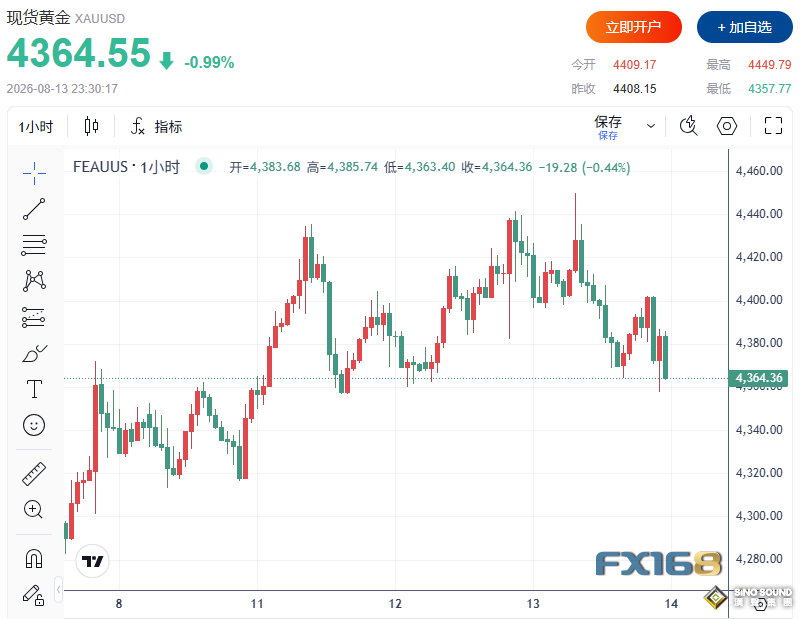
Spot gold and silver prices in the United States both moved lower during early Thursday US‑market hours. Although the overall US July PPI came in flat, core producer‑price pressures remained strong. Combined with a firm US dollar and cautious market sentiment ahead of Friday’s retail‑sales report, precious metals faced short‑term headwinds.
As of press time, spot gold stood at $4364.55 per ounce, down 0.99%; spot silver traded at $65.505, down 1.23%.
(Source: FX168)
Mixed Inflation Readings
The latest round of US inflation data shows a pattern of “surface‑level cooling with underlying stickiness”. Wednesday’s Consumer Price Index (CPI) showed July consumer prices rose 0.1% month‑on‑month and 3.4% year‑on‑year. Core CPI, excluding food and energy, climbed 0.2% month‑on‑month and 2.5% year‑on‑year.
Thursday’s Producer Price Index (PPI) showed final‑demand prices were flat month‑on‑month in July and up 4.7% year‑on‑year. However, the gauge excluding food, energy and trade services rose 0.4% month‑on‑month and also 4.7% year‑on‑year, indicating upstream price pressures have not eased materially.
Meanwhile, US initial jobless claims for last week increased by 9,000 to 209,000, while the four‑week moving average held steady at 199,000. Overall, the labour market has yet to show deterioration substantial enough to alter policy expectations significantly.
Rate‑Cut Expectations Remain Unclear
These figures have prevented the market from forming clear dovish signals for Federal Reserve pricing. Ahead of the PPI release, market odds for a September rate hike stood near 40%. At the same time, the benchmark 10‑year US Treasury yield hovers around 4.7%, showing rate‑related pressure on non‑yield‑bearing gold has not lifted.
Markets will now turn attention to US July retail‑sales data due on Friday Beijing time. Investors may gain clearer visibility over the Fed’s policy path once key weekly economic figures are fully released.
Limited Support From Geopolitical Risks
The Strait of Hormuz remains a critical geopolitical chokepoint for metals and energy markets. US officials state the strait remains open under US influence, yet regional sources report restricted passage. Iran’s conditions for full reopening have not been met.
Crude oil retreated amid demand concerns and soft inventory signals. WTI crude trades near $82 per barrel, while Brent crude is close to $87.70. Nevertheless, strait‑closure risks cap downside oil moves. For gold, this creates two‑sided effects: shipping risks bolster safe‑haven demand, yet a fresh oil‑price surge could reignite inflation pressure and keep traders pricing in chances of another Fed rate hike.
Global Markets Show Divergent Performance
Ahead of the US opening, global equities were generally firm but highly mixed. US stock index futures edged higher, with Dow, S&P 500 and Nasdaq futures all up 0.1%. European markets also posted modest gains supported by technology and financial sectors, though the FTSE 100 lagged on weakness among mining stocks.
ASIan sessions were similarly mixed. South Korean and Japanese equities advanced, while Hong Kong, Singapore and mainland China markets traded softer. Across external markets, NYMEX WTI crude is around $82.00 per barrel, Brent crude near $87.70; the US Dollar Index holds steady and the benchmark 10‑year Treasury yield remains near 4.7%.
Key Technical Levels Exposed
From a technical perspective, the next objective for spot‑gold bulls is to reclaim the $4448.00 resistance. A sustained breakout would open targets at $4575.00 and $4666.00. For bears, a break below $4332.00 would trigger further downside toward $4262.00 and $4205.00. Current primary resistance lies at $4448.00, followed by $4575.00; primary support sits at $4332.00, then $4262.00.
For spot silver, bulls need to retake $66.43 to resume upward momentum, with further targets at $71.43 and $72.08. The next bearish objective is a drop below $64.47, potentially opening moves toward $63.10 and $61.42. Silver’s primary resistance is $66.43, followed by $71.43; primary support is $64.47, then $63.10.