

News from Finance Press (ASIa‑Pacific): According to the latest Reuters report on Friday (August 14), US Treasury Secretary Scott Bessent stated that the United States will adopt "unprecedented" measures against Iran.
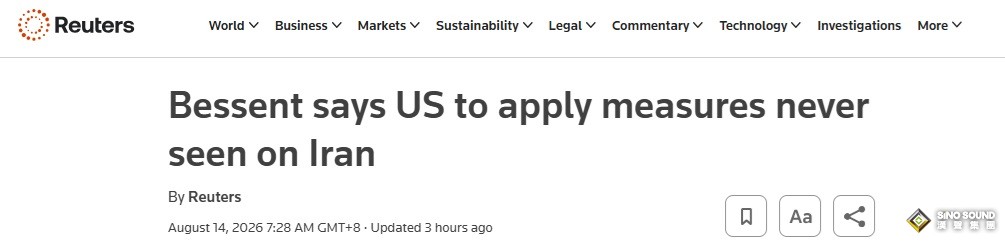
(Screenshot source: Reuters)
In an interview on Newsmax’s program “Rob Schmitt Tonight” on local‑time Thursday, Bessent said: “More announcements will come next week. The measures we will implement represent means of economic isolation that have never been imposed on any country in global economic history.”
Bessent noted: “This will be an unprecedented measure of economic isolation for the whole world. Meanwhile, the blockade on the Strait of Hormuz will be maintained to block all supplies from entering or leaving Iranian ports.”
He added that the United States plans to combine extreme economic pressure with maritime blockade to further escalate its crackdown on Iran. He did not disclose further details of the specific measures.
Bessent’s remarks send a strong signal. Its core is not merely expanding traditional sanctions, but attempting to impose systematic pressure on Iran through “maximum economic isolation”.
Judging from his wording, the United States may be considering further upgrading financial sanctions, energy‑export restrictions, trade blockades and shipping controls, aiming to cut off Iran’s access to foreign‑exchange resources and international trade channels. Bessent’s special mention of the blockade of the Strait of Hormuz means US pressure may extend from the financial sphere to global energy transportation chains.
From a strategic perspective, this reflects Washington’s intention to force Iran into concessions without launching a full‑scale direct war, namely leveraging economic strangulation and pressure on energy passages to raise bargaining chips in negotiations.
Nevertheless, the Strait of Hormuz ranks among the world’s most critical energy‑transport hubs. Any long‑term blockade or military stand‑off may push up international oil prices, trigger turmoil in global energy markets, and raise risks of regional misjudgment and conflict escalation.
Markets need to pay attention to the specifics of follow‑up US measures. If new sanctions mainly target Iran’s oil exports, financial settlements and shipping insurance, they may further squeeze Iran’s economic space. However, broader maritime‑blockade operations would bring greater geopolitical risks.
Bessent’s expression of “unprecedented” itself carries obvious deterrent implications, intended to send a signal to Iran and global markets that the United States is ready to adopt tougher actions.
As Bessent made these remarks, US Defense Secretary Pete Hegseth was reported to state on Thursday evening that the US military can maintain the maritime blockade against Iran “indefinitely”.
Hegseth told reporters that the US Navy will rotate warships under the current model. “We have always done this in the past and will continue to do so in the future.”
Media reports state that the USS George Washington aircraft carrier is heading for the Middle East to relieve the USS Abraham Lincoln, which has been deployed for more than 250 days. The deployment mission of the USS Lincoln was previously scheduled to end in May.
In a statement, the US Navy said the USS George Washington carrier strike group departed from Vietnam on August 12.
美国对伊朗采取“前所未见”的措施会对全球经济产生哪些影响? 美国和伊朗之间的紧张关系可能会如何发展? 美国对伊朗的制裁措施有哪些历史背景和原因?