

In today’s (Tuesday) ASIan session, spot gold opened at $4448.04 per troy ounce and hit a high of $4461.30 per troy ounce. Gold prices first traded in a narrow range, then accelerated lower at the start of the European session in the afternoon, breaking below the $4400 threshold and hitting a low of $4369.19 per troy ounce. At press time, gold was trading near $4376, with intraday losses widening to 1.64%.
The US Dollar Index pulled back briefly before rebounding higher intraday, peaking at 99.63 and last quoted at 99.59, up 0.18%. The 2‑year US Treasury yield rose 1.7 bASIs points to 4.344%; the 10‑year US Treasury yield climbed 3.5 bASIs points to 4.787%.
Global crude oil benchmarks maintained upward momentum. WTI Crude Oil stood at $87.45 per barrel, up 1.27%; Brent Crude Oil traded at $92.18 per barrel, up 1.50%. US Natural Gas CFD was quoted at $2.938 per million British thermal units, up 0.273%.
In today’s equity markets, China’s three major A‑share indices dipped then rebounded before slipping again toward the close. Total turnover across the Shanghai and Shenzhen bourses reached RMB 2.03 trillion, a decrease of roughly RMB 97.6 billion compared with the same period on the previous trading day. The SSE Composite Index fell 6.41 points or 0.16% to 3979.89. The SZSE Component Index dropped 142.62 points or 1.02% to 13872.38. The ChiNext Index lost 45.25 points or 1.32% to 3393.43.

Hong Kong’s two major indices opened lower and weakened throughout the session. At closing, the Hang Seng Index declined 237.26 points or 0.93% to 25329.73. The Hang Seng Tech Index fell 68.99 points or 1.49% to 4550.88. The Hang Seng China Enterprises Index shed 50.54 points or 0.59% to 8462.64. The Hang Seng China Red‑Chip Index dropped 32.16 points or 0.77% to 4138.2.
European major stock indices opened in the afternoon: Germany’s DAX 30 opened 0.42% lower; the UK FTSE 100 opened 0.39% lower; France’s CAC 40 opened 0.19% higher; the EURO STOXX 50 opened 0.03% lower; Spain’s IBEX 35 opened 0.04% higher; Italy’s FTSE MIB opened 0.07% higher.
In the afternoon, the Shanghai Gold Exchange’s Au(T+D) closed 1.15% lower at RMB 957.77 per gram, while Ag(T+D) closed 1.27% lower at RMB 16234.0 per kilogram.
Latest intraday data releases showed China’s August RatingDog Manufacturing PMI came in at 51.5 versus an expected 51 and a prior reading of 50.9. UK August Nationwide House Price Index MoM stood at 0.2%, versus expectations of 0.10%, with the prior figure revised from 0.10% to -0.1%. Switzerland July Real Retail Sales YoY printed at 2.3%, compared with a prior reading of 1.50%.
Germany’s August Final Manufacturing PMI registered 54.3 versus expectations of 54.1 and a prior reading of 54.1. France’s August Final Manufacturing PMI was 51.1 versus expectations of 51.5 and a prior reading of 51.5. The Eurozone August Final Manufacturing PMI read 52.7 versus expectations of 52.8 and a prior reading of 52.8. UK July Bank of England Mortgage Approvals hit 56,053 versus an expected 59,500, with the prior reading revised from 58,200 to 58,215. UK August Final Manufacturing PMI stood at 51.7 versus expectations of 51.5 and a prior reading of 51.5.
Eurozone August Preliminary CPI MoM was 0.4%, compared with a prior reading of 0.20%. Eurozone August Preliminary CPI YoY came in at 3.3%, matching market expectations and rising from the prior 2.90%. Eurozone July Unemployment Rate printed at 6.4%, versus expectations of 6.3%, with the prior reading revised from 6.30% to 6.4%.
Among key economic statistics, China’s August Manufacturing PMI remained in expansion territory for the ninth consecutive month. Production and demand saw accelerating expansion. Output growth quickened from July to its highest level in three months. Demand, output and exports all picked up notably. Faster growth in new orders and robust export expansion sent positive signals. Cost‑pressure edged higher but remained generally manageable.
UK house prices rose in August, indicating housing demand retained certain resilience despite economic fallout from ongoing US‑Iran conflicts. French manufacturing expanded in August, though at a slower pace than the flash estimate, reflecting peRSIstent soft demand, fading corporate confidence and stronger inventory destocking. German manufacturing expanded at a faster clip in August, with new orders rising steadily for the third consecutive month and driving the strongest manufacturing output growth in more than four‑and‑a‑half years.
Sustained war‑related pressures from Iran pushed prices higher. Inflation across the Eurozone’s 21 member states climbed to 3.3% in August from 2.9% in July, driven almost entirely by surging energy costs. Eurozone inflation has accelerated to a near‑three‑year high, further justifying an interest‑rate hike by the European Central Bank next week.
Markets currently price in a 25‑bASIs‑point rate hike from the ECB on September 10, with further hikes anticipated thereafter. A hike next week would cement its status as the most hawkish central bank among G7 economies.
Analysts note that amid Middle‑East geopolitical turbulence, international crude oil prices have risen 13% since early August and are roughly 25% higher than levels before the late‑February outbreak of conflict. The Trump administration’s objectives stand in direct opposition to Iran’s. Such geopolitical frictions will keep Eurozone inflation elevated, and the ECB must prepare for a protracted “war of attrition” in the Middle East.
The Federal Reserve maintains a hawkish stance toward inflation. The US dollar has regained some support recently, weighing heavily on global gold prices. Should inflation rebound and further lift rate‑hike expectations, gold may stay under pressure. Conversely, weaker subsequent economic data and cooling rate expectations could trigger a fresh rebound in gold prices.
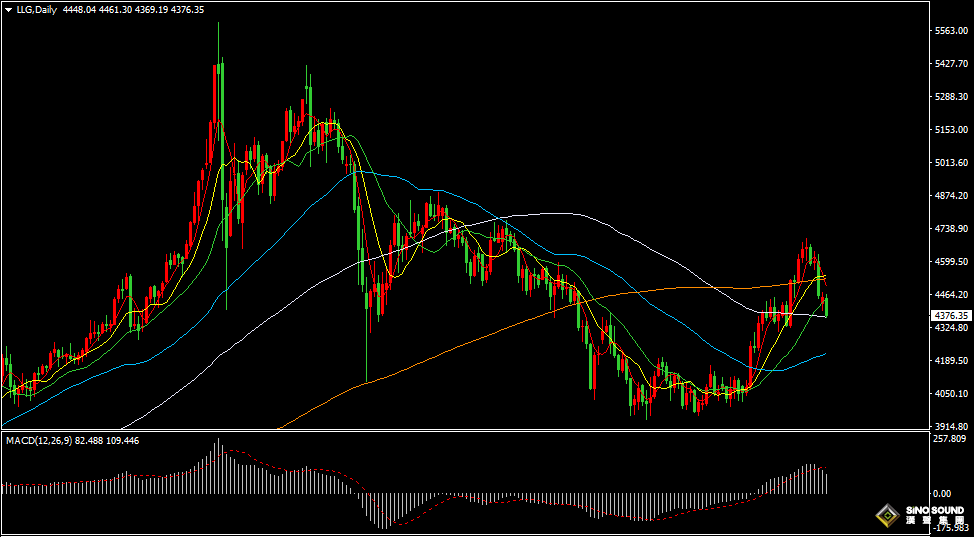
From the daily gold chart, gold has remained in a weak intraday adjustment phase. Unable to hold above the 20‑day moving average, it accelerated lower toward the vicinity of the 100‑day moving average. A valid break below the 100‑day moving average near $4370 would open downside targets toward the $4330‑$4300 zone. On daily indicators, MACD positive histogram continues to shrink, and the RSI has drifted lower to around the 48 level.
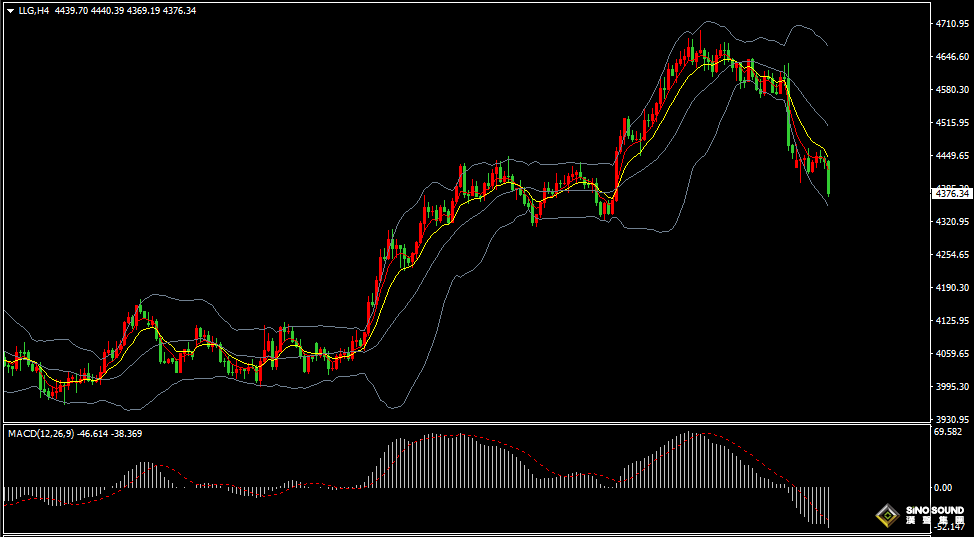
On the 4‑hour gold chart, prices have broken below the lower bound of the prior trading range, hitting a low near $4369. Short‑term EMA5 and EMA10 have formed a bearish downward alignment. MACD negative histogram remains elevated, and the RSI has fallen below oversold territory to around 27. For evening short‑term trading, expect gold to oscillate within the $4330‑$4430 range. A breakout higher would target $4450‑$4470 or near $4485; a breakdown lower would target $4320‑$4310 or near $4300.
Key economic data and events to watch tonight:
21:05 Fed’s Barr delivers speech
21:45 US August S&P Global Manufacturing PMI Final
22:00 US August ISM Manufacturing PMI
22:00 US July JOLTS Job Openings
22:00 US July Construction Spending MoM
04:30 (Next Day) US API Weekly Crude Oil Stockpiles for the week ending August 28
[Disclaimer]The views and opinions expressed in this article are solely those of the author and do not necessarily reflect the views of SinoSound. SinoSound remains neutral regarding the opinions and statements contained herein and makes no representations or warranties, whether express or implied, regarding the accuracy, reliability, or completeness of the information provided.
The content of this article is intended for informational and reference purposes only. Readers should exercise their own judgment and assume full responsibility for any decisions or actions taken based on the information contained herein.
[Copyright Notice]This article is original content and is protected by applicable copyright laws. Any reproduction, distribution, citation, or use of this content must clearly acknowledge the original source:
Gold2U
www.gold2u.com
We reserve all rights and may take legal action against any individual or entity that fails to comply with this notice or otherwise infringes our intellectual property rights.