

US President Trump stated on Thursday (Oct 8) that the United States will not attack Iran before the November 3 midterm elections, saying the two sides are holding "productive discussions". However, he emphASIzed that the maritime blockade against Iran will remain in place. Earlier reports that the US was considering resuming military strikes had pushed oil prices higher. Although his latest remarks erased part of the oil gains, they failed to remove market fears of further conflict escalation. #IranCrisisWatch#
As of 18:48 GMT on Thursday, NYMEX WTI crude futures for November delivery rose $3.29, or 3.73%, to settle at $91.57 per barrel. December Brent crude futures climbed $4.20, or 4.19%, to $104.40 per barrel. US crude is still on track for a nearly 2% weekly drop, yet its year-to-date gain stands at roughly 60%.
Trump Shifts to Diplomatic Rhetoric While Maritime Blockade Continues
Trump posted on Truth Social: "We will not attack Iran at any time before the midterm elections." He said the US is holding productive talks with Iran, reaffirmed that Iran must not obtain nuclear weapons, and stated the blockade measures will remain fully enforced.
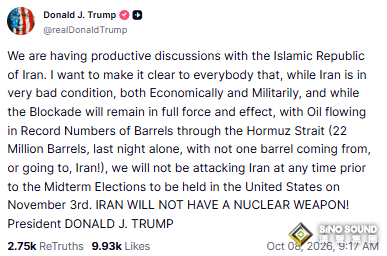
This marked a clear shift from his remarks less than a day earlier. On Wednesday evening, Trump told reporters that the administration was considering resuming strikes on Iran ahead of the election. At a campaign rally the same night, he added that reaching an agreement with Iran was "not really what I want to do".

NBC News previously revealed that Trump and his national security team were weighing attacks on Tehran in the coming weeks. The news amplified market worries about military escalation and disrupted energy supplies. Trump’s Thursday statement explicitly put off pre-election strikes, yet he made no commitment on actions after voting concludes.
Oil Prices and Living Costs Add Midterm Election Pressure
Trump has explicitly tied the timing of potential military operations to the domestic election calendar amid falling public support for the war and political pressure from rising fuel costs.
An August Reuters/Ipsos poll showed 31% of Americans support military action against Iran, down from 37% in March. 83% of respondents expected the conflict to drag on for a long time. Meanwhile, cost-of-living issues consistently rank among voters’ top concerns in multiple surveys.
AAA data showed the national average gasoline price stood at $4.36 per gallon on Thursday, up roughly 40% from a year ago and well above the $2.98 level before the war erupted in late February. Higher energy prices have added pressure on Republicans seeking to retain control of Congress. Some GOP candidates in competitive districts have tried to distance themselves from Trump on issues including the Iran war.
Reuters reported in September that senior Trump aides had pushed to contain the scale of the war before the midterms to limit Republican losses, while preserving the option of heavier military strikes once voting ends.
US Troop Buildup Continues, Post-Election Outlook Remains Uncertain
Despite Trump’s more diplomatic signals, US military deployments in the Middle East are being strengthened. The Associated Press reported last week that the US is sending roughly 9,000 additional sailors and marines to the region, plus a third aircraft carrier. This deployment could bring three US carriers to the Middle East by late October.
For crude markets, the pledge to avoid pre-election attacks helps ease near-term escalation risks. Yet the ongoing blockade, troop buildup and uncertainty over post-election policy prevent investors from fully removing the geopolitical risk premium.
Trump also claimed on Thursday that 22 million barrels of oil transited the Strait of Hormuz overnight, with none originating from or bound for Iran. CNBC has not independently verified this figure.
Kpler data showed roughly 11.3 million barrels per day of crude and oil products moved through the Strait of Hormuz in the week ending Tuesday, with total regional oil flows around 20.4 million barrels per day. Due to different statistical periods and coverage scopes, these figures cannot be directly compared with Trump’s "overnight" shipment volume.
US Crude Inventory Draw Exceeds Expectations, Underpinning Oil Prices
Beyond geopolitics, falling US crude inventories lent support to oil prices. Stockpiles fell by 3.186 million barrels last week, exceeding market forecasts of a 1.7 million barrel drop, following a 0.922 million barrel build in the prior week.
Finished product inventories showed mixed performance. Gasoline stockpiles rose by 0.382 million barrels, above expectations, after a 1.684 million barrel draw the prior week. Distillate inventories fell by 0.042 million barrels, while heating oil inventories increased by 0.668 million barrels. The crude draw is bullish, yet changes in refined product stocks indicate mixed demand signals.
Among other energy contracts, November natural gas futures fell 1.28% to $3.162 per MMBtu. November gasoline futures rose 2.93% to $3.329 per gallon. November heating oil futures climbed 5.85% to $4.8931 per gallon.
The oil market is currently balancing diplomatic progress and military risks. Trump’s pause on pre-election strikes does not mean the end of the blockade or a resolution to the conflict. Further pricing will continue to be shaped by whether negotiations yield tangible results, the smooth flow of oil through the Strait of Hormuz, and US military policy after the election.