

On Friday (Oct 2), the US September jobs report showed an unexpected sharp cooling in the labour market. The market quickly slashed bets on another Fed rate hike in October. US Treasury yields fell and the US Dollar weakened, triggering strong buying interest in gold and silver. Meanwhile, risks surrounding the Strait of Hormuz continued to lift uncertainties over energy and inflation, offering extra support for precious metals.
After the Nonfarm Payrolls release, spot gold rallied rapidly by more than $40 to hit an intraday high of $4226.66 per troy ounce, rising over 1% on the day. However, it then plunged sharply by over $100 from the peak and dropped to an intraday low of $4124.97 per troy ounce. Spot silver once climbed to a high of $62.078 per troy ounce before retreating heavily to a low of $59.677 per troy ounce.
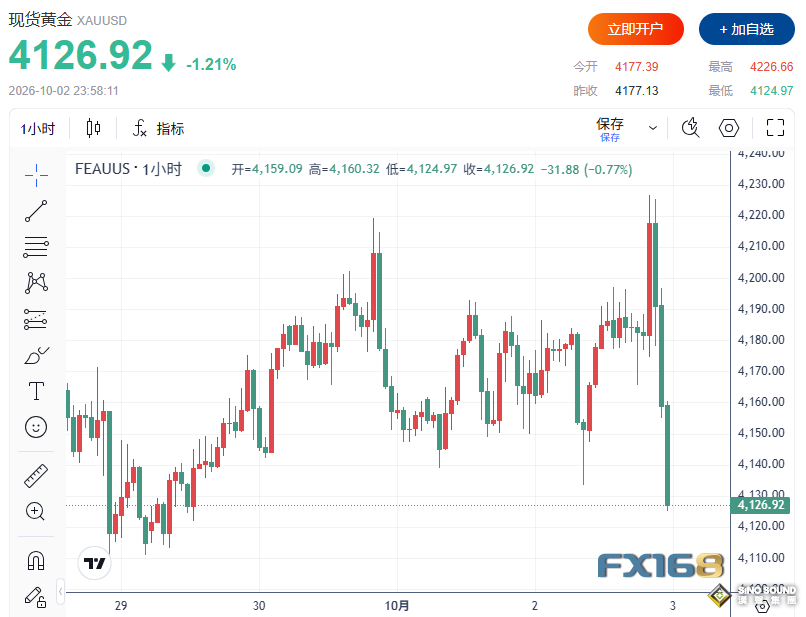
(Source: FX168)
Nonfarm Payrolls Misses Big, Rate Hike Bets Tumble
US Nonfarm Payrolls rose by only 29,000 in September, far below the prior market estimates of 88,000 to 90,000, while the unemployment rate climbed to 4.2%. Average hourly earnings edged up just 0.1% month-on-month, with the year-on-year growth falling to 3.0%.

More notably, total job gains for July and August were revised down by 60,000. July’s figure was even revised from a gain to a loss, showing the US labour market’s actual performance over the past few months was weaker than previously estimated.
This report quickly repriced the market’s expectations for the Fed’s next move. After the Nonfarm Payrolls release, the probability priced in by the market for another Fed rate hike in October fell rapidly to the low teens, a sharp drop from the nearly 70% level seen earlier this week.
As rate hike expectations cooled, the benchmark 10-year US Treasury yield dipped to around 5.2%, the US Dollar weakened in tandem, and US stock index futures advanced. For gold, the simultaneous drop in Treasury yields and the US Dollar directly eased the two major factors that had weighed on gold prices.
Gold Back Above $4200, Silver Rallies in Lockstep
Weak employment data usually reduces the urgency for further Fed monetary tightening, which puts pressure on real interest rates and the US Dollar. This is especially favourable for non-interest-bearing gold.
The market reaction was immediate this time. After Nonfarm Payrolls, gold quickly climbed back above $4200, and silver extended its gains, attracting capital inflows again after a notable pullback earlier this week.
Nevertheless, a single weak jobs report is not enough to completely reverse the Fed’s policy path. Core inflation remains markedly above the 2% target, and energy prices are still high. Therefore, the market will shift its focus back to inflation.
The US September Consumer Price Index (CPI) will be released on October 14, likely serving as one of the most critical data points ahead of the Fed’s late-October policy meeting. If employment continues to soften and inflation cools at the same time, the case for a rate pause in October will strengthen further. Conversely, if energy drives a renewed uptick in inflation, the Fed will still face complex policy trade-offs. The ISM Services data will be released next Monday.
Strait of Hormuz Risks Continue to Support Gold
Beyond Fed policy expectations, Middle East tensions remain another key theme that cannot be ignored in the gold market.
Although crude oil exports from the PeRSIan Gulf have largely returned to pre-conflict levels, with producers maintaining oil flows via pipelines, barges and ship-to-ship transfers, risks in the Strait of Hormuz have not fully faded. Refined product shipments are still disrupted, and recent tanker attacks have kept war risk insurance, shipping costs and diesel prices elevated.
The market currently believes the expanded US military presence in the region has lowered the odds of a full shutdown of the Strait of Hormuz in the short term, yet risks of further escalation between the US and Iran still linger.
This scenario gives gold two sources of support. On one hand, weak employment suppresses short-term Fed rate hike expectations. On the other hand, high oil prices and geopolitical risks keep adding uncertainties to the economic and inflation outlook.
At press time, WTI crude oil on NYMEX was quoted at $89.41 per barrel, and Brent crude at $101.12 per barrel. PeRSIstently high oil prices mean the Fed is now faced with a complex scenario featuring both softening employment and energy-driven inflation pressure, rather than a simple economic slowdown.
Gold’s Next Key Level: Watch $4225
From a technical perspective, gold broke back above the $4200 threshold after Nonfarm Payrolls, and bulls are now testing the $4203.65-$4225.28 zone. If gold can break above and hold firmly above $4225, the next target will be $4248.24, followed by a potential test of $4279.11.
To the downside, $4149.83 remains an important near-term support. A renewed break below this level may trigger further tests at $4117.63 and even $4063.81.
For silver, bulls are challenging the $61.737-$62.327 zone. A breakout and stable hold above $62.327 will open upside targets at $63.807 and $65.090 in sequence. If silver falls back below $60.258, it may retest $59.368 and $57.889.
After the shocking Nonfarm Payrolls miss, the biggest short-term bearish factor for gold — the prospect of another Fed rate hike in October — has cooled notably. However, amid high oil prices and lingering inflation risks, whether gold can truly transition from a rebound to a renewed rally hinges on the zone around $4225, which will serve as a key level to monitor going forward.