

Spot gold and silver both declined towards the end of US trading on Friday (Oct 2). Although the US September Nonfarm Payrolls report was far weaker than expected, prompting the market to sharply cut bets on another Fed rate hike in October, elevated US Treasury yields, a resilient US Dollar and lingering energy inflation risks ultimately outweighed the positive impact from the jobs data.
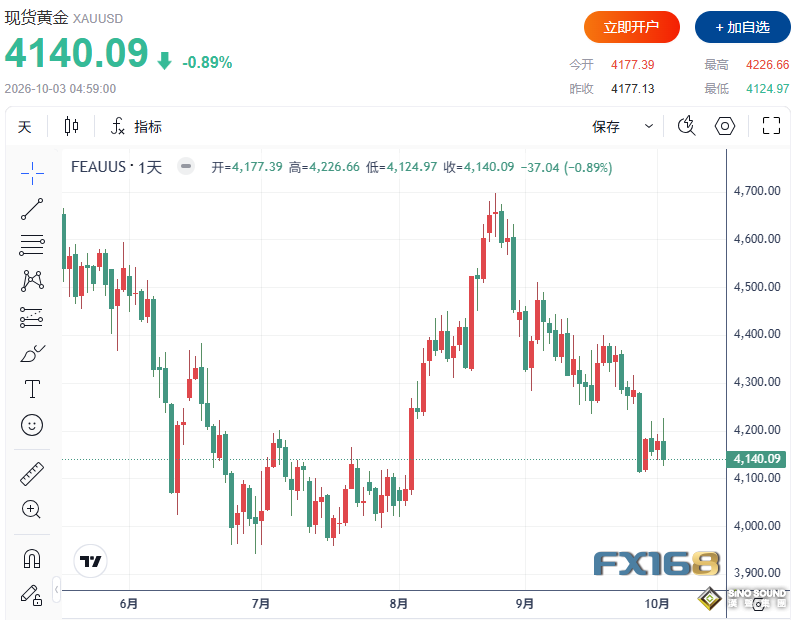
At the close of US session, spot gold settled at $4140.09 per troy ounce, down 0.89% on the day. Spot silver was quoted at $60.351 per troy ounce, a drop of 1.03%. The brief rebound in precious metals after the Nonfarm Payrolls release failed to sustain, and gold returned to key technical support zones.
(Source: FX168)
Nonfarm Payrolls Misses Expectations, Rate Hike Bets Plunge
US Nonfarm Payrolls rose by only 29,000 in September, well below market estimates of 80,000 to 90,000, with the unemployment rate standing at 4.2%. Average hourly earnings edged up just 0.1% month-on-month, and the year-on-year growth fell to 3.0%. Meanwhile, combined job gains for July and August were revised down by 60,000, further signalling a cooling labour market.

After the jobs data release, the market quickly reduced bets on another Fed rate hike in October. The probability of an October hike, which had neared 70% earlier this week, fell to roughly 20% on Friday.
Normally, weaker employment figures and lower rate hike odds should benefit gold, as they may put downward pressure on real interest rates and the US Dollar. However, market movements on the day did not follow this typical script.
US Treasury Yields Rebound, Offsetting Gold Bullish Factors
US Treasury yields fell sharply immediately after the Nonfarm Payrolls release, but bounced back quickly afterwards.
The benchmark 10-year US Treasury yield climbed back to around 5.25%, showing that although traders lowered expectations for an October rate hike, they remained concerned about inflation and a "higher-for-longer" interest rate environment. This became the biggest source of pressure on gold on the day.
Gold generates no interest income. When US Treasury yields stay above 5%, the opportunity cost of holding gold rises markedly. Therefore, as long as yields cannot keep falling, gold can hardly sustain a rally merely on the back of a weak jobs report.
Although the US Dollar Index retreated on the day, it posted gains for the whole week, further limiting gold’s upside.
US Stocks Rise While Gold Turns Down
US equities reacted more positively to the employment data compared with precious metals. The S&P 500 rose 0.7% to close at 7722.72. The Dow Jones Industrial Average advanced roughly 250 points, up 0.5%. The Nasdaq Composite climbed 1.2% to 27190.86.
European stock markets also rebounded broadly, as investors bet that cooling employment may prompt the Fed to pause further policy tightening for the time being.
For gold, the key question is not simply whether the Fed will raise rates in October, but whether long-term interest rates have truly peaked. If the 10-year Treasury yield remains above 5%, gold may still face heavy valuation pressure even if the Fed pauses hikes in October.
Risks in the Strait of Hormuz Still PeRSIst
Middle East tensions still offer some safe-haven support for gold, yet their impact has become more complex. As the market discussed releASIng emergency crude and fuel reserves, and Middle East crude exports partially recovered, international oil prices fell noticeably on Friday. WTI crude traded near $90.70 per barrel, while Brent crude stood at around $101.23.
Falling oil prices have dual implications for gold. On one hand, lower energy costs help ease inflation pressure and reduce the need for further Fed rate hikes, which is favourable for gold in the medium term. On the other hand, reduced energy supply risks will weaken geopolitical safe-haven demand.
Although shipping through the Strait of Hormuz has improved significantly from the worst phase earlier, major uncertainties remain regarding tanker safety, regional military operations and US-Iran relations. Hence the market has not fully priced out the Middle East risk premium.
Gold Pulls Back to Key Support Zone
From a technical perspective, gold has re-entered a critical battle zone in the short term.
To the upside, gold first needs to reclaim $4149.83, followed by $4171.46. A more important resistance zone lies between $4203.65 and $4230.51. A sustained breakout above this area will open the door towards $4319.61-$4327.50.
To the downside, $4110.87 acts as a major near-term support. A valid break below this level may trigger further technical weakness, with deeper support near $3942.10.
For silver, the $60 level has become a vital short-term defence line. To regain the upper hand, bulls need to break through $60.848-$61.737 first, and then target the 50-day moving average near $64.632. If silver falls below $60, the next support is at $59.57.
The Next Real Big Test Shifts to Inflation
After wild price swings on Friday, the market is rapidly shifting its focus from employment to inflation.
The September Nonfarm Payrolls data has markedly reduced the necessity for another Fed rate hike in October. However, as long as energy prices stay high and core inflation fails to cool consistently, the possibility of further policy tightening in December will not be completely ruled out.
Therefore, upcoming CPI, PPI readings and oil price movements will carry greater importance than employment data alone.
For gold, what truly needs to be seen is not merely weaker employment, but a combination of cooling jobs, falling inflation and a genuine pullback in US Treasury yields. Until all three conditions emerge simultaneously, gold may still rally briefly on positive data before being pushed down again by high yields, just as what happened on Friday.