

Spot gold and silver both rose on Thursday during early US trading, yet the upside was capped by elevated US Treasury yields and a still-strong US Dollar. Meanwhile, market pricing for a Fed rate hike in October fell noticeably from earlier this week, serving as one of the key supports for precious metals.
At press time, spot gold traded around the $4170 per ounce level, up 0.3% on the day; spot silver stood at $60.67 per ounce, a gain of 0.2%.
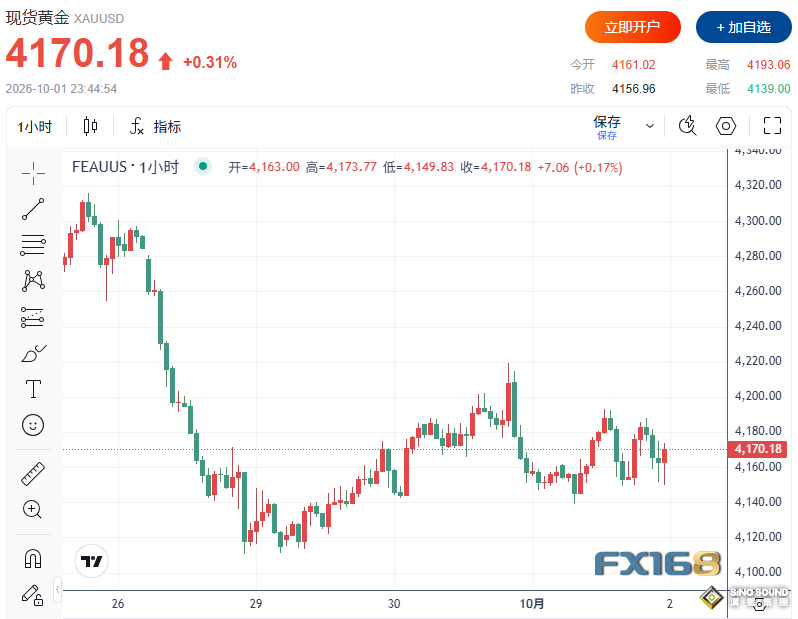
(Source: FX168)
Initial Jobless Claims Temper Rate Cut Expectations
US Initial Jobless Claims for the prior week dropped to 197,000, below the market forecast of 201,000 and the revised reading of 198,000, indicating low layoff levels. This figure dampened the market's dovish interpretation stemming from Wednesday’s softer Personal Consumption Expenditures (PCE) price index, preventing a further extension of the precious metals rebound.

ISM reported on Thursday that the US September Manufacturing PurchASIng Managers Index (PMI) edged down to 54.5 from August’s 54.6, falling short of the market expectation of 55. Even so, the index remains above 50, meaning the US manufacturing sector is still in expansion territory overall.
Currently, market pricing for an October rate hike stands at roughly 37%, sharply lower from the nearly 70% level seen earlier this week. Still, pressure peRSIsts in the bond market: the 10-year US Treasury yield once neared 5.34%, and the 30-year yield climbed to around 5.68%. Energy inflation, fiscal deficit concerns and heavy Treasury issuance continue to exert upward pressure on long-end yields.
Markets will turn their attention to the September jobs report due for release at 20:30 Beijing time on Friday. A stronger-than-expected Non-Farm Payrolls reading could keep the yield environment unfavorable for gold. Conversely, weaker labor data will reinforce expectations that the Fed can stay on hold, even amid inflation risks brought by oil prices.
Oil Prices and Geopolitical Risks Continue to Simmer
The situation in the Strait of Hormuz and US-Iran tensions remain uncertain, transmitting impacts to inflation expectations through crude oil prices. Iranian officials said on Wednesday that Tehran has received a formal US response to its latest proposal to end the seven-month-long war. However, there is no confirmation that the response accepts Iran’s terms or that the Strait of Hormuz will reopen.
US President Trump previously rejected Iran’s terms, under which Iran would reopen the Strait of Hormuz within one week if Washington meets certain demands. Brent crude traded at $100.10 per barrel and WTI crude at $91.78 per barrel. Oil prices stay high enough to stoke inflation fears, even though flows in the Gulf region have partially resumed.
For gold, geopolitical risks are inherently supportive. Yet when rising oil prices push the US Dollar and Treasury yields higher, the overall impact on gold prices remains negative.
Stronger US Dollar Weighs on Risk Appetite
Global risk sentiment weakened on Thursday. US equities moved lower amid a sharp rise in US Treasury yields, which pressured most markets. Meanwhile, Micron Technology released its key earnings report, drawing investor attention.
European stock markets mostly declined. France’s CAC 40 fell 1.2%, Germany’s DAX edged lower, and the UK FTSE 100 dropped 1.3%. At the same time, the US Dollar strengthened against the Yen and Euro, as elevated US yields kept attracting safe-haven capital inflows.
In external markets, NYMEX WTI crude held near $91.78 per barrel, and Brent crude was close to $100.10 per barrel. The benchmark 10-year US Treasury yield traded around 5.3%, and the US Dollar Index remained firm near its yearly highs. Market participants are also watching the impact of Dollar movements on gold, as the US Dollar remains a major factor driving gold price volatility.
Key Technical Levels for Gold and Silver
From a technical perspective, the next target for spot gold bulls is to reclaim the resistance zone of $4190.00 to $4210.63. A sustained breakout would open further upside toward $4238.00 and $4254.44. On the bearish side, a break below $4160.00 would target $4112.00 and $4073.00 next. The primary resistance stands at $4190.00, followed by $4210.63; the primary support is at $4160.00, with secondary support at $4112.00.
For spot silver, bulls’ next objective is to regain the $61.720–$62.0686 zone. A valid breakout above this range may push prices higher to $62.8338 and the 50-day moving average near $63.8900. Bears aim for a break below $60.639, with further downside targets at $59.960 and $58.940. The primary resistance for silver is $61.720, followed by $62.069; the next support level is $60.639, then $59.960.