

US latest inflation data came in unexpectedly lower than expected, rapidly altering trading logic across global markets on Wednesday. Market bets on another Fed rate hike in October cooled markedly. The S&P 500 and Nasdaq Composite climbed, the policy-sensitive 2-year US Treasury yield fell, and the US Dollar Index plunged before surging back. Nevertheless, this round of "dovish trading" failed to spread broadly: yields on 10-year and 30-year US Treasuries remained elevated, gold quickly erased gains after a brief spike, while international crude oil prices resumed their rise. As September and the third quarter entered their final trading session, global markets witnessed a rare "fire and ice" divergence.
US Commerce Department data showed the August Personal Consumption Expenditures (PCE) price index rose 0.3% month-on-month, below market expectations of 0.4%; core PCE increased 0.2% month-on-month, also falling short of forecasts. On a year-over-year bASIs, headline PCE climbed to 3.4% and core PCE stood at 3.0%. Since PCE is the Fed’s key inflation gauge, the lower-than-expected reading immediately weighed on market expectations of another rate hike in October.
Odds of October Rate Hike Plunge, US Tech Stocks Rebound First
After the inflation data release, near-term Fed rate hike expectations retreated noticeably. CME FedWatch data showed market bets on a 25-bASIs-point rate hike in October dropped to roughly 35%, sharply lower than the prior trading day and earlier this week. LSEG data also indicated investors now price in about a 65% probability that the Fed will keep rates unchanged next month.

US equities were thereby supported. The S&P 500 and Nasdaq Composite advanced during Wednesday’s session, with tech stocks showing relatively strong performance while the Dow Jones Industrial Average lagged noticeably. Despite wild market swings in September, the S&P 500 remains on track for monthly and quarterly gains, while the MSCI All Country World Index is still down for the month, reflecting a continued stark divergence between large US tech stocks and the rest of global markets.
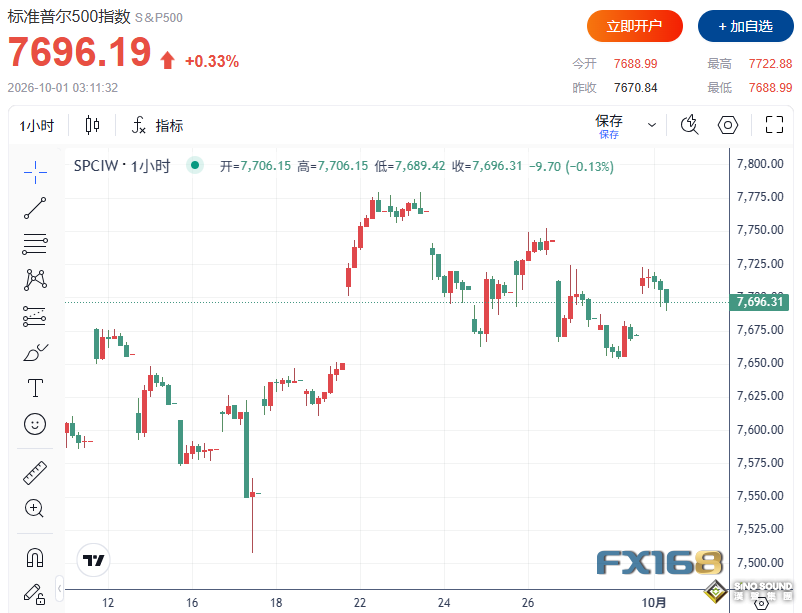
(Source: FX168)
Steve Wyett, chief investment strategist at BOK Financial, stated that markets are closely watching this PCE report as investors try to gauge how much more tightening the Fed will need to implement in the future. Adam Hetts, global head of multi-asset at Janus Henderson Investors, pointed out that although inflation data came in softer than anticipated, strong employment and economic growth figures mean market expectations for another rate hike before year-end may not disappear as a result.
Short-End Yields Slide While Long-End Bonds Remain Under Pressure
The bond market’s reaction merits particular attention. The 2-year US Treasury yield, most sensitive to Fed policy, retreated markedly after the data release, falling to around 4.83% at one point, showing traders are scaling back bets on further near-term rate hikes. Meanwhile, the 10-year US Treasury yield lingered near this week’s high of 5.29%, its highest level since 2007; the 30-year US Treasury yield climbed further to roughly 5.63%.
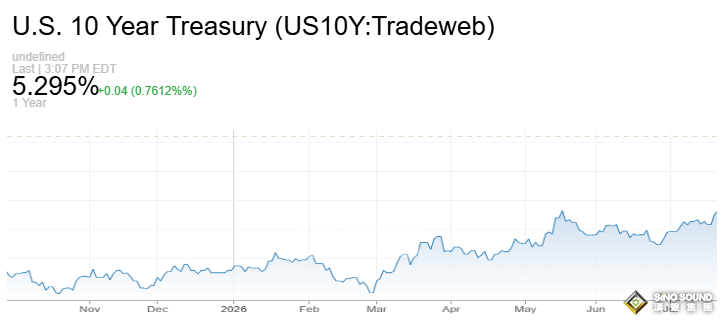
(Source: CNBC)
This pattern of falling short-end yields and peRSIstently high long-end yields highlights the core contradiction facing the bond market: near-term inflation pressures have eased, yet investors remain highly vigilant over long-term fiscal deficits, government debt issuance scale, energy prices and real interest rates. The 10-year US Treasury yield is on track for its largest monthly rise since 2022 in September, while major global sovereign bond markets are also under pressure, with France’s 10-year government bond yield poised for one of its steepest quarterly increases in nearly four decades.
Rob Haworth, senior investment strategist at US Bank Asset Management Group, said there is no obvious runaway inflation expectation at present, and markets may be more focused on the still solid US economic growth. The Atlanta Fed’s Q3 GDP forecast remains elevated, and US Q2 GDP data was also revised upward. These factors could push long-term real interest rates higher and continue weighing on long-duration assets.
Dollar Pulls Back but Still Set for September Gain
In the foreign exchange market, the US Dollar Index staged a V-shaped reversal after the PCE release. The index dipped to 101.03 at one point and then rebounded to a high of 102.48; EUR/USD rose to around 1.1360, while USD/JPY retreated to roughly 156.8. Even so, the US Dollar Index is still on track to post a gain for September, ending its two-month losing streak.
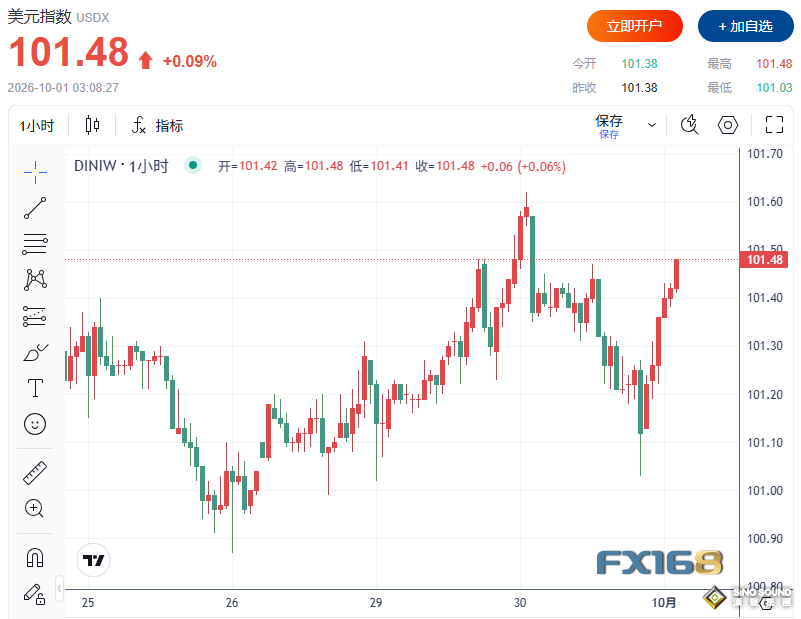
(Source: FX168)
Over the past few weeks, the US Dollar Index strengthened in tandem with US Treasury yields, driven mainly by rising oil prices, renewed inflationary pressures and increased market bets on further Fed rate hikes. The lower-than-expected PCE reading on Wednesday temporarily weakened this trade, yet downside room for the dollar remained limited as long-end US Treasury yields stayed near multi-decade highs.
Gold Spikes Then Retreats, Bullish Data Fails to Sustain Gains
The gold market’s performance was even more noteworthy. Following the inflation data release, spot gold initially climbed amid eASIng rate hike expectations, but gains quickly vanished as long-end US Treasury yields picked up and energy prices rose. At press time, spot gold fell to around $4153 per ounce, down roughly 0.7% on the day, with a nearly 6.6% cumulative loss in September; US gold futures closed slightly higher near $4186 per ounce.
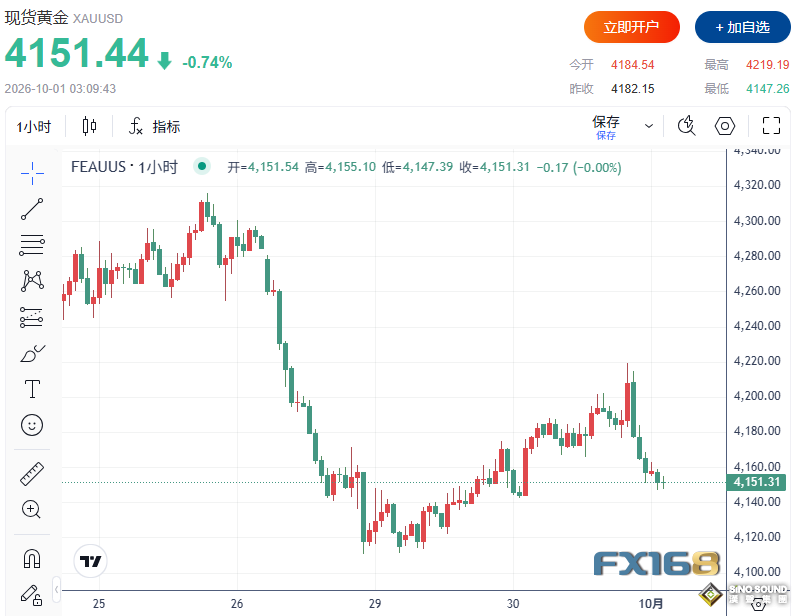
(Source: FX168)
Independent precious metals trader Tai Wong said although the lower-than-expected core PCE substantially reduced the odds of an immediate October rate hike, the rebound in energy prices quickly erased gains in the bond market and renewed pressure on precious metals. He described Wednesday as a "disappointing trading session" for gold.
The core issue facing gold remains opportunity cost. The Fed raised its policy rate to the 3.75%-4.00% range this month and continued to hint at potential further hikes. While gold is generally viewed as a hedge against inflation and macro risks, competition between non-yielding gold and high-yield bonds intensifies in an environment where US Treasury yields exceed 5%.
Oil Prices Resume Rise, Middle East Tensions Remain the Biggest Wildcard
The energy market once again became the focus of inflation trades. International crude oil prices rose on Wednesday, with Brent crude climbing above $103 per barrel and US WTI crude reclaiming the $90 per barrel mark. Brent crude’s cumulative gain in September stands at nearly 14%, poised for its largest monthly rise since July; WTI is also set to advance roughly 6% this month.
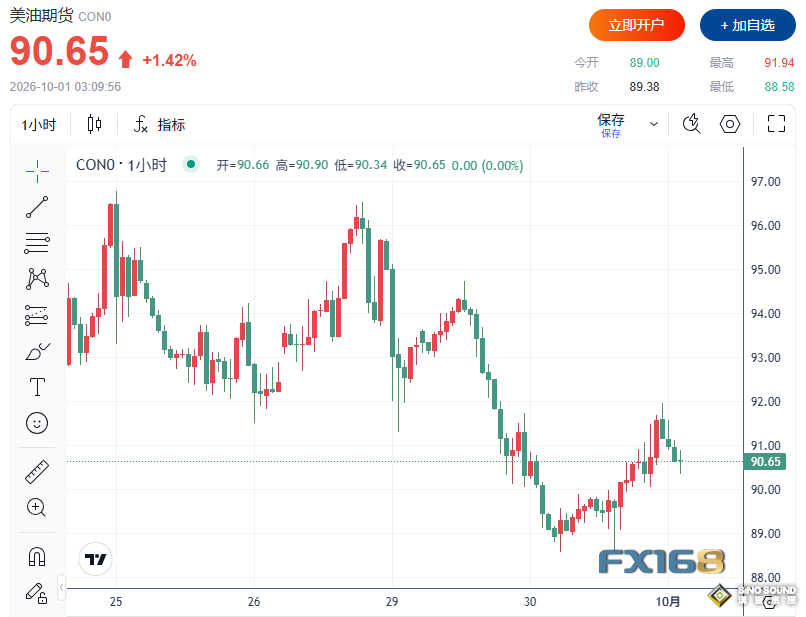
(Source: FX168)
The oil price rally was mainly driven by stalled US-Iran negotiations and tightening US refined product markets. Qatar is still attempting shuttle diplomacy between the US and Iran, but US President Trump denied reports that the US is willing to ease sanctions and release frozen funds in exchange for Iranian concessions on nuclear issues, stating the US has not put forward such terms to Iran.
At the same time, Middle East crude oil supply has partially recovered. Saudi Arabia restarted its East-West pipeline and resumed loading tankers at the Red Sea port of Yanbu; crude oil exports from Middle East oil producers in September have rebounded to their highest level since the outbreak of the Israel-Iran conflict. Nevertheless, market participants noted that shipping costs linked to the Strait of Hormuz remain high and logistics bottlenecks have not been fully resolved, so the crude oil supply risk premium cannot fully disappear in the short term.
Strong Employment Data Offset Inflation’s Positive Signal, Non-Farm Payrolls Become Next Major Test
Another key factor preventing markets from fully shifting to a dovish stance is the continued resilience of the US labor market. ADP data released on Wednesday showed US private-sector payrolls rose by 90,000 in September, exceeding market forecasts and markedly higher than the revised 36,000 in August. This means despite signs of cooling inflation, the US economy and labor market have not shown obvious signs of a slowdown.
Market focus has therefore quickly shifted to the US September non-farm payrolls report due on Friday. Current consensus forecasts expect non-farm payrolls to increase by approximately 84,000, down from 162,000 in August. If employment and wage data continue to beat expectations, investors may raise bets on a rate hike before year-end; conversely, a marked weakening in non-farm payrolls could further reinforce expectations of a pause in October and reassessment later this year.
Overall, Wednesday’s markets did not form a single directional trade amid cooler PCE data. Short-term interest rates and the dollar responded first to softer inflation readings, and US tech stocks also received a boost. However, long-end US Treasury yields, oil prices and gold price movements show markets still worry about overly strong economic growth, peRSIstent energy inflation and rising fiscal pressures. For investors, what determines the next phase of market direction is no longer inflation alone, but "whether inflation cooling can be sustained" and "how long employment and economic resilience will make the Fed wait". Friday’s non-farm payrolls report will serve as the next critical test for this judgment.