

Early Monday (Sep 28) ASIan trading hours saw a sudden crash in spot gold prices. Gold has now fallen to around $4215 per ounce, representing an intraday drop of nearly $70.
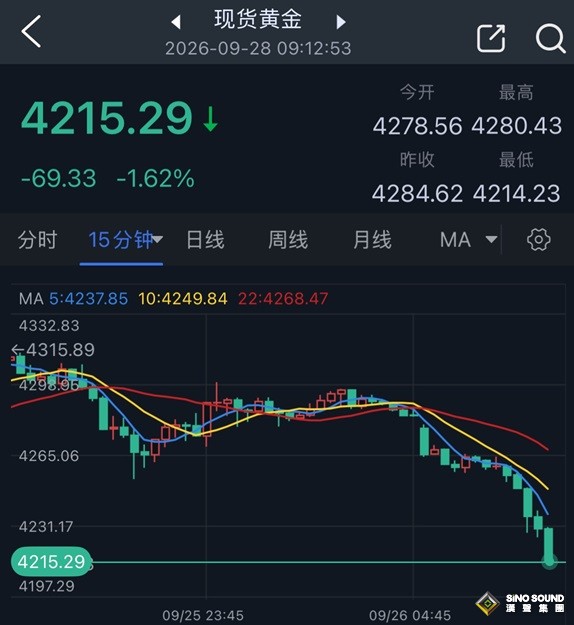
(15-minute chart of spot gold, Source: 24K99)
Bloomberg’s latest analysis on Monday stated that gold extended last week’s decline. The deadlock over the Strait of Hormuz keeps energy costs elevated, which continues to pressure the Federal Reserve to raise interest rates further to curb stubbornly high inflation. Gold fell more than 2% for the full week last week.
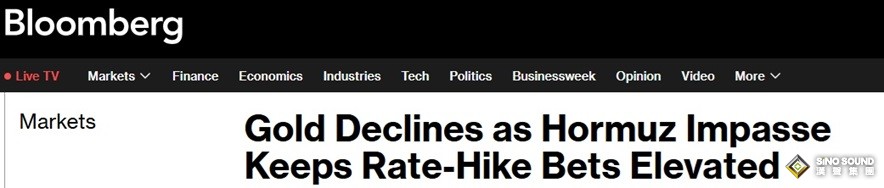
(Screenshot Source: Bloomberg)
While gold acts as a traditional inflation hedge, it bears no interest. Rising interest rates can reduce gold’s appeal compared with interest-bearing assets.
Oil prices climbed as Iran stated it would not ease its conditions for reopening the Strait of Hormuz. Earlier, U.S. President Donald Trump rejected Iran’s proposal to reopen the strait within seven days. Trump told media outlet Axios that he expects negotiations to resume between the two sides this week.

The Iran-U.S. conflict has entered its eighth month. Brent crude oil has surged by 70% since the start of 2026.
Cleveland Fed President Beth Hammack said last Friday that the rally in long-term U.S. Treasury yields is driven by multiple factors, including stronger economic growth prospects, concerns over government debt, and market expectations for additional rate hikes.
Fed officials voted unanimously to raise benchmark interest rates by 25 bASIs points in mid-September. Since then, multiple officials have signaled that further hikes may be needed. Investors currently price in around a 65% probability of another Fed rate hike in October.
Meanwhile, U.S. consumer confidence fell to a four-month low in September.
In the bond market, the extra yield investors demanded for holding 10-year U.S. Treasuries over 2-year Treasuries narrowed to just 17 bASIs points last week, the smallest gap since early 2025.
This so-called "flattening yield curve" raises the possibility that long-term Treasury yields will soon fall below short-term yields, forming a yield curve inveRSIon. Closely watched by markets, this phenomenon is generally regarded as a warning signal of economic recession.
Gold prices are now far below the all-time high near $5600 per ounce hit in January this year.
Even so, gold’s weak performance has not halted M&A activity in the gold sector. South African gold miner Gold Fields has made a takeover proposal for Australia’s largest gold producer Northern Star Resources in what could become a major deal, yet Northern Star rejected the bid on Monday.
The Bloomberg U.S. Dollar Spot Index, which measures the dollar’s performance, rose 0.1% early Monday ASIan trade. The index has gained 2% since early September.
At 09:12 Beijing Time, spot gold traded at $4215.29 per ounce.