

Gold closed lower again this week, with the market continuing to seek support around the $4300 per ounce level. Although downside risks have risen markedly, multiple analysts argue that gold still demonstrates considerable resilience. Meanwhile, the 10-year U.S. Treasury yield has climbed to a two-year high of 5.20%. Spot gold settled at $4284.62 per ounce on Friday, down $92.89 or 2.12% from last Friday.
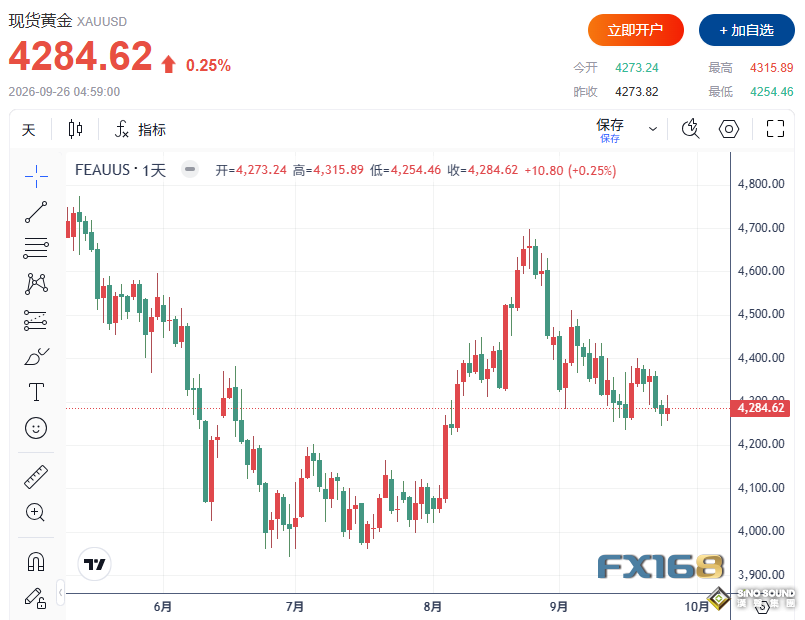
(Source: FX168)
The repricing of the Federal Reserve’s policy path stands as the core factor weighing on gold prices. Barbara Lambrecht, Commodity Analyst at Commerzbank, stated that the market is increASIngly pricing in expectations of earlier U.S. interest rate hikes, pushing U.S. Treasury yields and real interest rates higher and raising the opportunity cost of holding gold. She also noted that while the current environment is less favourable compared with two months ago when gold was testing support near $4000, gold has not suffered an uncontrolled collapse.
Commerzbank believes long-term capital remains allocated via gold ETF holdings, implying limited room for further pullbacks. Neil Welsh, Head of Metals at Britannia Global Markets, also said despite selling pressure, sustained central bank gold purchases, geopolitical tensions and deepening fiscal concerns offer structural buffers for the gold market. Joy Yang, Global Index Product Management Lead at MarketVector Indexes, pointed out subdued stock market volatility also helps preserve gold’s appeal.
Elevated U.S. Treasury Yields Weigh on Gold

Currently, the S&P 500 hovers near record highs above 7000. Stock volatility remains low even amid sticky inflation and rising bond yields. Yang said this environment shows equity investors are relatively calm over rising bond market risks, yet some capital may use gold as a hedging tool while waiting to see whether inflationary pressures ease.
Nevertheless, most analysts warn gold will struggle to fully escape selling pressure next week if U.S. Treasury yields stay above 5%. Ole Hansen, Head of Commodity Strategy at Saxo Bank, said he will focus on the new support level of $4235 per ounce next week. A break below this level may trigger further pullbacks and retest the $4000 zone seen between June and July. Conversely, if gold can withstand the dual pressure of rising yields and a stronger U.S. dollar, it would signal solid underlying demand. In his view, only a reclaim of the $4400 resistance level can shift the current defensive market tone.
Waleed Said, Market Analyst at GivTrade, argued $4000 per ounce is an achievable downside target, as aggressive market bets for additional Fed rate hikes this year are not materially overpriced and inflation remains well above the central bank’s 2% target. He stated gold remains biased to the downside as long as yields stay at current highs. If the Fed keeps raising rates and yields stay peRSIstent, a drop to $3800 cannot be ruled out.
Next Week’s Economic Data as Critical Catalyst
Although short-term sentiment is bearish, some analysts believe next week’s economic data may mark a key turning point for gold’s trajectory. A string of major releases is due, including the latest Personal Consumption Expenditures (PCE) price index, which is expected to show peRSIstent inflation pressures. The September Non-Farm Payrolls report on Friday will test labour market resilience under the current economic backdrop. Manufacturing data and private-sector employment figures will also draw attention.
Analysts generally agree gold investors should pay close attention to labour market data, which may exert a larger market impact than inflation figures. Welsh said weaker-than-expected jobs and wage numbers could pull yields and the U.S. dollar lower, immediately opening upside space for gold. On the contrary, a strong employment report may bolster the dollar and continue to cap gold.
Said added that the last time U.S. jobs data missed estimates, the market sharply repriced rate expectations and even removed rate hikes from the table. Monte Safieddine, Head of Research at Capital.com, said he will monitor next week’s PMI readings. He believes gold has held up well because investors are reluctant to step into the bond market, and underlying structural issues remain unresolved. If both PMI and labour data show clearer signs of weakness next week, it may prompt less hawkish rhetoric from the Fed.
High Interest Rates May Create Long-Term Buying Opportunity
From a longer-term perspective, many analysts still view gold’s recent pullback as a potential buying opportunity, arguing high interest rates may ultimately act as a catalyst for a new rally. Said pointed out U.S. debt stood at roughly $8.9 trillion the last time yields were this high, compared with more than $40 trillion today. This means every 1 percentage point rise in average borrowing costs adds approximately $400 billion in annual interest expenses, a level unsustainable over the long run in an environment with yields above 5%.
In his opinion, either slowing economic growth will force the Fed to pivot, or inflation will gradually erode debt and the U.S. dollar. Both outcomes are bullish for gold. Markets will closely watch the Reserve Bank of Australia rate decision, U.S. Consumer Confidence and JOLTS job openings data on Tuesday; ADP employment, U.S. final Q2 GDP and PCE on Wednesday; ISM Manufacturing PMI on Thursday; and Non-Farm Payrolls on Friday. All these releases may amplify gold price volatility.