
Global gold market faced notable pressure again on Thursday. Spot gold edged down 0.3% to settle at $4274.58 per ounce, dipping to an intraday low of $4244.16 per ounce, the lowest level since September 16 and a fresh one-week trough, barely holding above the near one-and-a-half-month low of $4235 hit on September 16. December gold futures closed 0.5% lower at $4298. The move resulted from the combined forces of energy prices, interest rate expectations and US dollar movements. As a traditional safe-haven and inflation hedge asset, gold has been temporarily shunned by the market due to higher holding costs and a stronger US dollar. During Friday’s ASIan morning session, spot gold traded in a narrow range near $4273 per ounce.
Spiking Oil Prices Fuel Inflation Fears and Weaken Gold’s Hedging Logic
The direct trigger for gold’s decline came from the crude oil market. On Thursday, Houthi forces launched missile attacks on Saudi Arabia. Although Saudi Arabia successfully intercepted the ballistic missiles, market worries over Middle East supply disruptions flared rapidly. Brent crude futures closed up 3.4% at $106.60 per ounce, marking the highest closing level since September 15. US crude rose 2.7% to $94.61 per barrel. Both contracts once jumped nearly 5% intraday. This rebound in oil prices put energy costs back in the spotlight.
Rising energy costs tend to pass through to overall prices via production expenses. When producers pass higher fuel and raw material costs downstream, inflation expectations reignite. Although gold theoretically works as an inflation hedge, in actual trading markets focus more on the possible responses from central banks. Once inflation pressures resurface, the odds of higher policy rates rise, and rate hikes lift the opportunity cost of holding gold. David Meger, Director of Metals Trading at High Ridge Futures, stated that the synchronized rise in energy prices and interest rates keeps weighing on gold. Higher energy costs stoke inflation fears and raise the likelihood of further Fed tightening, which erodes gold’s appeal.
Fed Officials Deliver Aggressive Hawkish Remarks, Rate Expectations Revised Sharply Higher
Resonating with climbing oil prices are the recent dense hawkish comments from Fed officials. Last week, the Fed raised interest rates by 25 bASIs points to a target range of 3.75%-4.00%, its first rate hike in three years. Since then, multiple officials have emphASIzed that further action may be necessary if inflation fails to cool markedly. On Thursday, Philadelphia Fed President Harker and New York Fed President Williams spoke in succession, arguing that additional rate hikes may be needed to rein in "unacceptably high" inflation. Fed Governor Barr also previously made it clear that further monetary tightening is required.
The market reacted extremely quickly to these signals. The CME FedWatch Tool shows traders now price in roughly a 69% probability of a rate hike at the October meeting, noticeably higher than a week ago. Meanwhile, the US Treasury market saw dramatic adjustments. The 30-year Treasury yield briefly hit 5.5016%, the highest reading since June 2004, and closed at 5.472%, up 7 bASIs points. The 10-year Treasury yield climbed to 5.185%, touching an intraday high of 5.2251%, a nearly 19-year peak. The two-year Treasury yield also advanced to 4.914%. The steepening and overall rise of the yield curve directly lifted the opportunity cost of holding non-interest-bearing gold, diverting some capital toward positive-yield US dollar assets.
Stronger US Dollar and Geopolitical Turmoil Create a Clearer Bearish Path for Gold
The US Dollar Index rose to a two-month high on Thursday, touching 101.39 intraday and finishing near 101.28. Robust employment data reinforced this move — initial jobless claims fell to 197,000 last week, below the market forecast of 201,000, showing the labour market remains solid. A stronger dollar makes dollar-denominated gold more expensive for overseas buyers and naturally curbs demand.
At the same time, peRSIstent uncertainty in the Middle East offered some safe-haven support to the US dollar. Houthi attacks and rumours of US-Iran negotiations over the Strait of Hormuz have pushed up oil prices while making the market weigh risk assets and safe-haven assets repeatedly. The end result: higher oil prices amplify inflation and rate hike expectations, which support the US dollar and place gold in a relatively unfavourable position.
Ole Hansen, Head of Commodity Strategy at Saxo Bank, warned that the low support around $4235 per ounce for gold recently is the first key level to watch. A decisive break below this zone may shift market focus back toward the $4000 level seen between June and July. Although gold remains at a relatively high level, upside resistance and downside risks coexist.
Outlook
Overall, this round of gold correction is not driven by a single factor but by the combined impact of surging oil prices, hawkish Fed rhetoric, spiking Treasury yields and a stronger US dollar. Gold’s traditional safe-haven and inflation hedging properties remain intact, yet its relative attractiveness has been temporarily suppressed amid high rates and a strong dollar environment.
In the short term, markets will keep a close eye on developments in the Middle East, oil price swings and further remarks from Fed officials. If oil gains are contained, inflation expectations ease, or US dollar and Treasury yields pull back noticeably, gold may hold support near $4235. Conversely, if rate hike expectations keep rising and the US dollar stays strong, gold may face further corrective pressure. While monitoring geopolitical risks, investors need to prioritize the interest rate path and US dollar trends to accurately assess gold’s next directional move.
For this trading session, investors should also watch the preliminary reading of US August durable goods orders month-on-month, remarks from Kansas City Fed President Schmid, and news regarding the China-US leaders’ meeting.
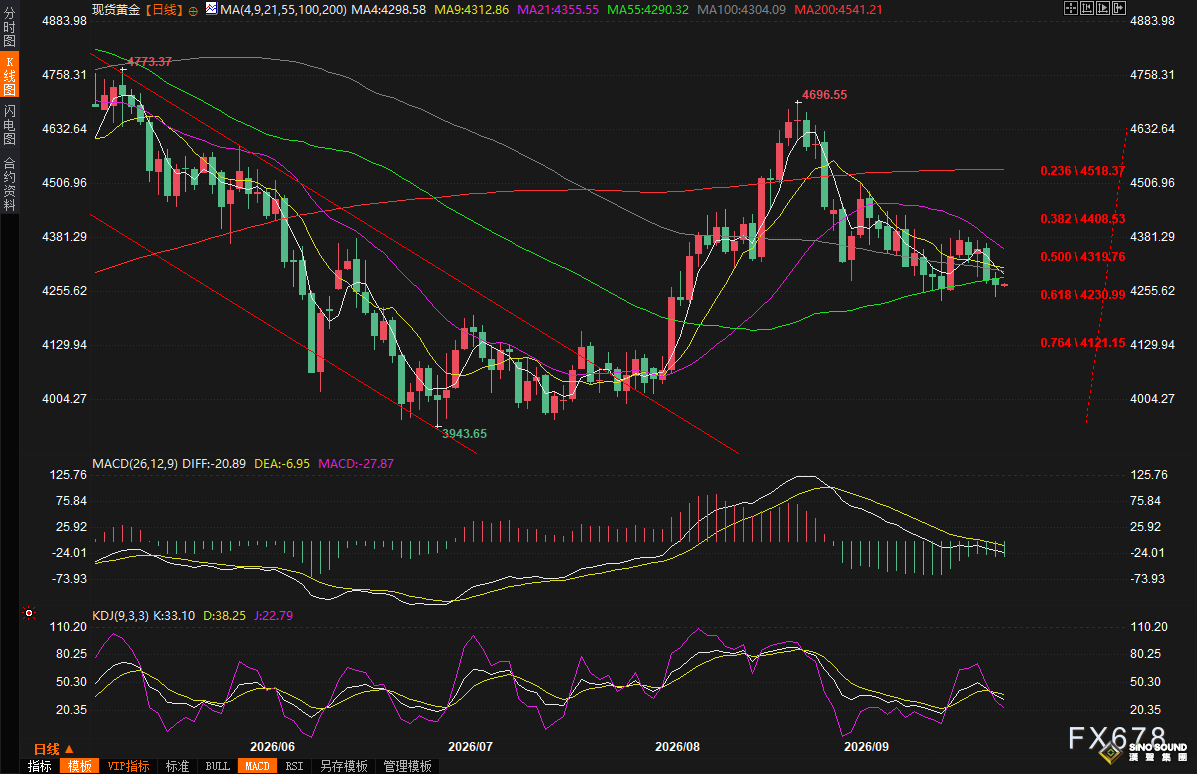
(Spot Gold Daily Chart, Source: Yihuitong)
At 07:44 Beijing time, spot gold was quoted at $4273.86 per ounce.