

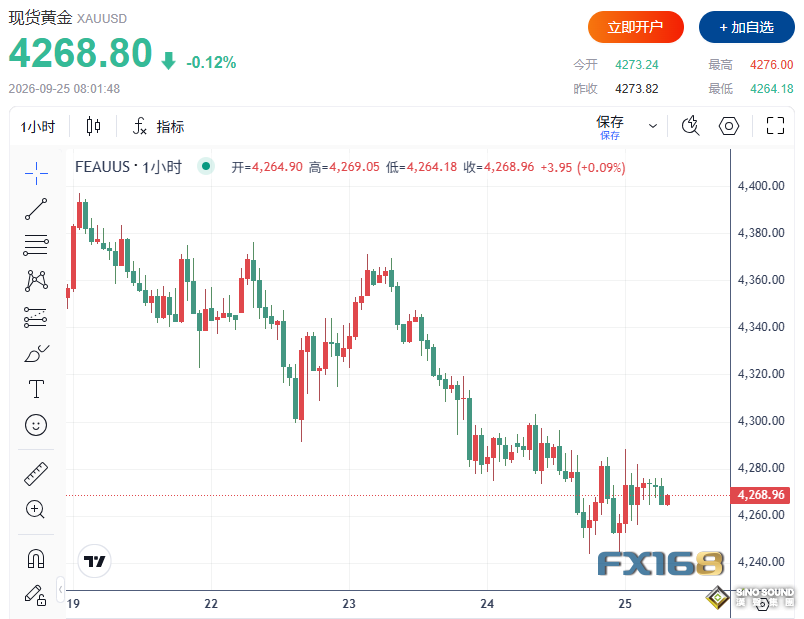
During Thursday's US session, spot gold and silver continued to weaken. With US Treasury yields staying high, the US dollar strengthening and oil prices rebounding, these two non-interest-bearing precious metals faced sustained pressure. At the close, spot gold settled at $4273.82 per ounce, down 0.31% on the day; spot silver traded at $63.848 per ounce, a drop of 0.91%. #GoldClosingComment#
(Source: FX168)
US Treasury Yields and Dollar Weigh on Gold and Silver
Market bets on another Fed rate hike remain high. Better-than-expected US economic and housing data have further reinforced the "high-yield trade" logic. The September preliminary PMI showed private sector growth at its fastest pace in more than five years. US initial jobless claims for the week ending September 20 fell to 197,000. August new home sales rose by 6.4% to an annualized rate of 684,000 units.
Federal funds futures during the trading session priced in roughly a two-thirds to 70% probability of an October rate hike. Meanwhile, the US Dollar Index held near 101, and the 10-year US Treasury yield hovered around the 5.1% level. Since gold and silver generate no interest, rising yields and a stronger dollar usually erode their appeal.
Markets will next watch US August durable goods orders and the final reading of the UniveRSIty of Michigan Consumer Sentiment Index due on Friday. Stronger orders data or stickier inflation expectations may keep gold suppressed by yields and the dollar. Weaker figures will test whether short-term selling pressure after gold broke below $4300 this week is nearing an end.
Strait of Hormuz Tensions Lift Oil Prices
The Strait of Hormuz and US-Iran tensions remain a direct shock factor for crude oil markets and exert indirect pressure on gold. Little visible progress was made in the latest negotiations, with the two sides still divided over terms to end the conflict. Tehran’s proposal still prioritizes lifting US maritime blockades on Iranian ports and reopening the Strait of Hormuz.
Evening market data showed Brent crude at $105.42 per barrel and WTI crude at $94.30 per barrel. As international crude relies heavily on Middle East sea lanes, Brent maintains a higher maritime risk premium. Rising oil prices boost safe-haven demand on one hand, but also fuel inflation fears, push up US Treasury yields and reinforce Fed tightening expectations, creating a complex impact on precious metals with both safe-haven support and rate pressure.
US and European Stock Markets End Mixed
North American stocks were nearly flat after volatile trading. The S&P 500 fell 1.90 points, or less than 0.1%, to 7704.13. The Dow Jones Industrial Average dropped 161.61 points, or 0.3%, to 51349.98. The Nasdaq Composite gained 3.34 points, or less than 0.1%, to 26939.37. The Russell 2000 lost 3.09 points, or 0.1%, to 2835.57.
European stock markets mostly closed lower amid rising oil prices and climbing bond yields. The STOXX Europe 600 fell 0.55% to 636.43. Germany’s DAX declined 0.57% to 25266.53. France’s CAC 40 dropped 0.52% to 8081.43. The UK FTSE 100 lost 0.24% to 10679.99. Italy’s FTSE MIB fell 0.85% to 51543.45. Overall, higher energy costs and tighter financing conditions are weighing on risk appetite.
Focus on Technical Levels
From a technical perspective, the next target for spot gold bulls is to reclaim the resistance zone of $4311.00 to $4347.26. A sustained breakout would open the next target at $4400.00 and further toward $4530.00. For bears, a break below $4252.44 would send gold down to $4160.00, followed by the psychological level of $4000.00. The primary resistance sits at $4311.00, then $4347.26. The primary support is at $4252.44, then $4160.00.
For silver, bulls need to push prices back above the $65.3565 to $66.4745 zone. A successful breakout would target $68.00 and then the psychological level of $70.00. If bears break below $63.1920, the next target is the $61.00 to $62.00 range, followed by $57.00. Silver’s primary resistance is $65.3565, then $66.4745. The next support is $63.1920, then $62.00.
In external markets, the correlation among Nymex WTI crude, Brent crude, 10-year US Treasury yields and the US Dollar Index remains the key variable determining the short-term direction of gold and silver. If oil prices continue to lift inflation expectations and drive yields higher, precious metals may stay under pressure. Conversely, weaker economic data ahead may loosen market pricing for the Fed’s rate hike path and offer precious metals some breathing room.