

China’s gold demand is sending a strong signal. Latest data shows China’s gold imports in August rose to the highest monthly level this year, pushing gold imports for the first 8 months of 2026 above 1000 tonnes. This marks the highest level for the period since at least 2017 and has already surpassed China’s total gold imports for the whole of 2025.
While global gold prices remain at high levels, China is accelerating gold imports. This trend is driven by rising investment demand, RMB exchange rate, price spread between domestic and international gold prices, and continuous gold purchases by the central bank. Meanwhile, China’s gold ETFs keep attracting capital inflows. The People’s Bank of China added a substantial 20.2 tonnes of gold reserves in August, marking the largest monthly purchase in nearly three years.
Imports in First 8 Months Surpass Last Year’s Full-Year Total
Latest customs data shows China imported more than 1000 tonnes of gold from January to August this year, compared with roughly 886 tonnes for the entire year of 2025. This means that after only two-thirds of the year, gold imports have exceeded the full-year figure for last year. Measured by value, China’s spending on gold imports in the first eight months reached approximately $158.8 billion, higher than the $96.5 billion for all of 2025.
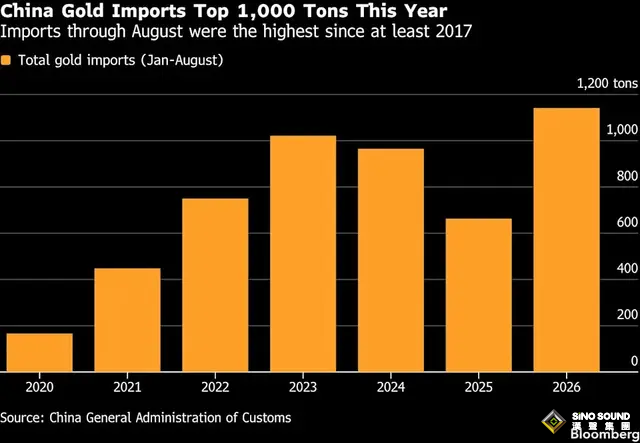
This growth is particularly noteworthy as international gold prices have stayed near historic highs this year. Normally, high gold prices curb physical demand, yet Chinese investors maintain strong appetite for gold allocation. Domestic gold prices were at a premium to international benchmark prices at one point, creating arbitrage opportunities for traders to boost imports.

Zijie Wu, analyst at Kingring Futures, stated that robust investment demand pushed mainland China gold prices above international benchmarks, making gold imports more attractive to wholesalers.
At the same time, the RMB has remained relatively strong overall this year, eASIng the import pressure for dollar-denominated gold. Wu Zijie believes this has created more favourable conditions for gold imports and allowed regulators to grant sufficient import quotas to the market.
Sustained Capital Inflows into Gold ETFs
Apart from the sharp rise in imports, Chinese investors have shown markedly greater enthusiasm for gold allocation via ETFs.
World Gold Council data shows China’s gold ETFs added around 11 tonnes of holdings in August alone, lifting total holdings to roughly 293 tonnes. Cumulative holdings increased by about 45 tonnes over the first eight months of the year. By the end of August, assets under management of China’s gold ETFs stood at approximately 282 billion RMB, equivalent to around $42 billion.
Globally, gold ETF demand was also very strong in August. Global gold ETFs recorded about $18 billion in net inflows, with total holdings rising by 121 tonnes to 4189 tonnes, hitting a record high. ASIan gold ETFs attracted roughly $2 billion in inflows, and China was one of the major sources of capital inflows in ASIa.
The World Gold Council noted that the rebound in domestic Chinese gold prices, falling treasury yields and relatively weak equity market performance have further boosted gold’s appeal among investors.
Amid pressured returns from traditional investment channels such as real estate, and peRSIstent macroeconomic and geopolitical uncertainties, gold is increASIngly viewed by Chinese households and institutional investors as an asset allocation and wealth preservation tool.
Central Bank Added 20.2 Tonnes in August in One Go
Another major source of buying comes from the People’s Bank of China.
World Gold Council data shows the People’s Bank of China reported an increase of 20.2 tonnes in gold reserves in August, the largest monthly addition since October 2023 and marking the 22nd consecutive month of gold reserve growth.
As of the end of August, China’s official gold reserves reached approximately 2387 tonnes, with gold accounting for roughly 9% of total foreign exchange reserves. Over the first eight months of this year, the central bank has accumulated about 80 tonnes of gold in total.
Driven by rising gold prices and continuous central bank purchases, the market value of China’s gold reserves has risen noticeably. At the end of August, China’s official gold reserves were valued at around $350.08 billion, an increase of roughly $43.7 billion from $306.35 billion at the end of July.
Sustained gold purchases by the central bank not only directly lift official gold demand, but also to some extent draw greater attention from domestic investors to gold’s long-term allocation value. Wu Zijie believes the noticeably accelerated pace of gold buying by the central bank in recent months has supported sentiment in the retail market.
Resonance of Three Forces in China’s Gold Demand
A rare convergence of multiple demand drivers is emerging in China’s gold market: record import volumes, continuous capital inflows into gold ETFs, and markedly faster gold purchases by the central bank.
From the wholesale market perspective, the domestic-international gold price spread and RMB exchange rate support imports. On the investment side, low interest rates, asset allocation needs and macro uncertainties push capital into gold ETFs and physical gold. On the official side, the People’s Bank of China continues to raise gold’s share within foreign exchange reserves.
That said, there remains clear divergence within gold demand. World Gold Council data shows withdrawals from the Shanghai Gold Exchange dropped seasonally in August, reflecting that high gold prices have suppressed jewellery and some physical consumption demand. Meanwhile, investment and official demand represented by ETFs and the central bank stayed robust.
This means the core forces driving China’s gold market are increASIngly tilted toward investment and asset allocation demand rather than traditional jewellery consumption.
As the world’s largest gold consumer market, if the three capital streams of imports, ETF allocations and central bank gold purchases remain strong, shifts in China’s demand will continue to act as an important variable shaping global gold supply and demand fundamentals and gold price trends.