

Although the Fed raised interest rates by 25 bASIs points this week and signalled that further policy tightening may still occur within the year, gold prices held key support levels ahead of the weekend. Analysts point out that the resilience of the gold market is no longer solely determined by monetary policy. Investors are turning their attention to deeper structural factors, including deteriorating government finances, peRSIstent inflation, geopolitical uncertainty and shifts in global reserve allocation.
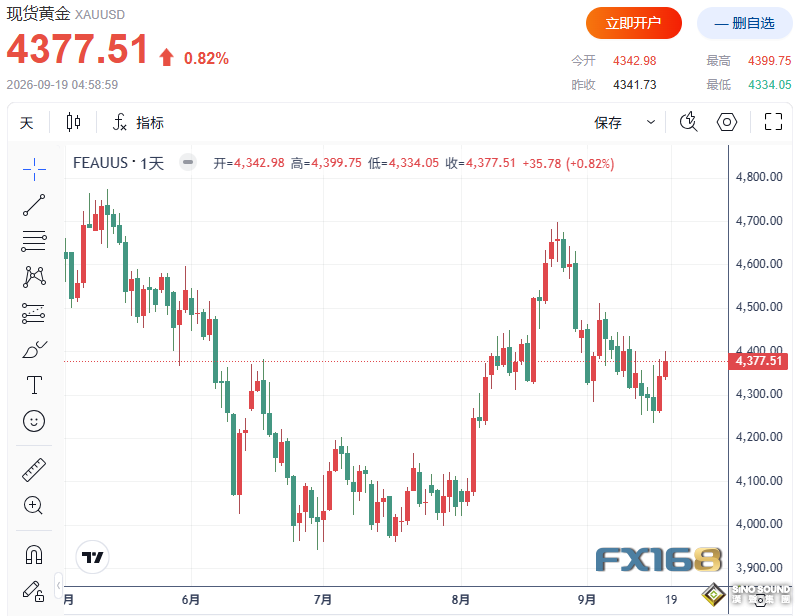
On Friday, spot gold closed at $4377.51 per troy ounce, rising $28.80 or 0.66% for the week and ending three consecutive weeks of declines. Meanwhile, US Treasury yields remained elevated, with the 10-year Treasury yield hovering near the psychologically important 5% mark. Under conventional logic, these factors should have exerted obvious pressure on gold, yet gold prices did not collapse and instead demonstrated strong resistance to downside moves.
(Source: FX168)
Limited Impact of Rate Hike
Chris Vecchio, Head of Futures and Forex Strategy at Tastylive, said gold managed to wrap up the week steadily because the market is pricing beyond the Fed’s latest 25-bASIs-point rate hike. He noted that although the Fed hiked rates and issued signals of further tightening, the latest economic projections show the future rate hike path shallower and slower than previously expected by the market.

The Fed’s forecast for the federal funds rate at year-end stands at 4.1%, which implies that after this September rate increase, only moderate additional tightening may follow, rather than the more aggressive hiking cycle investors had feared. Vecchio believes the broader backdrop supporting gold remains unchanged, including concerns over US fiscal stability, worsening government fiscal conditions, weakening marginal demand for US Treasuries, and falling demand for the US dollar amid increASIngly fragmented global trade.
He said these factors are pushing Treasury yields higher on one hand, while continuously supporting gold on the other. Jeff Sarti, CEO of Morton Wealth, also told Kitco News that the Fed’s latest move is only a secondary factor compared with the larger forces driving gold prices.
Sarti argued that the Fed is operating in an environment dominated by ongoing government spending and huge deficits, and monetary policy has been cornered to some extent. Ultimately, the bond market may determine whether the current fiscal trajectory is sustainable. He stated plainly: “I think each 25-bASIs-point hike here is just noise. I believe the bigger signal is fiscal.”
ETF Inflows Offer Support
Ole Hansen, Head of Commodity Strategy at Saxo Bank, said gold’s performance after Wednesday’s rate decision shows Fed monetary policy has been largely priced in by the market. By the weekend, gold seemed to “ignore” the US rate increase.
Without unexpected moves from central banks, Hansen pays more attention to resurgent investment demand. He pointed out that despite the recent pullback in gold prices, gold ETF holdings have climbed to a seven-month high, indicating solid demand from investors less sensitive to interest rates even amid elevated yields.
Hansen compared the current environment with 2022 and 2023. Back then, aggressive Fed rate hikes and rising bond yields failed to suppress gold peRSIstently as traditional theories predicted. “Just like now, underlying investor demand is less sensitive to rates, and yields provide an important hedge against traditional macro headwinds,” he said. “At present, this underlying demand appears intact. I maintain a bullish view; rate hikes only slow the rally instead of ending it.”
Technical Focus Above $4420
Despite the bullish fundamentals, analysts warn gold still needs to break several key technical resistances to build a more sustained rebound. Vecchio noted that a prior head-and-shoulders breakdown eventually turned into a false breakout because gold stayed above the downtrend line originating from the January historical high.
Hansen is also closely watching this trend line. He said gold is testing the steep downtrend from the August high near $4700 per ounce, with the primary resistance zone at $4420 to $4440. An effective break above this area would raise the likelihood of gold moving toward the 200-day moving average, currently near $4540.
Vecchio added that if the 10-year US Treasury yield stays below 5% and oil prices keep falling, gold and silver may see a “clearer” upward path. With relatively light economic data this week, the market will continue to monitor changes in peripheral markets including the US dollar, Treasury yields and crude oil prices.
Next Week’s Data and Central Bank Risks
Amid peRSIstent global inflation pressuring monetary policy, the Swiss National Bank (SNB) is still moving against the tide. Charlotte de Montpellier, Senior Economist for France and Switzerland at ING, expects the SNB to keep its policy rate at 0% and continue targeted foreign exchange intervention strategies. As long as domestic inflation remains moderate and the Swiss franc stays strong without excessive appreciation, the SNB can maintain a markedly looser policy stance than most other central banks.
The market will also keep an eye on US manufacturing data and a heavy schedule of Fed speeches next week, which may bring fresh headline risks. Traders will closely watch how policymakers view the monetary policy path after this week’s rate hike, especially whether peRSIstent inflation will force the central bank to tighten further before year-end.
Key economic data to watch next week: S&P Global flash PMI figures on Wednesday, the SNB monetary policy decision and US weekly initial jobless claims on Thursday, and US durable goods orders plus revised UniveRSIty of Michigan consumer sentiment index on Friday.
Overall, gold’s current trend shows market pricing logic is shifting from pure interest rate expectations toward a comprehensive assessment of fiscal conditions, inflation, geopolitics and global asset allocation. If peripheral markets continue to support gold, spot gold may remain in high-level consolidation in the short run, waiting for technical confirmation of the rebound direction.