

Gold rebounded to a high level after sharp swings this week. Driven by surging oil prices, US Treasury yields approaching 5% and market bets on Fed rate hikes, gold faced pressure early in the week and dropped to a more-than-one-month low. However, after the Fed delivered the expected rate hike, gold rebounded rapidly as pressure from oil prices and yields eased. The weekly gold chart closed higher, ending three consecutive weeks of declines.
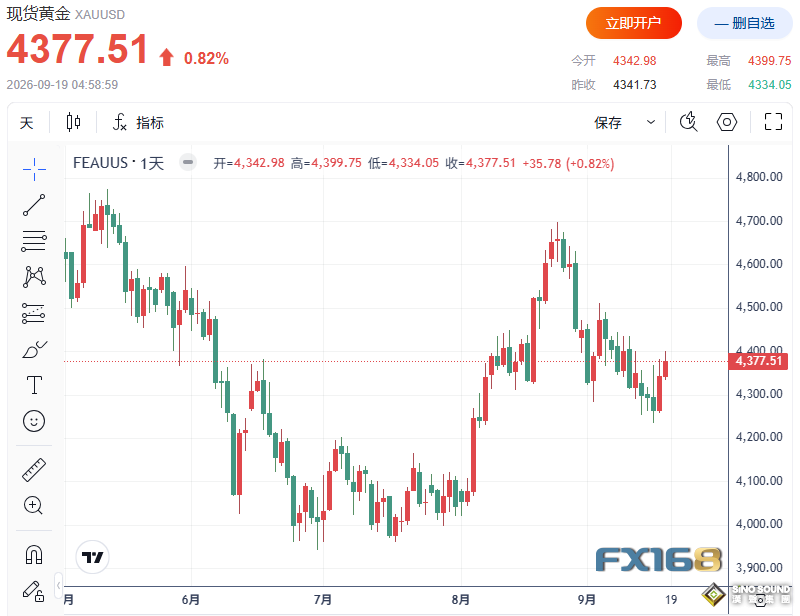
On Friday, spot gold settled at $4377.51 per troy ounce, rising $28.80 or 0.66% for the week and halting the previous three-week losing streak. At the opening of Sunday night’s session, gold was quoted at $4340 per troy ounce, before being sold off amid rising crude oil prices, renewed US-Iran tensions and growing inflation risks. By Tuesday, gold dipped to around $4279.30 per troy ounce, hitting a more-than-one-month low.
(Source: FX168)
On Wednesday, the Federal Open Market Committee (FOMC) voted 12-0 to raise the federal funds rate target range by 25 bASIs points to 3.75%-4.00%. The latest dot plot showed 16 out of 18 policymakers still expected another rate hike before year-end. Spot gold fell again after the decision and touched the weekly low of $4261.80 per troy ounce on Wednesday afternoon.
Gold Recovers Quickly After Rate Hike

Entering Thursday, gold began to recoup losses as crude oil prices retreated, the US dollar weakened and US Treasury yields fell from weekly highs. Gold extended its rebound on Friday. With oil prices falling for the third straight trading day and yields continuing to ease from highs, spot gold hit an intraday peak of $4400.60 per troy ounce, the highest level of the week.
Although gold pulled back slightly from the intraday high, it stayed near $4377 per troy ounce before the weekend, meaning gold posted a gain across the five trading days of the week. Market participants noted that support around the $4300 level was especially critical, helping gold maintain its medium-term uptrend after the rate hike.
Wall Street Is Fully Bullish
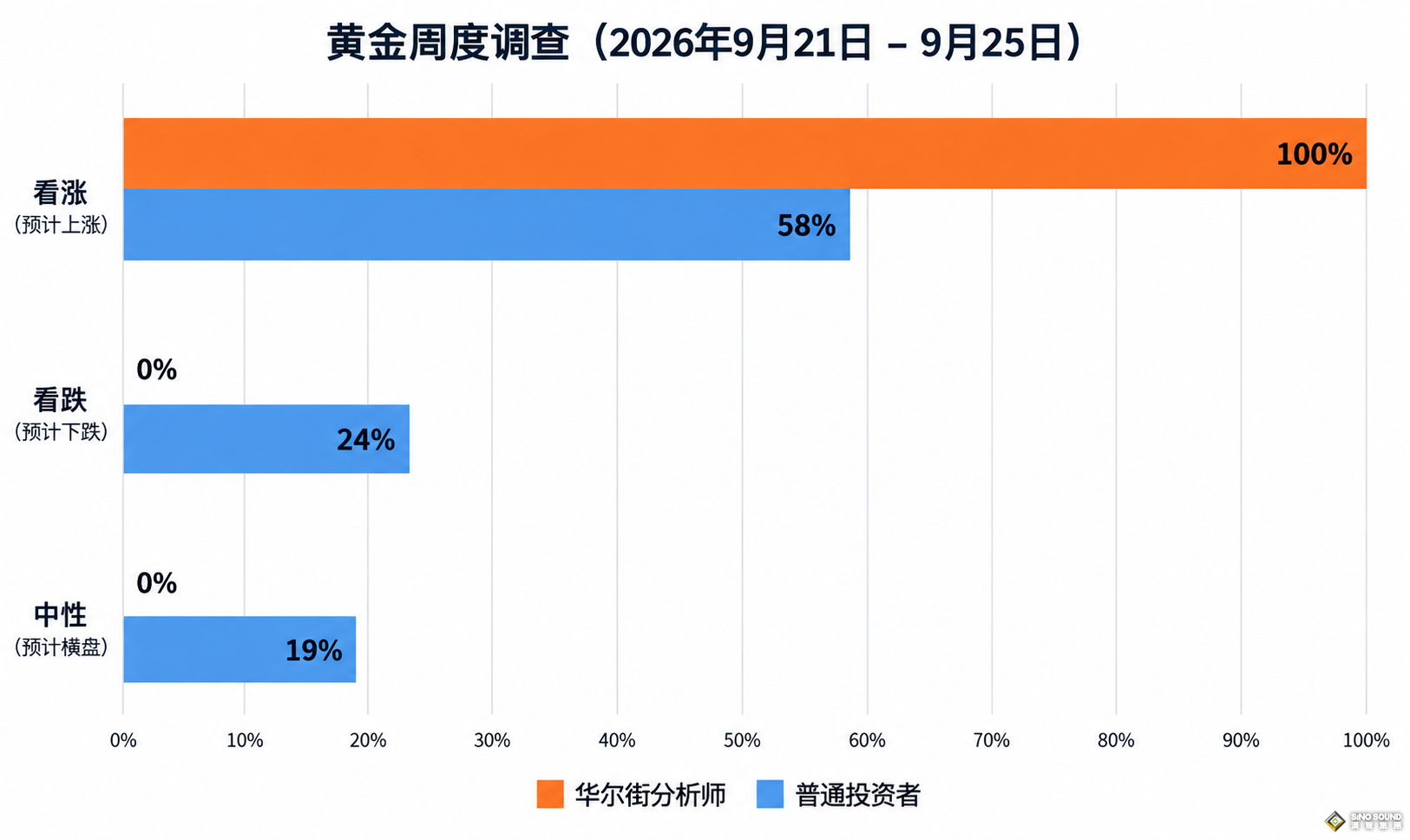
The latest Kitco News weekly gold survey shows bullish sentiment among Wall Street analysts rose sharply after the Fed rate hike. All 16 participating analysts expected gold prices to move higher next week, representing a 100% bullish reading. Meanwhile, bullish retail investors also increased: out of 220 online votes, 127 investors or 58% predicted gold would rise next week, 52 or 24% expected a drop, and 41 or 19% predicted sideways consolidation.
Marc Chandler said spot gold posted its first weekly gain in four weeks. Though the gain was just above 0.5%, it was enough to signal the return of buying interest. He noted gold fell near $4235.60 mid-week before rebounding to nearly $4400 ahead of the weekend. A break above the $4432-$4445 zone could further strengthen market sentiment.
Adam Button argued gold buying still emerged despite the FOMC’s hawkish stance, showing investor interest in precious metals was not dampened by the rate hike. He described the outlook simply as "higher" and called the performance "impressive".
Technicals and Inflation Expectations Offer Support
Darin Newsom, Senior Market Analyst at Barchart.com, said the short-term trend for December gold turned upward on the daily closing chart, indicating a slight rise in buying interest or at least eASIng selling pressure. He pointed out gold closed below the 45-day moving average on Tuesday but did not trigger algorithmic selling. Combined with stochastic readings closer to oversold than overbought and neutral volatility, gold may attract more buying next week.
Mark Leibovit, publisher of VR Metals/Resource Letter, issued a "buy" rating and said gold was at a "cyclical low". Rich Checkan, President and COO of Asset Strategies International, said this week’s 25-bASIs-point FOMC rate hike had already been priced into the market, which is why gold rebounded quickly after a short dip. In his logic, there is little reason to abandon gold when rates sit at 4% and official inflation stands at 3.4%. If consumers experience inflation close to 8%, gold becomes far more attractive compared to negative 4% real returns.
James Stanley, Senior Market Strategist at Forex.com, also remained bullish. He said gold closed positive on the weekly chart for the first time in three weeks, and support near $4300 was critical, showing bears failed to sustain losses after the FOMC meeting. A degree of capitulation selling may have occurred in the market.
Geopolitics and Seasonality In Focus
Sean Lusk, Co-Director of Commercial Hedging at Walsh Trading, said gold was gaining fresh upward momentum from the Fed decision and seasonal factors. He expected gold could strengthen further in October if energy prices ease, before cooling around the US midterm elections. He warned a renewed crude rally to $110 or $115 would act as a strong resistance, while gold would benefit if oil prices calmed down.
Lusk also said markets were increASIngly driven by geopolitical news rather than purely economic data. The US-Iran deadlock, developments in Yemen and global political tensions could all support gold. Meanwhile, starting from late September, metal markets are usually boosted by physical demand and seasonal factors such as Diwali. Gold is on track to resume a trending upward move unless crude oil surges to $119.
Colin Cieszynski, Chief Market Strategist at SIA Wealth Management, also believed gold may have bottomed in the short run and still has upside in the medium to long term. He noted gold hovered near $4000 over the summer and has now moved back into the $4300-$4400 range, showing a markedly improved market structure compared with summer. If the Fed raises rates again this year, it will most likely not happen before the December meeting. A rate hike in the week before midterm elections is almost impossible, meaning US interest rate policy will likely stay unchanged over the next three months, creating a neutral-to-bullish environment for gold.
Cieszynski added gold, as a traditional inflation hedge, will benefit if inflation picks up again, Treasury yields do not spike sharply and the US dollar does not strengthen dramatically. He also mentioned elections outside the US are adding political uncertainty, an environment that typically favors gold.
Institution Targets $4590
Alex Kuptsikevich, Senior Market Analyst at FxPro, predicted gold would move higher again next week. He said risk assets performed positively in the latter half of the week, and gold staged a rebound amid a stronger US dollar and market reassessment of the outlook for US monetary policy. The Fed’s rate hike showed it would act decisively based on fundamental signals, boosting confidence in the Fed and US assets without hurting stocks, and instead fuelling a strong rebound in precious metals.
Kuptsikevich noted gold only posted a mild weekly gain, but more importantly, the pullback below $4250 after the rate hike has been fully recovered. From a technical analysis perspective, price reversed near the 50-day moving average, confirming the medium-term trend turned bullish and validating the higher-low uptrend established since mid-July. If favourable conditions peRSIst, gold may touch $4500 next week; a move toward the $4700 zone in the coming weeks could convince sceptics that gold is steadily marching toward new highs.
Analysts at CPM Group issued a "buy" recommendation for the period from September 17 to October 2, with an initial target price of $4590 and a stop-loss at $4270. They said gold fell below $4300 after the Fed decision but then fluctuated around $4400. Since hitting the high of $4755 on August 25, gold had been in a downtrend, but this trend now appears to be reveRSIng. Gold has held support levels over the past few days and technicals are gradually improving. A combination of global political developments and fundamental factors could push gold markedly higher in the months ahead. The analysts warned gold may still pull back in the short term, but investors risk missing a major rally if it does not. If price quickly breaks above the target, the stop-loss can be raised to a trailing stop.
Michael Moor, founder of Michael Moor Analytics, also expected gold to keep climbing next week. His multi-timeframe analysis identified multiple key price levels and historical signals, arguing the structure formed from gold’s previous breakouts and pullbacks remains strong. He stated that if the current "benign bullish correction" continues, the minimum target points to the corresponding level of 4963. He also warned that if price falls back below the current formation, renewed pressure should be anticipated.
From a broader market perspective, the core reason gold recovered quickly after the rate hike this week lies in combined shifts in real interest rates, the US dollar and risk appetite. Lower oil prices eased upward pressure on inflation expectations, retreating Treasury yields reduced the opportunity cost of holding non-yielding assets, and geopolitical plus election uncertainty continued to strengthen gold’s safe-haven appeal. If these factors peRSIst next week, gold may keep testing higher ranges.