

On Monday (Sep 14), spot gold tumbled to its lowest level in more than one month. Surging oil prices and strong US inflation data from last week boosted expectations of a Fed rate hike this week, weighing on non-interest-bearing gold.
Spot gold closed down $50.28 or 1.2% at $4298.43 per ounce on Monday, touching the lowest level since August 7 during intraday trading.
10-year US Treasury yield breaks above 5%
Driven by last week’s US Producer Price Index (PPI) and Consumer Price Index (CPI) readings, markets expect inflation may climb further, pushing US Treasury yields higher. Among them, the 10-year US Treasury yield crossed the 5% threshold for the first time since 2023.

On Monday, the 10-year US Treasury yield rose 4 bASIs points intraday to 5.01%. The last time it surpassed 5% was in October 2023.
FXStreet analyst Christian Borjon Valencia noted that gold got off to a weak start this week amid the 10-year US Treasury yield hitting 5%, dipping to a one-month low of $4253 per ounce on Monday. The Federal Open Market Committee (FOMC) monetary policy decision is due this week.
Valencia said surging energy prices lifted the US dollar and kept US Treasury yields elevated, which kept non-yielding gold under pressure on Monday. An attack by Houthi forces on Saudi Arabia’s East-West oil pipeline triggered a precautionary shutdown, cutting crude output by roughly 7 million barrels per day.
The US dollar climbed to a two-week high, making dollar-denominated gold more expensive for holders of other currencies and adding further downward pressure on gold prices.
The US Dollar Index (DXY), which tracks the greenback against six major currencies, rose 0.32% to 99.41 on Monday.
Oil prices spike higher
Oil prices rose roughly 4% early Monday. The shutdown of a key Saudi oil pipeline, coupled with a fresh wave of attacks on Saudi energy and civilian infrastructure and Iranian assaults on vessels in the PeRSIan Gulf, deepened supply concerns.
A previously scheduled meeting between Iran and other PeRSIan Gulf states has been postponed, and diplomatic efforts in the Middle East appear to have stalled.
Jim Wyckoff, market analyst at American Gold Exchange, stated: “Sharply higher crude oil prices on Monday boosted inflation expectations, meaning major global central banks will have to tighten monetary policy to contain inflation, which is bearish for the metals markets.”
Probability of Fed rate hike this week hits 93%
Most economists expect the Fed to raise interest rates this Wednesday and deliver at least one more hike before the end of March next year. This reverses the fragile market consensus for steady rates that prevailed before last Friday’s official inflation data release.
The US Bureau of Labor Statistics (BLS) reported last Friday that August CPI climbed 0.4%, following a modest 0.1% rise in July.
According to the CME FedWatch Tool, traders now price in around a 93% chance of a rate hike at this policy meeting.
Although gold is normally viewed as a safe-haven asset against inflation, rising interest rates tend to reduce the appeal of non-interest-bearing assets such as gold.
Gold Technical Analysis
#GoldTechnicalAnalysis# FXStreet analyst Christian Borjon Valencia pointed out that gold dropped to a five-week low intraday on Monday and tested the 50-day simple moving average (SMA) at $4271 per ounce. The Relative Strength Index (RSI) remains bearish, signaling potential further declines.
Valencia stated that on the upside, the primary resistance for gold sits at the psychological level of $4400 per ounce. A break above this level would open targets at $4450 and $4500 per ounce, followed by the 200-day SMA at $4539 per ounce.
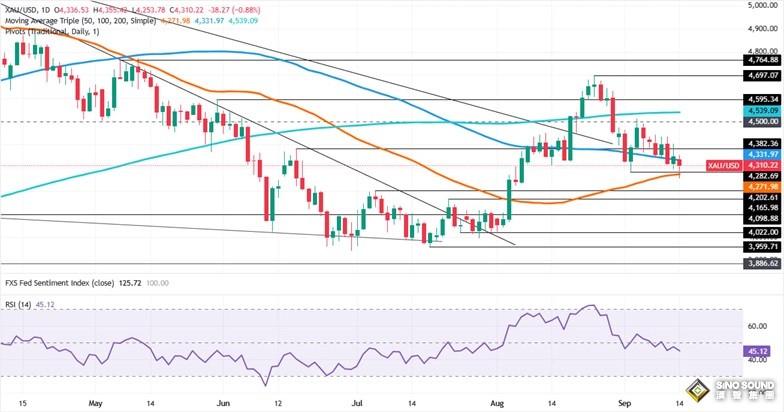
(Spot Gold Daily Chart | Source: FXStreet)
On the downside, gold has broken below the $4300 per ounce mark. Valencia said if gold remains below this level, the subsequent support levels are the September secondary low of $4282 per ounce and the 50-day SMA at $4271 per ounce.