

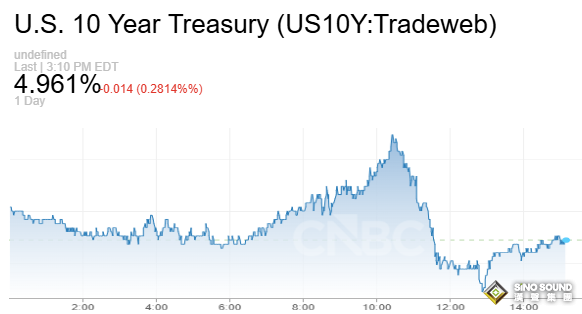
Global financial markets underwent obvious repricing ahead of the Fed's key interest rate decision on Monday (Sep 14). The 10-year US Treasury yield briefly broke above 5% intraday, hitting 5.014%, the highest level since October 2023. Brent crude rose as high as $109.80 per barrel, while US WTI crude touched $104.95. The US dollar strengthened in tandem, whereas gold, silver and US tech stocks came under notable pressure.
The core logic driving market trading is shifting. Escalating Middle East tensions have lifted energy prices. With oil back above $100 per barrel, the downward trajectory of inflation faces new uncertainties. Meanwhile, US inflation data for August remained sticky, and the probability of the Fed delivering a 25-bASIs-point rate hike this week has climbed to roughly 90%. This has prompted the market to reassess previous expectations of looser monetary policy and price in the possibility of "higher rates for longer, or even further tightening".
Macro: Surging oil reignites inflation fears, Fed decision stands as the week’s focal point
The US Consumer Price Index (CPI) rose 0.4% month-on-month in August, higher than July’s 0.1% gain. Inflation remains markedly above the Fed’s 2% long-term target. As the final major inflation release before this week’s policy meeting, this reading has already reinforced expectations of further Fed tightening. The recent sharp rally in international oil prices has further amplified worries of renewed inflation acceleration.

According to the CME FedWatch Tool, markets now price in nearly a 90% chance of a 25-bASIs-point rate hike on Wednesday, a sharp rise from around 60% one week ago. Jay Woods, Chief Market Strategist at Freedom Capital Markets, states that based on current economic data and market pricing, a rate hike is the more widely anticipated outcome. Since this scenario has been largely priced in, the real market focus will shift to guidance on the future rate path from the Fed Chair and the policy statement.
This means this week’s risks do not merely hinge on "whether rates will be raised". If the Fed hikes while signaling further policy tightening, markets may continue to lift expectations for the terminal rate and long-term interest rates. Conversely, if this move is viewed as a relatively "dovish hike", or the Fed gives no clear hint of additional action ahead, the recently rapid rise in the US dollar and Treasury yields may see a phase pullback.
At the same time, other major global central banks are entering critical policy windows. The Bank of Japan is set to announce its rate decision on Friday, with markets closely watching whether it will continue raising rates and the pace of future tightening. The Bank of England is expected to hold rates steady this week, yet markets have begun pricing in potential further hikes down the line. The European Central Bank has already implemented a rate hike previously, showing that the global monetary policy environment is once again constrained by energy and inflation factors.
US Treasuries: 10-year yield tops 5%, repricing of fiscal and inflation risks
The US Treasury market took center stage for global asset pricing on Monday. The 10-year Treasury yield climbed to 5.014% intraday, breaking the closely watched psychological threshold of 5%, before retreating to around 4.95%. A further break above 5.02% would lift the 10-year yield to its highest level since July 2007, the high zone before the global financial crisis.
(Source: CNBC)
Meanwhile, the 2-year Treasury yield holds around 4.63%, and the 30-year Treasury yield remains at the elevated level of roughly 5.33%. The sustained climb in long-term rates reflects not only Fed policy expectations but also a market reassessment of US fiscal deficits, Treasury supply and inflation risks.
Jason Ware, Chief Investment Officer at Albion Financial Group, notes that part of the current rise in bond yields stems from a clear supply-demand imbalance. The US Treasury keeps expanding bond issuance, while corporate financing demand stays high. Massive new debt is competing for limited long-term capital. At the same time, the term premium investors demand for long-dated US bonds is rising, meaning markets require higher returns to compensate for uncertainties over future inflation, fiscal deficits and interest rate volatility.
This point deserves particular attention. If the upward move in long-term yields is driven by robust economic growth and improved corporate earnings, it may not be entirely bad news for risk assets. But if yield gains stem from renewed inflation, widening fiscal deficits and excess Treasury supply, then a 5% 10-year yield will exert a much more pronounced tightening effect on financial conditions.
Treasury Secretary Bessent previously sought to ease pressure on the long-end market by expanding the bond buyback program. However, BMO Capital Markets argues such measures can improve market liquidity to some extent yet cannot alter the fundamental factors pushing 10-year and 30-year yields higher. In the meantime, markets must remain alert to latent risks in highly leveraged bASIs trades. If financing costs, margin requirements or volatility rise further, some hedge funds may be forced to unwind positions simultaneously, amplifying bond market swings.
US Equities: Dual pressure from high rates and AI valuation, tech stocks as main drag
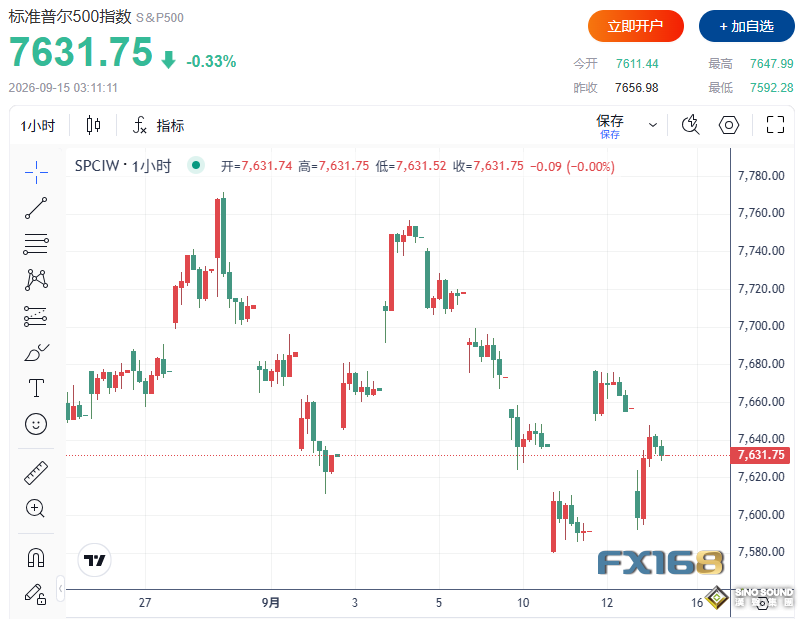
US stocks came under broad pressure on Monday, though losses narrowed intraday. The S&P 500 fell as much as 0.8%, the Nasdaq Composite dropped up to 1.3%, and the Dow Jones was down nearly 300 points at its intraday low. Markets then stabilized, with the S&P 500 and Nasdaq trimming losses to roughly 0.3% and 0.2% respectively, while the Dow’s decline retreated to around 100 points.
(Source: FX168)
The high-rate environment continues to weigh on growth stock valuations, and the AI sector served as the primary drag on the day. Nvidia fell about 2%, Broadcom and AMD dropped roughly 4%, Intel nearly 5%, and Marvell Technology lost close to 6%. Beyond rising yields, debates within the AI industry over development speed and safety regulation further soured market sentiment.
Dario Amodei, CEO of Anthropic, recently called for slowing the development pace of cutting-edge AI models to mitigate potential safety risks, prompting investors to reassess future capital expenditure and growth trajectories in the AI sector. Market interpretations of this news remain mixed. On one hand, if AI investment slows, revenue growth for related semiconductor and infrastructure firms may be pressured. On the other hand, lower capital expenditure may boost free cash flow and profit margins for large tech companies.
From a broader market perspective, the real pressure on US equities still stems from interest rates. If the 10-year Treasury yield stabilizes around 5% for an extended period, high-valuation growth stocks will face higher discount rates and stricter earnings requirements. Although the S&P 500 has posted solid gains year-to-date, short-term market volatility may rise further amid overlapping seasonal factors, uncertainties tied to midterm elections and macro policy risks.
FX Market: US dollar gains dual support, lifted by safe-haven demand and rate hike expectations
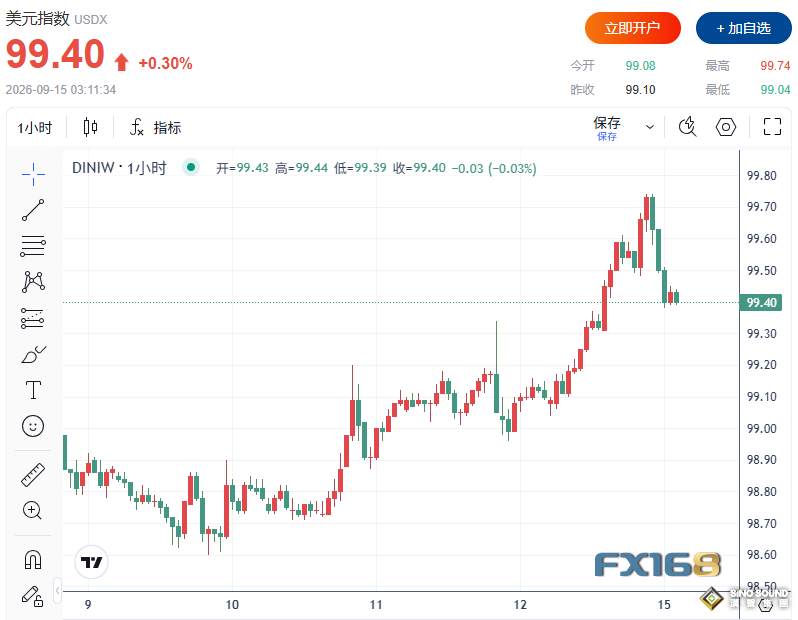
In foreign exchange markets, the US dollar strengthened across the board on Monday. The US Dollar Index climbed as high as 99.74, its strongest level since September 2, before retaining a gain of about 0.3%. EUR/USD fell to a one-month low near 1.153, GBP/USD retreated to around 1.3509, and USD/JPY rose roughly 0.5% to 154.37.
(Source: FX168)
The US dollar is currently backed by two forces. First, deteriorating Middle East conditions and rising energy supply risks draw safe-haven capital into the dollar. Second, rapidly climbing Fed rate hike expectations have reinforced the dollar’s yield advantage. Lee Hardman, Senior Currency Analyst at MUFG, states that markets are continuously upgrading expectations for the Fed to re-enter a tightening cycle, delivering extra support for the US dollar.
Nevertheless, the dollar’s subsequent trajectory remains highly dependent on the Fed’s policy remarks. If the Fed unexpectedly keeps rates unchanged, it may be viewed as markedly dovish and exert substantial downward pressure on the dollar. Even if the Fed hikes as expected, the dollar could see profit-taking if forward guidance turns noticeably mild without signaling further action.
The yen saw some counter moves. Earlier expectations of Bank of Japan rate hikes once lifted the yen, yet USD/JPY rebounded on Monday. With the BOJ entering its policy meeting window this week, markets will further assess whether the US-Japan yield spread is truly starting to narrow.
Precious Metals: Higher rates overpower safe-haven demand, gold drops to over one-month low
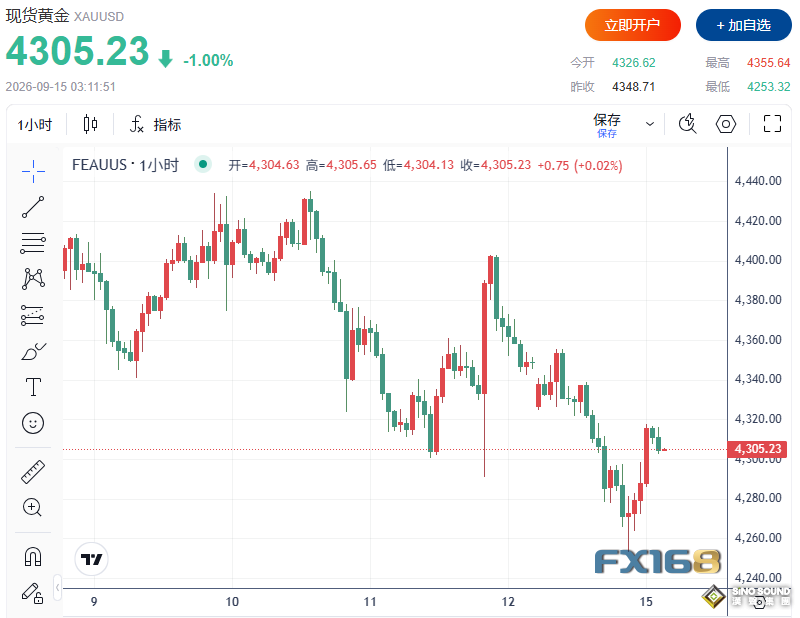
Precious metals weakened sharply on Monday. Spot gold tumbled to $4253.32 per ounce intraday, down more than 1.8% and hitting its lowest level since August 7. US gold futures fell roughly 2.2%. Spot silver suffered a steeper decline, dropping about 2.5% to $62.88 per ounce. Platinum and palladium also moved lower in tandem.
(Source: FX168)
This price action shows that traditional safe-haven support for gold from geopolitical risks has been temporarily overwhelmed by higher interest rates and a stronger US dollar in the current market environment. Although rising oil prices boost uncertainty, they simultaneously lift inflation expectations and further reinforce the need for major global central banks to maintain tighter policy stances. For gold, an asset that generates no interest income, US Treasury yields near 5% markedly raise its holding cost.
Jim Wyckoff, market analyst at American Gold Exchange, points out that the sharp rally in crude oil is pushing inflation expectations higher, meaning major global central banks may need to maintain stricter monetary policy, a backdrop that typically weighs on precious metals.
In addition, a stronger US dollar amplified gold’s correction. The US Dollar Index climbed to a two-week high, making dollar-denominated gold more expensive for holders of other currencies. In the short run, core variables for the gold market will continue to center on Fed policy guidance, US Treasury yields and international oil prices. If the Fed delivers more hawkish signals, gold may remain under pressure. Conversely, if markets begin pricing in that policy has neared a cyclical peak after the rate hike, gold may regain support from allocation capital.
Crude Oil: Shutdown of key Saudi pipeline, supply risks lift energy risk premium
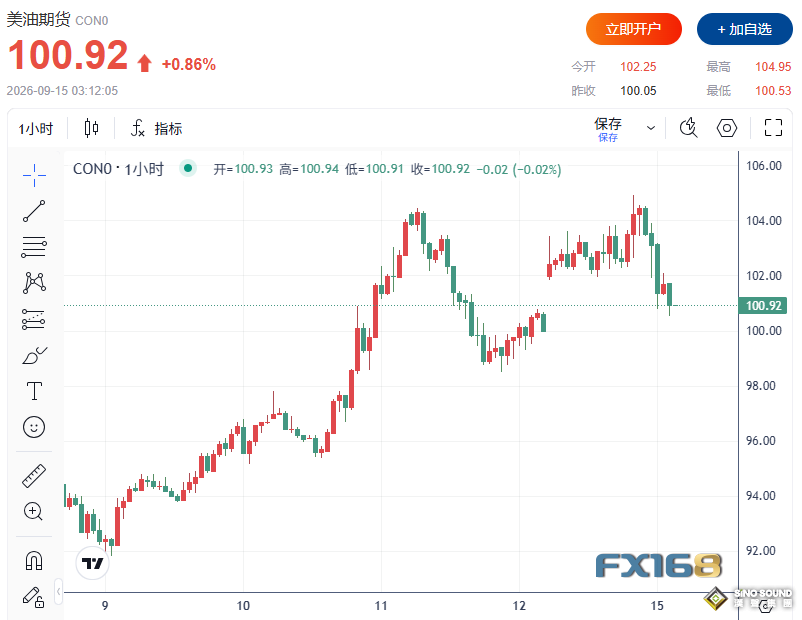
Crude oil remains one of the sources of global macro risks. On Monday, Brent crude peaked at $109.80 per barrel before pulling back above $105. US WTI crude hit $104.95 intraday and then retreated to around $101. Last week, US crude topped $100 for the first time since May, notching a roughly 9% weekly gain.
(Source: FX168)
The immediate catalyst behind this oil rally is Saudi Arabia’s shutdown of its strategic east-west oil pipeline. This pipeline connects Saudi eastern oilfields to export terminals on the Red Sea coast, with a maximum capacity of about 7 million barrels per day. It serves as a vital energy route for Saudi Arabia to bypass the Strait of Hormuz. After drone attacks damaged some pumping stations, Saudi authorities closed the relevant facilities, yet the full extent of damage and restoration timeline have not been disclosed.
Market assessments remain deeply divided. Rystad Energy believes Saudi Arabia can use existing inventories to buffer export pressure in the short term, so oil prices are not spiraling out of control for now. However, if the pipeline closure lasts more than five to seven days and inventory buffers shrink, market reactions may intensify rapidly. Andy Lipow, President of Lipow Oil Associates, argues that judging from public imagery, parts of the infrastructure sustained severe damage and full repairs may take a long time.
Kpler estimates that if the pipeline stays shut for one month and inventories at the Yanbu port on the Red Sea keep depleting, the market could lose roughly 120 million barrels of crude exports. Against an already tight global crude balance, this scale of supply loss would push the risk premium markedly higher.
More notably, Middle East energy transit risks are spreading from the Strait of Hormuz to the Red Sea and Bab el-Mandeb Strait. The scheduled meeting between Iran and Gulf states has been postponed, commercial vessels in the region continue to face attacks, and expanding Houthi operations have exposed Red Sea shipping lanes to greater safety hazards.
This means Saudi Arabia’s alternative transit network, originally built to bypass the Strait of Hormuz, is itself coming under strain. For global markets, if shipping through both the Strait of Hormuz and the Red Sea faces sustained disruptions, the oil risk premium may rise further, renewing inflation and monetary policy pressures.
Overall, the most important signal from Monday’s market is not isolated sharp gains or losses in any single asset class, but the repricing of global assets around one unified macro logic: higher oil prices reignite inflation risks, higher inflation pushes markets to upgrade rate expectations, and elevated interest rates ultimately trigger chain reactions across bond, dollar, equity and precious metal markets.
This week’s Fed decision will act as the linchpin determining whether this trading logic strengthens further. If the Fed confirms the market’s view of additional tightening, US Treasury yields and the dollar may stay strong, while risk assets and precious metals face heavier pressure. If policy remarks turn relatively dovish, the "higher rates trade" built up rapidly in recent sessions may see a collective correction.