

Although August US CPI data reinforced market rate hike expectations and the CME FedWatch Tool puts the probability of a rate hike at nearly 90%, spot gold has held the $4300 per ounce level, showing that the bearish impact of a single rate increase is fading. Many institutions warn that compared with inflation, the ballooning US government debt is shaking the US Treasury market. Coupled with upcoming policy meetings by multiple central banks and potential unwinding risks of yen carry trades, global asset markets are facing undercurrents. Gold faces pressure in the short term, yet its long-term supporting fundamentals remain intact.
US August CPI Boosts Hike Expectations; Gold Pulls Back and Holds Key Support
Spot gold fell 1.83% last week to close at $4349.30 per ounce, finding support around the $4300 level. The August Consumer Price Index was viewed by some economists as a key signal for a rate hike. After stripping out volatile food and energy components, core inflation rose 2.4% year-on-year, in line with estimates, while the month-on-month gain hit 0.3%, higher than the expected 0.2%. While prices are not accelerating further, they remain above the Fed’s 2% target.
Chris Zaccarelli, Chief Investment Officer at Independent Advisor Alliance, stated: "The Fed does not necessarily have to raise rates this week, but it is hard to find a reason to hold rates steady." Data from the CME FedWatch Tool shows markets are pricing in a nearly 90% chance of a rate hike this week. Even with aggressive hike expectations, gold has not suffered a severe breakdown. The market is starting to recognize that the negative impact of a single rate increase is gradually weakening.
Heavy Debt Constrains the Fed; Bond Market Risk Rises
Analysts argue that the Fed’s challenges extend far beyond inflation. US government debt has surpassed $40 trillion, continuously weighing on the Treasury market. The 10-year US Treasury yield stays at a three-year high and is edging toward the 5% threshold. Even though the US Treasury purchased more than $5 billion in long-dated bonds last Thursday, yields remained elevated and the buyback operation fell short of expectations.
Jeff Sarti, CEO of Morton Wealth, said the Fed has limited room for aggressive rate hikes under the current fiscal backdrop. "The Fed can fight inflation as much as possible, but its ability to raise rates is constrained by domestic fiscal conditions. Inflation will likely stay elevated. More importantly, the worsening fiscal picture has sent very clear signals to the bond market."
Naeem Aslam, Chief Investment Officer at Zaye Capital Markets, believes the Fed’s credibility is being tested, which lends strong support to gold. Kevin Warsh, Fed Governor, reiterated in his speech at the Jackson Hole Global Central Bank Symposium last month that policy priorities are stabilizing prices and bringing inflation back to target. Naeem Aslam commented: "If the Fed raises rates, US Treasury yields may still fail to meet market expectations. If it keeps rates unchanged, its policy credibility will be questioned. Holding gold remains a preferred strategy at the moment."
Institutional Views Diverge; Multiple Global Central Banks Set to Release Decisions
Ryan McKay, Commodity Strategy Director at TD Securities, noted in a research report last Friday that gold faces increased downside risk ahead of the Fed’s Wednesday rate decision, yet the downside scope is relatively limited. He said: "Strong economic data and a hawkish Fed may only trigger modest programmatic selling. Diminishing US dollar credit, peRSIstent gold purchases by global central banks and ETF inflows underpin long-term allocation. Short-term gold pullbacks can be viewed as buying opportunities."
Ryan McIntyre, President of Sprott, holds the view that the Fed may not raise rates and could maintain a neutral policy, because much of the current inflation stems from higher energy prices caused by the Iran conflict. He added that even if a rate hike is delivered, the market has already fully priced it in. Gold prices below $4400 have already priced in a 25-bASIs-point increase. He stated that regardless of the Fed’s choice, the broader trend of rising sovereign debt risk will not reverse in the long run.
Besides the Fed, the Bank of England will announce its rate decision on Thursday, with markets expecting the benchmark rate to stay unchanged at 3.75%. The Bank of Japan will also hold a meeting before the weekend, and markets anticipate a 25-bASIs-point rate hike. Adam Turnquist, Chief Technical Strategist at LPL Financial, warned that a Japanese rate hike will trigger global ripple effects. Investors need to watch whether USD/JPY breaks support near 152. He said a valid breakdown would spur rapid yen appreciation, trigger short covering and ignite risks from unwinding yen carry trades, spreading to US Treasuries and other global assets.
Conclusion
Short-term Fed rate hike expectations remain the direct factor weighing on gold. Nevertheless, gold’s hold above $4300 demonstrates the resilience of long-term buyers. The market should not only focus on this 25-bASIs-point Fed policy move. Treasury market pressure stemming from massive US debt, coupled with policy shifts from the Bank of England and Bank of Japan, plus potential risks from yen carry trades, constitute core variables for global assets.
Most institutions believe short-term gold declines belong to range-bound volatility. Long-term supporting drivers including sovereign debt risks and central bank gold purchases remain valid, leaving room for upside in gold’s medium and long-term outlook.
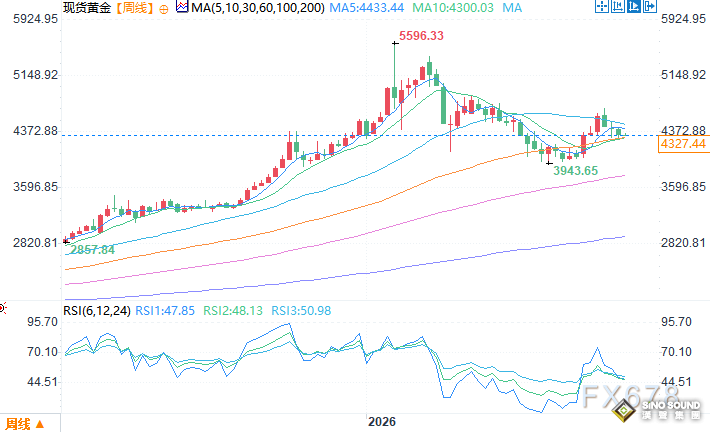
Spot Gold Weekly Chart Source: Yihuitong
13:46, September 14 (Beijing Time) Spot Gold quoted at $4330.44 per ounce