

Gold started the week on a weak note, with spot gold dipping to near $4,410‑per‑ounce during the ASIan morning session. The previously released US August employment figures came in well above market expectations. Non‑farm payrolls rose by 162,000, far exceeding the prior consensus forecast of roughly 56,000, while the unemployment rate held steady at 4.1%. Labor‑market strength has reinforced market expectations for further US interest‑rate hikes, putting short‑term pressure on non‑interest‑bearing gold.
Interest‑rate markets repriced rapidly after the jobs report. Odds for a 25‑bASIs‑point rate hike at the September 16 Federal Reserve meeting have climbed to around 60%, up from approximately 50% before the employment release. Higher rate expectations generally underpin the US dollar and US Treasury yields while raising the opportunity cost of holding gold, triggering a notable pullback in gold following the non‑farm payroll print.

Nevertheless, judging gold’s medium‑term trend solely from employment data has limitations. What markets truly need to confirm is whether US economic resilience will feed through into inflation. Robust employment combined with rising energy costs that reignite cost‑push pressures could extend the period of high US interest rates and add greater near‑term valuation pressure on gold. Conversely, if upcoming inflation data show no further heating, the hawkish shock from strong jobs numbers may gradually fade.
Market focus has shifted from labor‑market readings to inflation indicators this week. The US August Producer Price Index will be published on September 10, followed by the Consumer Price Index on September 11. These releases represent two of the most important macro inputs ahead of the September rate decision. According to the New York Fed economic calendar, both PPI and CPI are due this week, and the FOMC is scheduled to meet September 15‑16.
Markets are paying close attention to how energy‑cost increases pass through into final inflation. Should PPI and CPI beat forecasts, rate‑hike bets may rise further, leaving room for the US dollar and Treasury yields to advance, while gold could retest $4,400 or lower. By contrast, mild core inflation could ease policy‑tightening expectations fueled by payrolls, and a weaker US dollar would open a rebound window for gold. Current consensus looks for August PPI year‑over‑year growth of about 5.2%, compared with a prior reading of 4.7%, pointing to substantial uncertainty around inflation outcomes.
It is worth noting that this pullback in gold does not mean the long‑term bullish narrative has fundamentally reversed. Gold had rallied sharply, and market‑participant composition has shifted. Beyond short‑term speculative flows, long‑term allocation demand, physical‑market activity and derivatives‑related capital still provide meaningful support. Accordingly, investors should monitor absorption levels following the decline from highs rather than interpreting short‑term losses as a full trend reversal.
From a global‑asset‑allocation perspective, gold operates within a complex macro backdrop. On one hand, rising US rate expectations, higher Treasury yields and periodic US‑dollar strength directly weigh on gold valuations. On the other hand, inflation risks stemming from higher energy prices, diverging global rate paths and safe‑haven demand can lift gold’s allocation appeal. This suggests gold may enter a regime where macro headwinds cap near‑term moves while structural demand underpins the medium‑term outlook.
On the daily chart, spot gold is in a clear corrective phase. After falling toward $4,410, prices are approaching key prior support. Momentum is weak, yet no definitive medium‑term reversal signal has emerged. If $4,400 holds effectively, gold retains scope for an upward recovery. Initial resistance sits near $4,465, a significant near‑term barrier that needs to be overcome to restore bullish momentum. A sustained break above $4,500 would signal a potential shift back toward bullish sentiment, with further resistance around $4,675. Alternatively, a breach of $4,400 would target next support near $4,350, followed by $4,260.
On the 4‑hour timeframe, gold remains in a weak oscillating structure. Sharp losses after non‑farm payrolls have pressured short‑term moving averages, and momentum has not fully recovered. Markets are inclined to wait for inflation data to set direction. Stabilization above $4,400 followed by a break above $4,465 could unlock near‑term rebound potential. Repeated rejection near $4,465 would indicate bears still hold short‑term control. A decisive close below $4,400 could trigger further tests of $4,350 and prompt searches for buying interest at lower support zones.
Overall, gold is caught in a classic tug‑of‑war between macro‑policy expectations and long‑term allocation demand. Strong employment data has substantially raised September tightening odds, yet PPI and CPI remain the critical variables that will ultimately shape market direction. Further near‑term corrective pressure may materialize if inflation heats up; cooling inflation could ease rate‑hike fears and deliver rebound impetus for gold.
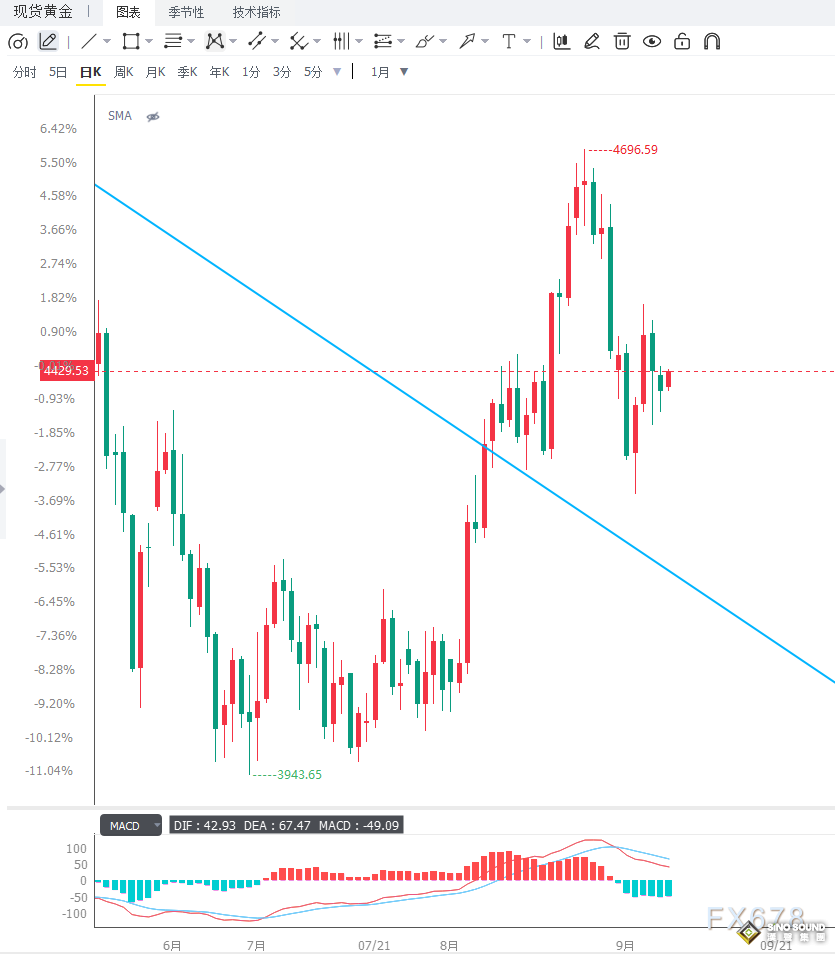
Better‑than‑expected US August non‑farm payrolls have refocused gold’s immediate headwinds on Fed policy expectations, the US dollar and Treasury yields. Even so, gold’s long‑term bullish fundamentals remain intact. Markets need to monitor inflation prints, energy‑price movements and global allocation flows. The $4,400 level serves as a crucial bull‑bear dividing line, while PPI and CPI will likely determine gold’s next major trend move. For now, focus should be placed on breakouts at key support and resistance levels while waiting for directional confirmation.