

US President Donald Trump floated another highly‑controveRSIal proposal for a geographic‑name change on Wednesday (Sep 2): renaming the Strait of Hormuz, one of the world’s most vital energy shipping lanes, to the “Trump Strait”.
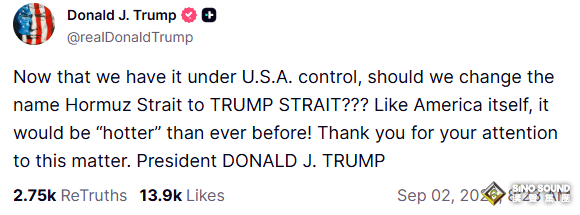
Trump posted on Truth Social that since the Strait of Hormuz is now “under US control”, should it be renamed the “Trump Strait”? He also claimed the waterway will become “hotter than ever before”, just like America. #IranCrisisTracker#
(Source: Truth Social)
The remarks quickly drew widespread attention. Nevertheless, Trump’s claim that the United States has taken control of the Strait of Hormuz is highly contested. Military and shipping risks along this critical waterway remain acute. Fresh US‑Iran military engagements, merchant‑ship attacks, mine‑laying threats and shipping disruptions continue to roil global energy markets.
From “Gulf of America” to “Lake America”, and Now “Trump Strait”

This is not Trump’s first push to alter well‑known geographic names.
Upon returning to the White House in January 2025, Trump directed US federal agencies to refer to the Gulf of Mexico as the “Gulf of America”.
On August 27 this year, he signed an executive order mandating federal bodies rename Lake Ontario to “Lake America”, a change rejected by Canada.
Now, Trump has set his sights on the Strait of Hormuz.
Notably, some of Trump’s earlier seemingly jocular or performative renaming comments were eventually formalised as official US‑government actions. For this reason, observers are watching closely whether “Trump Strait” remains merely a social‑media quip or could trigger further policy moves down the line.
Even if US authorities adopt the new name in domestic official documents, they cannot unilaterally dictate how Iran, Oman or the international community refer to this international waterway.
Trump: “Nearly Full Control” Over the Strait of Hormuz
Trump has repeatedly insisted that the United States holds the upper hand in the Strait of Hormuz.
In earlier Truth Social posts, he said he was not seeking to force Iran back to the negotiating table, arguing the United States was in a “far better position” and asserting US forces had “nearly full control of the Strait of Hormuz”, while Iran’s economy is deteriorating rapidly.
The reality on the ground stays complex. The Strait of Hormuz has long stood as one of the world’s most sensitive energy chokepoints. Before hostilities erupted, roughly one‑fifth of global oil trade transited this passage. Any deterioration in shipping safety can send shockwaves through crude‑oil, natural‑gas, inflation‑expectation and global bond markets.
Security conditions around the strait have worsened further amid the latest flare‑up in US‑Iran military tensions.
US Central Command reported US forces carried out strikes on Islamic Revolutionary Guard Corps military targets on September 1, including air‑defence sites, radar installations, maritime military assets, communications infrastructure and mine‑laying‑related facilities.
Washington described the operation as a response to recent Revolutionary Guard attempts to attack commercial shipping and US personnel in the Strait of Hormuz.
Oil Tanker Struck by Three Unidentified Projectiles
Meanwhile, commercial‑shipping risks inside the strait have escalated sharply.
The UK Maritime Trade Operations (UKMTO) previously reported an oil tanker was hit by three unidentified projectiles while exiting the Strait of Hormuz, around 17 nautical miles east of Khasab, Oman.
Authorities launched an investigation after the incident. Initial reports stated no environmental pollution occurred, yet further safety events involving merchant vessels and casualties subsequently took place within the Strait of Hormuz.
The string of attacks underscores a plain reality: whatever Washington claims about its military control, the Strait of Hormuz is far from restored to normal, safe and stable commercial‑shipping conditions.
Oil Prices Have Surged More Than 30% Since Hostilities Began
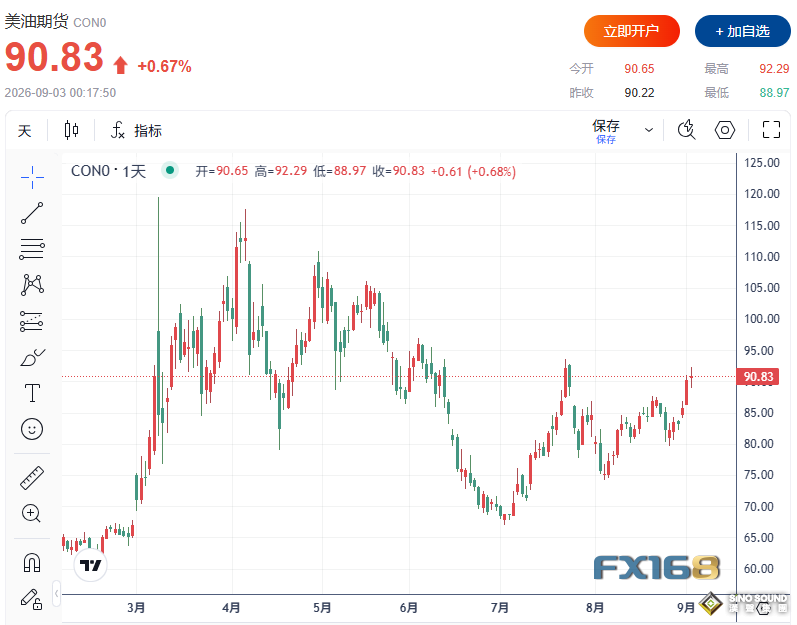
Crude‑oil markets have reacted sharply to these risks. At press time, WTI crude trades near $90.80 per barrel, up approximately $23.78 or 35.48% from $67.02 before the outbreak of the Iran conflict.
(Source: FX168)
Brent crude is changing hands near $95.42 per barrel, representing a $22.92 or 31.62% gain from $72.48 on February 27.
In short, despite Trump’s claim of “nearly full US control” over the Strait of Hormuz, crude‑oil markets are still pricing in a substantial risk premium for geopolitical turmoil and supply‑disruption threats.
Until shipping through the strait genuinely returns to normal, with peRSIstent threats from mines, drones, missiles and tanker assaults, traders cannot dismiss energy‑supply risks purely on the strength of political statements.
True Oil‑Price Signals Come From the Market Itself
From a short‑term technical perspective, the $90 level for WTI crude marks a key threshold to watch.
Oil prices rebounded from near $88.97 and climbed back above $90. Technically, sustained price action above the short‑term 100‑period moving average and the $90 handle means sellers have not yet seized meaningful control.
Conversely, a decisive break below $90 for WTI followed by sustained technical weakness could serve as an early signal that the geopolitical risk premium is starting to recede.
For financial markets, whether Trump actually pushes through the “Trump Strait” name is secondary. The trajectory of oil prices will ultimately hinge on whether safe shipping resumes in the Strait of Hormuz, whether US‑Iran military hostilities escalate further, and when one of the world’s pre‑eminent energy arteries regains stability.
Until then, every attack, mine‑laying operation and US‑Iran military escalation in the Strait of Hormuz may continue to act as catalysts for sharp swings in international crude‑oil prices.