

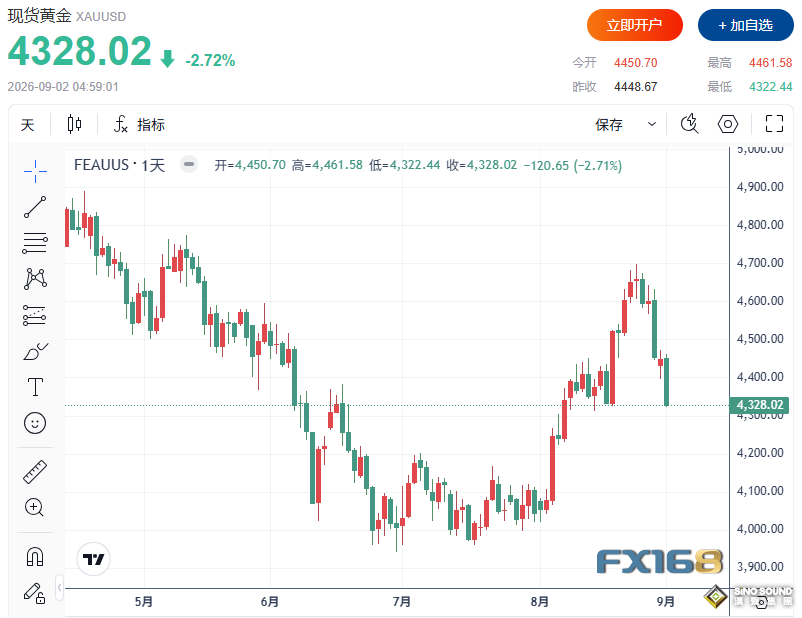
Fresh off its largest monthly gain this year, gold turned weaker at the start of September, with spot gold testing support near $4350 per troy ounce at one point. Ole Hansen, Head of Commodity Strategy at Saxo Bank, noted that gold is currently under pressure mainly because investors remain focused on short‑term inflation worries, which are partly being driven by rising commodity prices. Spot gold closed at $4328.02 per troy ounce, slumping $120.65 or more than 2.7% on the day.
(Source: FX168)
Meanwhile, silver has fallen more than 4% cumulatively since Friday. According to Hansen, the pull‑back in gold and silver stems from three market headwinds following Fed Chair Kevin Warsh’s speech at the Fed’s annual symposium in Jackson Hole, Wyoming: rising short‑term rate expectations, higher real and nominal yields, and a stronger U.S. dollar.
Hansen mentioned that West Texas Intermediate (WTI) crude moved back above $90 per barrel overnight amid escalating hostilities between the United States and Iran. At the same time, the ongoing war in Ukraine and unfavourable global weather conditions have lifted prices for grains and soft commodities, led by sugar, wheat and corn.
He added that the Bloomberg Commodity Agriculture Total Return Index surged 12.4% in August to a 14‑year high. Hansen described the current dynamic: commodity prices that create inflationary pressures keep marching higher, while precious metals traditionally bought to hedge inflation consequences are falling.
Speaking to Kitco News last Friday, Hansen said renewed investor focus on inflation may weigh on gold prices, yet he does not believe this shift will derail gold’s longer‑term uptrend driven by rising government debt and fears of currency depreciation.
He explained that higher real interest rates driven by a credible inflation‑fighting central bank are generally negative for gold. By contrast, the picture changes completely when rising long‑term yields stem mostly from debt‑sustainability concerns, massive sovereign bond issuance and eroding fiscal credibility. As debt‑servicing costs keep climbing, policymakers may eventually face pressure to stop long‑term borrowing costs from spiralling upwards indefinitely.
“Gold is therefore caught between two opposing forces: immediate pressure from funding‑costs on one hand, and longer‑run concerns over money supply and credibility on the other,” Hansen remarked. Sustained central‑bank buying and reserve diveRSIfication still offer another structural underpinning for gold prices, one less sensitive to shifts in U.S. short‑term interest rates.
Hansen also pointed out that supply‑driven inflation poses a unique challenge for the Federal Reserve. Central banks can cool demand, yet they cannot conjure more crude oil, refining capacity or natural‑gas supply out of thin air.
If climbing commodity prices force interest rates to stay higher for longer, pressure on heavily‑indebted governments could revive market worries over fiscal deterioration and currency debasement — some of the most powerful structural drivers of precious‑metals investment demand, he stated.
From a market‑logic perspective, gold may remain capped near‑term by the U.S. dollar, Treasury yields and rate‑hike expectations. Nevertheless, if energy and agricultural‑commodity prices keep lifting inflation expectations, gold’s long‑term support as an inflation‑hedge and hedge against currency‑credit risk remains intact.