
Federal Reserve Chair Kevin Warsh may soon hand US President Donald Trump a “gift” he least wants: an interest‑rate increase weeks before the critical November mid‑term elections.
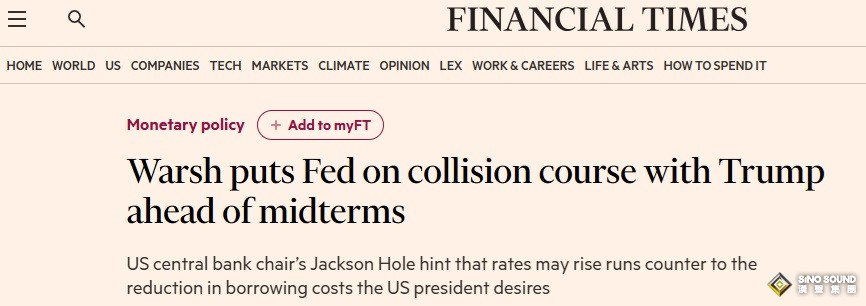
(Screenshot source: Financial Times, UK)
For years, Trump pressured Warsh’s predecessor, former Fed Chair Jay Powell, to cut interest rates. After appointing Warsh earlier this year, the US president has repeatedly renewed calls for rate reductions.
Last Friday, however, at the Jackson Hole Global Central Bank Symposium, Warsh made it clear that current “concerning” inflation readings mean “the Fed’s primary focus at present should be prices.”
Analysts point out that any rate‑hike move could make Warsh a direct target for Trump’s attacks.
“Warsh has drawn a very clear, bright red line regarding his objectives and intentions,” said Eswar Prasad, Professor at Cornell UniveRSIty. “This will put him in direct conflict with Trump’s position of pushing for rate cuts regardless of data and consequences.”
Prasad added that Warsh has “stated extremely clearly and forcefully that he intends to place the Fed’s price‑stability mandate at the very core.”
Ahead of his first major speech as Fed Chair, Warsh faced a difficult choice:
Either prove to critics on Wall Street and within the Fed that he takes inflation control seriously, or appease Trump while failing to convince markets that rate hikes are truly on the table.
His Jackson Hole address made plain: Warsh chose the former.
He prioritised addressing demands from financial markets and fellow Fed rate‑setters. Both groups had criticised Warsh in recent weeks for failing to spell out how he intended to tackle inflation.
Notably, US inflation has run above the Fed’s 2‑percent target for five consecutive years.
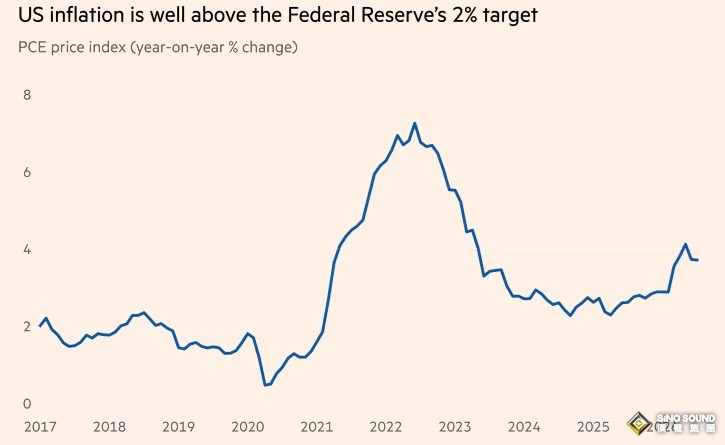
(Screenshot source: Financial Times, UK)
“Investors badly want him to uphold the most fundamental principles of a central bank … and that is exactly what he did,” said Gregory Daco, economist at EY Parthenon.
Speaking at the Kansas City Fed‑hosted Jackson Hole symposium, Warsh opened by referencing “hikes” — mountain treks he took in the mountain resort with former Fed Vice‑Chair Don Kohn and Ben Bernanke, his supervisor during his first Fed tenure. The word appeared to foreshadow the real focus ahead: rate hikes.
After digesting the full speech, financial markets quickly raised bets on Federal Reserve rate increases. Investors now price a higher probability of a 25‑bASIs‑point September rate‑hike than of holding rates unchanged.
Warsh had previously warned that the Fed “has more work to do” in fighting inflation if price pressures in the world’s largest economy do not ease soon.
Warsh’s speech achieved its objective, earning positive reviews from analysts and warm applause from attendees on site.
The prospect of a rate hike as early as September, however, is unlikely to please Trump.
For much of his second White‑House term, Trump has called for aggressive Fed rate cuts.
Shortly after taking office as Fed Chair in 2018, Jay Powell gradually lost Trump’s support over interest‑rate policy.
Relations later hit rock‑bottom. The US Department of Justice once opened a criminal investigation into Powell’s handling of the Fed headquarters renovation project. The probe has since been dropped.
The Trump administration nonetheless continues to pursue action against Fed Governor Lisa Cook, seeking her removal over alleged mortgage‑related fraud, accusations which Cook denies.
Just last week, Trump described current US borrowing costs of 3.5%‑3.75% as “absurd”.
Warsh directly pushed back against that view last Friday. “All things considered, I would be hard‑pressed to characterise broad financial conditions as restrictive,” he stated.
Warsh also made clear that rather than stimulating US economic growth which he deemed “appears to have strengthened”, his greater concern lies in regaining control over inflation.
Warsh singled out the six‑month inflation gauge, which has surged sharply amid the Iran war launched by Trump.
He warned that while market expectations for future inflation remain relatively anchored for now, that picture could shift rapidly should the Fed fail to contain price pressures.
In fact, some officials inside the Fed already support raising rates.
At the Fed’s July rate‑setting meeting, three out of twelve voting FOMC members backed a 25‑bASIs‑point increase.
Warsh voted to keep rates unchanged at that gathering.
Even so, Robert Sockin, Chief US Economist at PGIM, said Warsh’s Jackson Hole address has firmly placed the Fed Chair within the “hawkish camp”.
“This reinforces our view that Warsh is the most hawkish member of the FOMC, or at least tied for most hawkish,” Sockin commented.
Warsh’s Friday speech revealed another noteworthy shift.
After stepping down from the Fed Board in 2011, Warsh had been a frequent public critic of the Federal Reserve, remarks that irritated many Fed officials attending Jackson Hole this year.
This time, however, he made clear efforts to repair relations with senior central‑bank officials and economists present.
“Market pricing shows investors believe we will deliver price stability. That is a tribute to this institution and consistent with the Fed’s finest traditions,” Warsh said.
He then emphASIsed: “I can assure you, their judgement is correct.”
Some analysts argue that Warsh, who enjoys closer personal ties with Trump than Powell did, may be better equipped to absorb political pressure from the White House.
Trump has in fact begun crafting an alternative narrative for potential future rate hikes, seeking to downplay Warsh’s personal responsibility for tightening decisions and attributing them to a “politically‑tinged” FOMC.
“The Trump administration has framed Warsh’s chairmanship within a narrative of him potentially facing a hostile FOMC, and that storyline actually gives the Fed Chair greater room for manoeuvre,” Daco explained.
At the same time, others hold that Warsh’s speech still leaves substantial ambiguity.
Accordingly, whether the Fed will actually raise rates, and whether that will trigger White‑House fury, is far from a foregone conclusion.
“He left plenty of room. More economic data are yet to come,” said Bill English, Professor at Yale UniveRSIty.
David Wessel, Senior Fellow at the Brookings Institution, offered: “I think Warsh did intend to send a hawkish signal. But truly breaking free from Trump’s influence requires actual rate hikes, not just tough rhetoric.”