

Gold’s dramatic surge over past years has lifted its price to once‑unimaginable levels. Yet one market strategist warns investors should not get distracted by assorted price targets. John LaForge, Head of Alternative Strategy at Ned Davis Research, says the gold trade remains remarkably straightforward: the precious metal’s long‑term uptrend will stay intact until global governments finally confront mounting debt burdens.
When Will Gold Peak? The Answer Lies In Debt
LaForge stated: "Gold will peak when people figure out how to handle debt. The longer we kick the can down the road, refuse to pay down obligations and keep piling up debt, the higher gold can go."
Asked whether investors should set their sights on $8000, $10000 or even $12000 per ounce, LaForge noted those price points carry little weight in his outlook. “For me, there are no magic levels such as $8000 or $12000. All I know is the trend stays up until government debt gets fixed. I believe we still have multiple years of price gains ahead, because I see zero willingness among global politicians and leaders to tackle this problem.”
Even after gold climbed from roughly $1500 per ounce to above $4000 over the past decade, LaForge maintains substantial upside remains. He believes commodities in general are about six or seven years into a broader super‑cycle, with no evidence the long‑run trend is nearing exhaustion.
Central Banks Deliver Structural Demand, Gold’s Unique Status as Bearer Asset
LaForge describes current conditions as potentially one of the strongest fundamental backdrops gold has ever seen.
He points out the key differentiator for this cycle: central banks have become a major source of structural demand as they reassess the safety of traditional reserve assets. This shift accelerated sharply after the 2022 Russia‑Ukraine conflict and the subsequent freezing of Russia’s foreign‑exchange reserves. According to LaForge, that episode drove home for central‑bank policymakers that assets held within the global credit system remain subject to governmental control.
By contrast, gold remains one of the few globally‑recognised bearer assets that can be held physically outside the credit system. “There are not many bearer assets central banks can hold that the whole world will accept. Hand them a gold bar, and they will take it as payment,” he commented.
Mounting Debt Makes Currency Depreciation The Only Practical Exit
Meanwhile, LaForge notes massive sovereign‑debt expansion creates increASIngly powerful tailwinds for hard assets.
As governments keep piling on debt, he sees few politically acceptable paths forward other than eventual currency depreciation. “There is no way to pay these debts except debASIng everything, and that is gold’s biggest tailwind,” he said.
While US sovereign debt topping $40 trillion has drawn heavy attention to America’s economic outlook in recent weeks, LaForge says Japan delivers an important cautionary tale for other highly‑indebted advanced economies. Western policymakers once looked to Japan as proof governments could suppress borrowing costs indefinitely via yield‑curve control even with enormous debt loads. Rising Japanese yields and the exit from decades‑long ultra‑loose monetary policy have instead demonstrated the limits of that strategy. “Many Western nations will have to resolve their debt in similar fashion. Authorities want nothing more than to avoid proving yield‑curve control does not work,” he observed.
Pullbacks Are Merely Awaiting Fresh Catalysts; No Signals Of An Immediate Peak
LaForge has stayed bullish on gold through multi‑month pullback phases while government debt kept growing. He adds Treasury market interventions have re‑ignited the debasement trade, and what he views as gold sell‑offs are simply markets waiting for another catalyst.
One key gauge lies in gold’s long‑term momentum. Even with new all‑time highs this year, none of the indicators LaForge monitors show the blow‑off‑top signals that normally mark the end of a commodity super‑cycle. “Not a single peak signal, zero,” he remarked. Current momentum resembles mid‑cycle behaviour rather than the speculative overheating seen near the 2011 peak.
This backdrop shapes LaForge’s portfolio guidance. He recommends investors allocate at least 10% of holdings to alternative assets, with roughly 5% assigned to gold. Gold deserves the largest weighting because it delivers the most direct exposure to the structural debt and monetary pressures driving this cycle. “Gold finds itself in an extraordinarily unique historical moment, where all these factors converge,” LaForge said.
LaForge contends the ultimate end of gold’s bull market will unlikely be defined by whether prices hit $8000, $10000 or any preset figure. Investors should instead watch for the moment governments enforce fiscal discipline and restore confidence in fiat‑currency systems. Until then, he sees little reason for gold’s structural uptrend to reverse. “It has not completely derailed, yet it is like a train accelerating from 40 mph to 120 mph. We have to slow it down or we cannot stay on the tracks,” he stated.
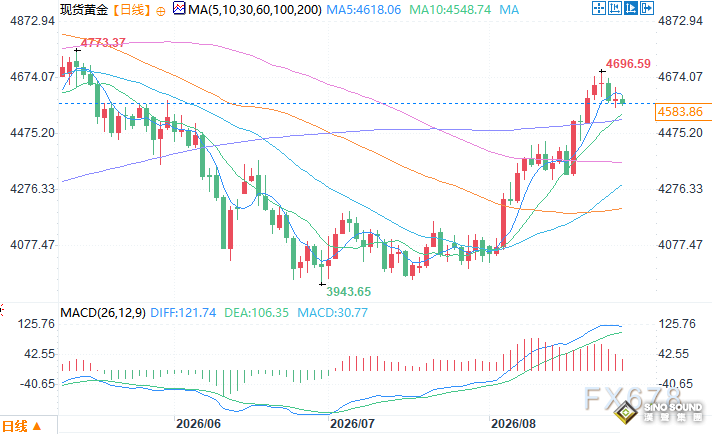
Spot Gold Daily Chart, Source: Yihuitong
At 10:39 Beijing Time, August 28, spot gold trades at $4588.86 per ounce.