

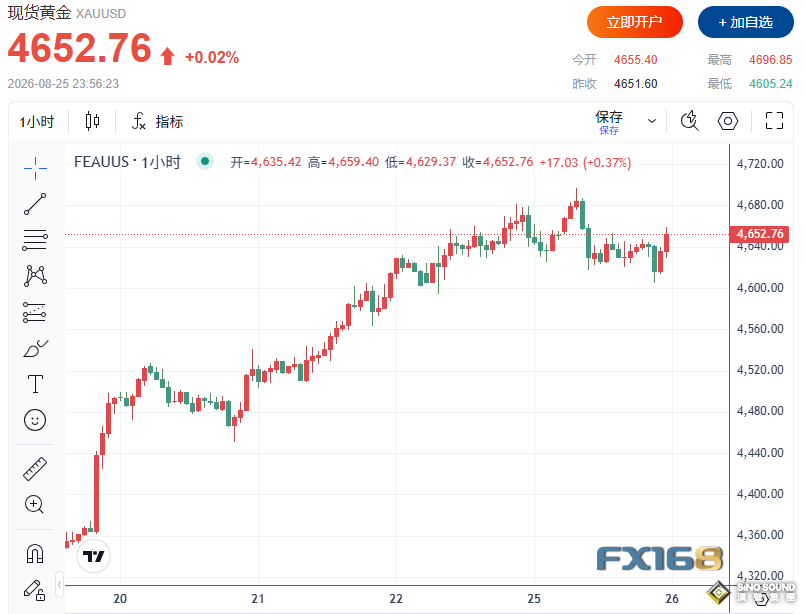
On Tuesday (August 25), gold pulled back sharply after hitting a near‑three‑month high during intraday trading. Spot gold (XAU/USD) climbed as high as $4,697, yet profit‑taking flows soon triggered a drop to roughly $4,605. At press time, the precious metal was trading around $4,650.
(Source: FX168)
Following gold’s recent strong run, technical indicators show signs of overbought conditions, prompting some investors to lock in profits. Even so, simultaneous declines in the US Dollar and Treasury yields, heightened worries over US fiscal prospects, expanded long‑dated Treasury buybacks and renewed interest in dollar‑debasement trades continue to underpin gold prices.
Market focus is shifting away from pure interest‑rate moves toward US fiscal health and its implications for long‑term US‑Dollar credibility. TD Securities notes that larger‑scale US Treasury buybacks of long‑term bonds are delivering fresh upward momentum to precious metals. Meanwhile, Middle‑East tensions, energy prices and inflation risks keep shaping expectations for Fed policy. With the US PCE price index due for release and Fed Chair Warsh set to speak at the Jackson Hole global central‑bank symposium, the $4,700 level stands as a critical benchmark to watch for gold’s near‑term upside potential.
Gold Pulls Back After Notching Three‑Month Peak

Gold extended its rally early Tuesday and hit $4,697, a fresh three‑month high, before quick profit‑taking drove prices lower. During US trading hours, gold fell to around $4,605, demonstrating intensified near‑term selling pressure as prices neared the psychological $4,700 mark.
Notably, this correction unfolded against a backdrop of modestly weaker US Dollar and Treasury yields. Normally, a softer dollar and lower bond yields are supportive of non‑yielding gold. The pull‑back therefore stems largely from profit‑taking after rapid prior gains rather than an abrupt deterioration in macro fundamentals.
Technical metrics also reflect near‑term overheating. The 14‑period Relative Strength Index (RSI) climbed near 71, entering classic overbought territory. While upward momentum remains robust, the risk of chASIng further gains has risen.
TD Securities: Treasury Buybacks Are “Igniting” Gold
Shifts in the US Treasury market form a key backdrop for gold’s rally. TD Securities points out that precious metals received notable support after US Treasury Secretary Bessent announced expanded long‑term bond buybacks last week.
The institution projects Treasury bond repurchases could more than double to roughly $8 billion between September 9 and November 4. According to TD Securities, Washington is seeking to ease pressure from surging long‑end yields via larger buybacks, and this policy shift has already boosted gold and silver.
More importantly, US fiscal health is back in investors’ spotlight. Mounting government‑debt levels have stoked concerns over long‑run fiscal sustainability and dollar purchASIng power, reviving interest in dollar‑debasement trades.
Under this framework, gold’s advance is not merely a response to lower rates. It is increASIngly viewed as a hedge against fiscal risks and eroding monetary credibility. This explains gold’s resilience even while long‑term Treasury yields stay elevated.
Middle‑East Tensions and Oil Prices Remain Key Variables
Geopolitical risk continues to sway the gold market. Iranian Finance Minister Ali Madanizadeh stated on Monday that Iran is “fully prepared” for Washington’s latest round of sanctions.
The US Treasury previously launched “Operation Economic Outcast”, a new sanctions initiative designed to further isolate Iran from global economic and financial networks. By broadening secondary sanctions, the US aims to squeeze Iran’s trade and financing channels.
Even so, global oil prices reacted relatively muted to the latest developments. WTI crude tumbled nearly 3% at one point on Tuesday yet remains well above pre‑conflict levels. PeRSIstently high energy prices mean inflation risks have not fully faded, which may shape the Federal Reserve’s future policy choices.
This creates a complicated backdrop for gold. On one hand, geopolitical and fiscal risks lift safe‑haven demand. On the other hand, if expensive oil keeps inflation elevated, the Fed may need to maintain a more hawkish stance, raising opportunity costs for holding bullion.
Fed Has Not Ruled Out Further Rate Hikes
Boston Fed President Susan Collins said Tuesday that US monetary policy remains “modestly restrictive”. Additional near‑term tightening would be appropriate without consistent evidence of cooling inflation, she warned.
She also noted the labour market stays broadly balanced yet faces lingering risks. Her remarks signal ongoing debate inside the Fed over whether further hikes will be needed.
Data released Tuesday showed the four‑week average for US ADP employment change rose from 9,500 to 11,750, pointing to no sharp deterioration across the jobs market.
For gold, Fed policy paths represent one of the most immediate risk factors. Stubborn inflation that revives rate‑hike expectations could lift Treasury yields and the US Dollar, weighing on bullion. Conversely, softer economic and inflation prints may unlock fresh upside for gold.
$4,700 Emerges as Critical Battleground for Bulls and Bears
From a technical standpoint, gold’s broader bullish structure remains intact. On daily charts, prices sit comfortably above the 50‑day, 100‑day and 200‑day simple moving averages, situated roughly between $4,185 and $4,520.
This bullish SMA alignment signals the medium‑term uptrend is still dominant. Meanwhile, the MACD indicator holds firmly in positive territory, showing no fundamental reversal in bullish momentum.
Nevertheless, the overbought RSI suggests limited near‑term upside room. $4,700 acts as immediate overhead resistance. A decisive break and hold above this level could open a move toward $4,850.
On the downside, initial support lies near the 200‑day moving average at $4,520. Further supports sit at the 100‑day SMA around $4,379 and the 50‑day SMA near $4,186. In the event of a deeper correction, the $4,000 zone remains an important medium‑to‑long‑term support area.
PCE and Jackson‑Hole May Determine Next Market Direction
Gold markets face the week’s two most important macro events ahead.
The US July Personal Consumption Expenditures (PCE) price index will be published on Wednesday. As one of the Fed’s favoured inflation gauges, PCE figures can directly shape market rate‑path expectations.
PeRSIstent inflation prints may boost bets on higher‑for‑longer rates or additional tightening, lifting the dollar and yields to pressure gold. By contrast, softer‑than‑expected inflation data would strengthen bullish sentiment for bullion.
Later in the week, Fed Chair Warsh will deliver a speech at Friday’s Jackson Hole central‑bank gathering. Investors will closely watch his assessment of current inflation, long‑term interest rates and market reactions to expanded US Treasury bond buybacks.
All told, profit‑taking as gold neared $4,700 comes as no surprise. Near‑term overbought conditions leave prices prone to increased volatility. Still, US fiscal worries, dollar‑debasement trades and geopolitical risks keep offering underlying support. This is therefore best viewed as a corrective pause within a powerful uptrend, not a full trend reversal.
Whether gold can sustain a break above $4,700 will define its next phase. A firm hold could target $4,850. Repeated rejection at this level would likely trigger a more thorough technical pull‑back.