

On Monday (August 24), spot gold extended last week’s rally, underpinned by buying interest after the U.S. Treasury expanded its long‑term Treasury‑bond buyback programme. A prior sharp weakening of the U.S. dollar together with mounting worries over U.S. fiscal outlook and government debt offered dual support for gold.
At press time, XAU/USD was trading around $4640. Earlier in the session it rose nearly 1.3% and hit an intraday peak of $4681.11, the highest level since May 14. Nevertheless, ahead of key economic data releases and Federal Reserve Chair Kevin Warsh’s Jackson Hole speech this week, gold buyers have grown reluctant to chase further highs.
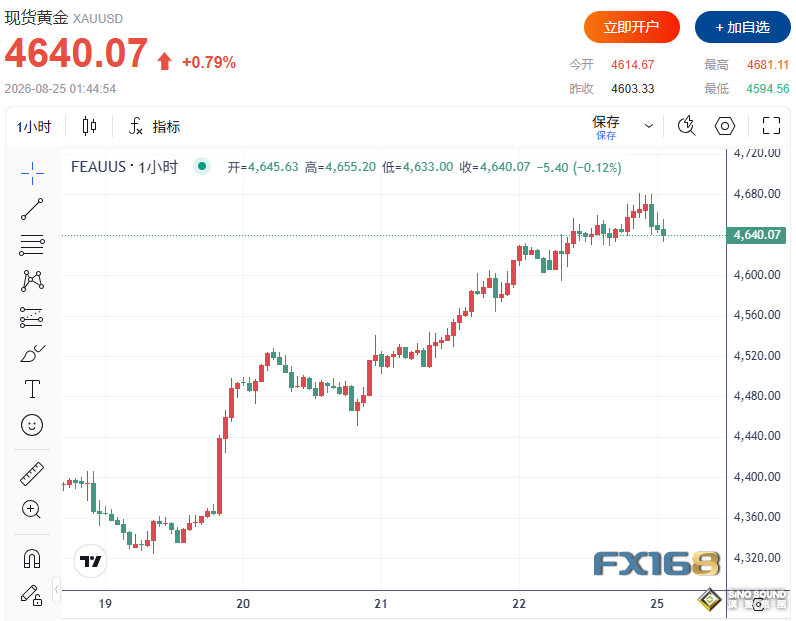
(Image source: FX168)
The U.S. Treasury’s expanded long‑dated bond buyback was a key catalyst for gold’s breakout rally last week. Designed to improve liquidity in the long‑term Treasury market, the announcement triggered heavy selling in the U.S. dollar, with the Dollar Index dropping to a three‑month low at one point.
Gold benefited on two fronts: a weaker dollar directly lowers the cost of dollar‑denominated gold for holders of other currencies. Meanwhile heightened scrutiny over U.S. fiscal policy, debt levels and long‑term Treasury‑market stability drove safe‑haven capital flows into gold.

OCBC strategists commented that following the Treasury’s unexpected bond‑buyback expansion, the “dollar‑debasement trade” has returned to market focus. The move may signal policymakers’ unease over the recent sharp rise in long‑term yields.
According to OCBC, resulting unwinding of steepener trades on the U.S. yield curve further reinforced other debasement‑linked trades, including dollar weakness, gold’s rebound and higher U.S. inflation breakeven rates.
The dollar stabilised on Monday. The DXY, measuring the greenback against six major peers, traded near 98.96, up roughly 0.12% intraday, yet remained stuck in the low range established after last week’s sharp drop.
Geopolitical Risks Re‑escalate
Beyond dollar moves and U.S. fiscal concerns, developments in the Middle East have re‑emerged as an important pillar of support for gold.
U.S. Treasury Secretary Scott Bessent is set to unveil a new round of sanctions targeting Iran. For its part, Iran has warned it may block crude‑oil exports through the Strait of Hormuz and other PeRSIan Gulf shipping lanes should Washington press ahead with its so‑called “economic war”.
As one of the world’s most vital energy chokepoints, any threat to shipping through the Strait of Hormuz could quickly lift global oil prices and reignite worldwide inflation pressures.
For gold, this creates a mixed‑but‑mostly‑bullish backdrop. On one hand, geopolitical risks boost safe‑haven demand. On the other hand, sustained energy‑price gains lifting inflation expectations may force the Fed to keep interest rates higher, capping gold’s upside.
Market Awaits PCE and Jackson Hole
Two major risk events will steer gold in the second half of this week.
First, investors will watch Wednesday’s release of U.S. July Personal Consumption Expenditures (PCE) price index. As the Fed’s favoured inflation gauge, PCE will help markets judge whether cooling inflation justifies holding rates steady in September.
Markets still do not view a September rate hike as the base‑case scenario. Per the CME FedWatch Tool, futures price in around a 38% probability of a September increase.
Later on Friday, Federal Reserve Chair Kevin Warsh will deliver remarks at the Jackson Hole global central‑bank symposium. Markets will closely parse his latest comments on inflation, growth, financial conditions and the future monetary‑policy path.
Given gold’s substantial recent rally, hotter‑than‑expected PCE inflation or hawkish rhetoric from Warsh could push Treasury yields higher and apply near‑term pressure on bullion.
Conversely, further cooling inflation and rising expectations for steady or eventual Fed eASIng would weigh on the dollar and open fresh upside for gold.
Technical Outlook: Bulls Remain in Control, RSI Hits Overbought Territory
Technically, gold’s near‑term bias remains firmly bullish.
Spot gold keeps trading above its 100‑day and 200‑day simple moving averages, confirming solid medium‑to‑long‑term momentum. The Average Directional Index (ADX) stands near 33, signalling strong peRSIstence in the uptrend.
Meanwhile the daily Relative Strength Index (RSI) has climbed to 72, entering classic overbought territory. While bullish momentum prevails, near‑term signs of overheating are appearing and the risks of chASIng price highs are rising.
The MACD maintains a positive setup, further backing gold’s bullish trend. So long as gold holds key moving averages and major FibonaCCI support zones, the technical landscape favours further gains.
On the upside, the first major resistance sits near $4685, corresponding to the 78.6% FibonaCCI retracement level.
A decisive break above $4685 would shift market focus toward the prior cycle high around $4886.
To the downside, primary support lies at $4528 (61.8% FibonaCCI retracement). The 200‑day moving average is currently near $4517; together they form a strong support zone.
In case of deeper pullbacks, subsequent supports emerge around $4417, $4380, $4307 and $4170. The $4380 area also aligns with the 100‑day moving average and represents a key medium‑term bullish defence level.
Overall, gold stays within a powerful uptrend. The U.S. Treasury’s expanded bond‑buyback programme has reignited the dollar‑debasement trade, while fiscal risks and geopolitical uncertainty continue to bolster gold’s safe‑haven appeal.
Even so, with gold technically overbought, this week’s PCE figures and Jackson Hole speech will likely act as critical catalysts determining whether bullion can break above $4685 and push toward fresh all‑time highs.