

FX168 News Bureau (ASIa‑Pacific) CNBC published an exclusive report on Monday (August 24, local time). According to two senior U.S. Treasury officials, the U.S. Treasury Department may draw on the nearly $1‑trillion Treasury General Account (TGA) to fund its recently announced expanded government‑bond buyback programme.
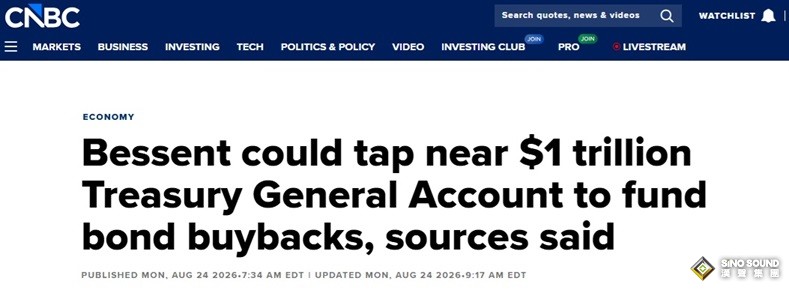
(Screenshot source: CNBC)
Tapping the TGA would give the Treasury greater power to influence long‑term Treasury yields. Last week, the U.S. Treasury surprised markets by doubling the buyback size for off‑the‑run long‑dated bonds from $2 billion to at least $4 billion. Treasury Secretary Scott Bessent noted in a CNBC interview that actual operation sizes could exceed this new minimum threshold.
Nevertheless, the Treasury did not specify how these buybacks would be financed. Most market participants previously assumed the Treasury would raise funds by issuing short‑term Treasury bills. The cited Treasury officials did not rule out this option.
In the CNBC interview, Bessent dubbed the initiative the “Treasury Twist”, referencing past operations conducted by the government or Federal Reserve that purchased long‑term bonds and funded them via short‑term debt issuance. This also hints the Treasury may sell short‑dated Treasury securities.

Since this surprise announcement, bond markets have pulled back from their initial rally, with yields moving higher again. Part of the reason is that many market analysts question the real‑world effectiveness of the measure and worry about the Treasury’s finite deployable resources.
Such market perceptions could shift should the Treasury opt to deploy the TGA.
Essentially, the TGA is the U.S. government’s “bank account” held at the Federal Reserve, functioning as the government’s emergency cash reserve. Its funds currently stem mainly from existing tax revenues.
Under Bessent’s tenure, the TGA balance has risen to roughly $950 billion, well above the $550‑600 billion target range set during the Biden administration.
Treasury officials declined to confirm whether the TGA would be used, the exact amount that might be deployed, or timing for any related announcement. Nor did they signal that TGA funds would be used for purposes other than the long‑dated off‑the‑run bond buyback programme unveiled last week.
But they explicitly stated that TGA funds count as deployable resources.
No Federal‑Reserve Assistance Required
The TGA balance carries substantial policy flexibility.
Under former Treasury Secretary Janet Yellen, Treasury officials aimed to keep the TGA at levels covering “cash needs for the coming week”. The current Treasury maintains that the account size aligns with its long‑standing cash‑balance‑management policies.
If the Treasury deploys part of the TGA yet seeks to maintain a near‑$1‑trillion account balance, it may need to issue additional bonds later to replenish funds.
Still, a moderate decline in the TGA balance would not appear to trigger immediate risks for now.
A lower TGA balance means less cash reserves available should the U.S. government face another debt‑ceiling impasse. Latest projections indicate the U.S. may hit the debt‑ceiling limit no earlier than next winter, possibly delayed until early 2027, leaving time for the Treasury to rebuild cash holdings.
Meanwhile, even partial TGA deployment, or simply market recognition of the Treasury’s ability to utilise the account for Treasury purchases, could move bond yields.
Furthermore, tapping the TGA could ease concerns among some bond‑market participants who feared the Treasury would require Federal Reserve support to carry out these operations.
(The Federal Reserve holds the Treasury’s TGA account as a bank would, yet it is not treated as a monetary‑policy tool.)
U.S. Treasury Rejects “Market Manipulation” Allegations
U.S. Treasury officials also pushed back against market criticism over the surprise expanded buyback announcement.
Some investors argue the Treasury’s move departs from its long‑held “regular and predictable” Treasury‑issuance principles and accuses it of leveraging informational advantages to sway markets.
The expanded‑buyback announcement was released on August 19, merely two weeks ahead of the quarterly refunding statement, whereas such details are normally disclosed to markets during quarterly refunding meetings.
Senior Treasury officials stated no official bond‑auction timetables have been altered.
They pointed out that the programme was announced nearly three weeks before the first operation scheduled for September 9, giving markets ample preparation time.
Additionally, the Treasury laid out the full quarter’s operational plans within its August 19 release.
Officials added it remains too early to assess market impacts given that the initial buyback has not commenced.
Bessent told CNBC last week that the Treasury aims to make markets “focus on fundamentals instead of trading on headlines during thin‑market conditions. We want to maintain balanced markets.”
He added government fiscal deficits should improve as tariff revenues previously ordered to be refunded by courts get replaced by new tariff measures.