

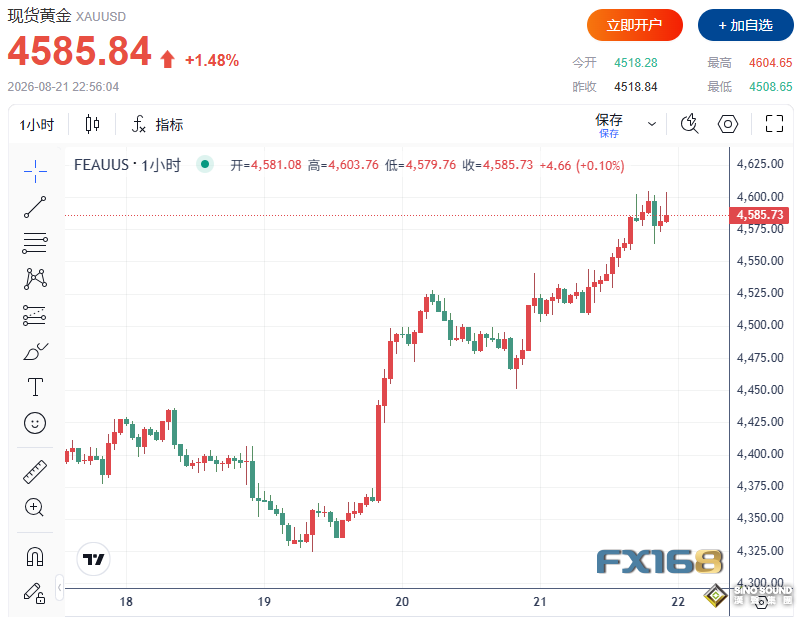
Early Friday US session, spot gold and silver extended powerful breakouts. Fueled by a weaker US dollar, cooling market expectations for another Fed rate‑hike in September, and mounting US fiscal worries, buying interest dominated precious‑metals trading. During US hours, spot gold surged past $4,600 per ounce, gaining $95 intraday. Spot silver hit a high of $70.015, rising 2.85%.
(Source: FX168)
Weaker Dollar and Cooling Rate‑Hike Expectations

Current market pricing remains caught between “slowing US growth” and “sticky inflation risks”. Soft US CPI data, flat headline PPI, weak retail sales and falling consumer confidence released last week have scaled back bets on a September rate increase. That said, Thursday’s initial jobless claims and Philadelphia Fed manufacturing survey showed no sharp deterioration in employment or regional factory momentum. Fed meeting minutes show some officials stand ready to hike if inflation fails to cool, yet traders still lean toward no policy change next month.
On interest‑rate markets, the 10‑year Treasury yield hovers near 4.7%, the 30‑year yield sits close to 5.25%, and the US Dollar Index has fallen below 99.00.
Intraday data showed US preliminary August Manufacturing PMI printed at 53.2, a five‑month low. Preliminary Composite PMI Output Index reached 56.0, a 52‑month high. Preliminary Services PMI Business Activity Index hit 56.8, a 20‑month high. Preliminary Manufacturing Output Index stood at 51.9, a 13‑month low.
Chris Williamson, Chief Business Economist at S&P Global Market Intelligence, commented that US business activity is booming. Firms reported accelerating output growth in August, marking the fastest expansion in more than four years as Q3 momentum strengthened. Survey data points to an annualized growth rate near 3.0% for Q3, a sharp jump from 1.5% in Q2. August also saw an encouraging rebound in job creation, with employer confidence improving as worries over tariffs and Middle‑East conflict fallout faded. Still, the Middle‑East situation remains a key concern for businesses, especially its impact on supply chains and energy prices. August reported supply‑chain delays at the worst level in four years, clearly restraining factory output for many companies. Price pressures have eased but stay elevated, and renewed energy‑price rallies could quickly reignite inflationary risks. Growth momentum has rotated from manufacturing toward services between Q2 and Q3. With depleted safety inventories and supply‑chain bottlenecks weighing on factory expansion, services are now the main engine driving ongoing US economic expansion.
Gold and Silver Break Key Resistance Levels
Gold and silver represent the most prominent moves across asset markets. Gold has cleared the former‑support‑turned‑breakout level at $4,447, moved above the $4,500 zone and is testing resistance near $4,595. Silver has broken sequentially above $66.55 and $68.02, advancing toward resistance around $69.48 and trading near this week’s highs.
This rally is not simply a “lower‑yield trade”. Precious metals have strengthened even with long‑dated yields still elevated, showing that fiscal‑risk hedging, dollar weakness and geopolitical demand are offsetting carrying‑cost pressure from high interest rates. In short, gold’s market narrative is no longer driven purely by real‑rate moves; it is reinforced by stronger safe‑haven and wealth‑preservation demand.
Middle‑East Tensions and Oil Prices Offer Support
The Strait of Hormuz remains the critical geopolitical chokepoint affecting crude‑oil prices, inflation expectations and demand for defensive assets. US‑Iran negotiations remain stalled. Washington is threatening harsher economic measures against Tehran, while commercial‑vessel traffic through the Strait stays far below normal levels. Only seven commercial ships transited the strait on Thursday, half the prior day’s volume, and overall shipping activity remains a small fraction of pre‑conflict levels.
Brent crude trades near $93.45 per barrel, WTI crude around $86.53. For gold this sends mixed signals: restricted Gulf shipping plus dollar weakness bolster safe‑haven demand, yet peRSIstently high crude keeps inflation risks elevated, caps further Treasury‑yield declines and prevents a perfectly smooth rally for precious metals.
Divergent Global Market Performance
Global equities traded mixed ahead of the US opening. US equity futures advanced broadly: S&P 500 futures +0.3%, Dow futures +0.4%, Nasdaq futures +0.6%, following Thursday’s sell‑off. In Europe, FTSE 100 fell 0.1%, CAC 40 was flat, DAX rose 0.2%. Across ASIa, Nikkei 225 dropped 0.3%, KOSPI gained 0.9%, Hang Seng Index climbed 1.2%, Shanghai Composite edged up less than 0.1%.
Other markets: Nymex WTI crude near $86.53/bbl, Brent crude near $93.45/bbl; benchmark 10‑year Treasury yield close to 4.7%; US Dollar Index continues softening. The Kitco Global Index measures how much of gold’s daily gain stems from dollar moves versus intrinsic bullion momentum.
Technical Levels: Watch $4,595 for Gold and $69.48 for Silver
Technically, gold bulls target reclaiming resistance at $4,595. A sustained breakout opens subsequent targets at $4,671 and $4,778. Near‑term bear objectives are a break below $4,447, followed by $4,320 and $4,228. Gold’s first resistance sits at $4,595, next at $4,671; primary support at $4,447, secondary support at $4,320.
For silver, bulls aim to retake $69.48. A valid breakout unlocks upside toward $71.03. Bears look for a drop below $68.02, then $66.55 and $64.20. Silver’s first resistance is $69.48, next $71.03; primary support $68.02, secondary support $66.55.